

We are an insurance and tax practice, not a law firm
Everything below describes Florida statutes as published, with a link to each section so you can read it yourself. Updating a beneficiary form is a carrier form and we help with it at no charge. Anything involving a trust, a divorce decree, an employer plan or a probate estate belongs with a Florida attorney, and we will tell you so rather than guess.
1. The form decides, and the will does not
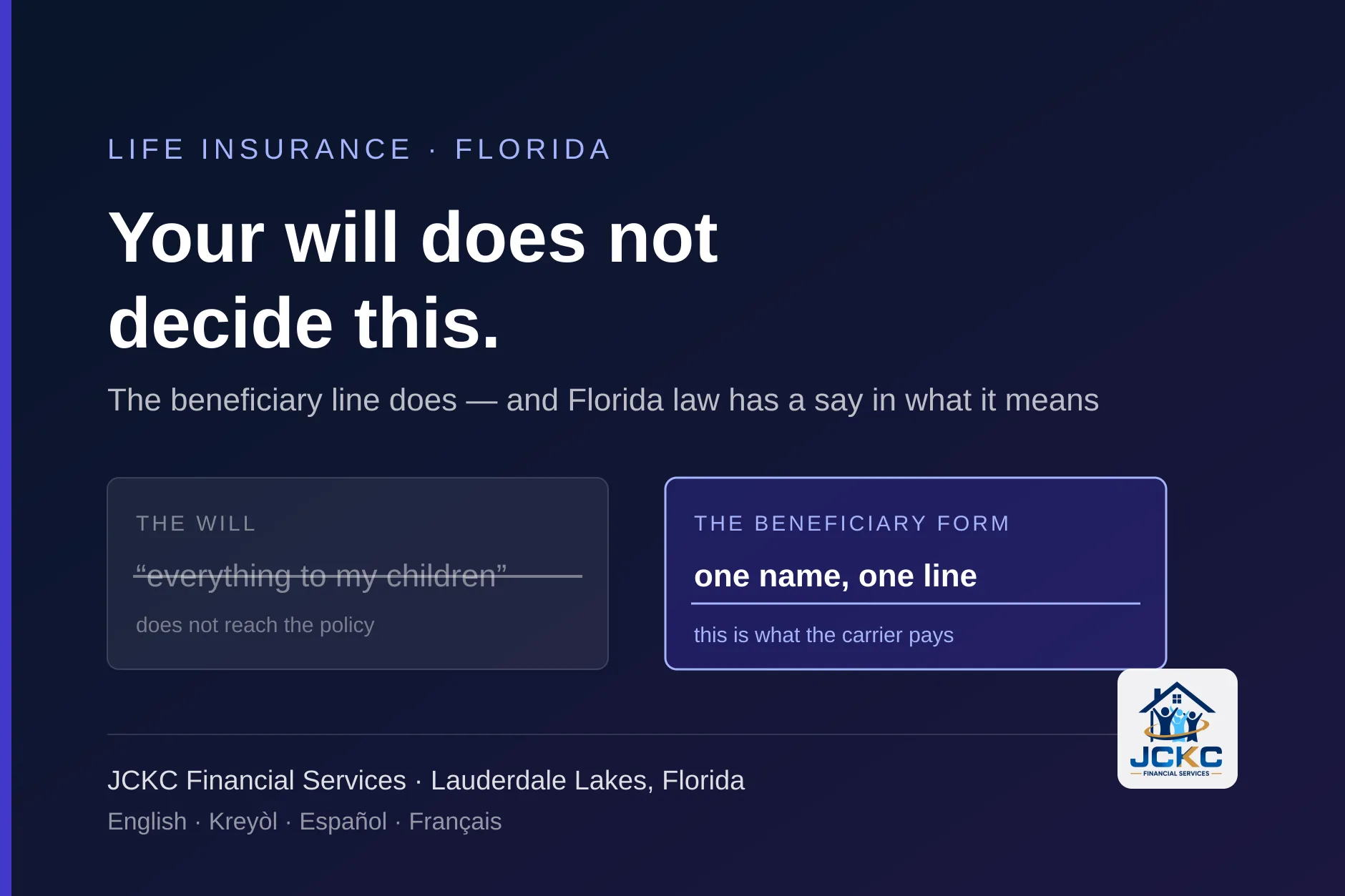
Start with the thing that surprises almost everybody. A life insurance policy is a contract, and it pays the person named on the carrier’s beneficiary form. It does not pass under your will, and it does not wait for probate:
- The form was probably completed once, at the point of sale or on a first day at a job, and has not been looked at since.
- A will drafted ten years later, saying something entirely different, does not change it. The two documents do not talk to each other.
- Nobody checks the form while you are alive. The first person to read it carefully is a claims examiner, after the funeral.
- Which means an out-of-date form is not a risk that announces itself. It sits there looking exactly like an up-to-date one.
What follows is what Florida law does on top of that. Three statutes and one Supreme Court case do most of the work, and between them they decide whether the name on the form is the name that gets paid. We cover what the different kinds of policy are for separately, in our guide to life insurance basics.
2. What Florida does to an ex-spouse designation
Florida has a statute for the commonest version of the out-of-date form: the ex-spouse who is still named. Section 732.703 of the Florida Statutes provides that a designation for the benefit of the decedent’s former spouse is void as of the time the marriage was judicially dissolved or declared invalid, and that the interest passes as if the former spouse had predeceased the decedent. Read the conditions closely, because each one does work:1
- It takes a court order. A separation, a filing, an agreement between you, a move to another address: none of these trigger it. The marriage has to have been judicially dissolved or declared invalid.
- The designation must have been made before that order. One signed afterwards is a different thing entirely.
- The money does not vanish into the estate. It passes as if the former spouse had died first, which means it goes to the contingent beneficiary you named — and if you never named one, to wherever the policy says it goes in that case.
- It reaches deaths on or after July 1, 2012, whenever the designation itself was made.
That is a sensible default and it has saved a lot of families. It is also the single most dangerous thing in this article, because people who know it exists stop updating their forms. The sections that follow are the reasons not to rely on it.1
3. Which accounts the divorce rule reaches
The statute lists the assets it reaches, and the list is broader than life insurance. If you are going to do this once, do it across all of them in the same sitting:1
| Asset | Covered by the Florida divorce rule |
|---|---|
| Life insurance held outside an employer plan | Yes |
| An annuity or similar contract held outside a plan | Yes |
| Life insurance or a qualified annuity held inside an employee benefit plan | Yes — subject to the federal-law exception below |
| An employee benefit plan itself | Yes — subject to the federal-law exception below |
| An IRA, traditional or Roth, including an individual retirement annuity | Yes |
| A payable-on-death bank account | Yes |
| A security or account registered in transfer-on-death form | Yes |
| An account held jointly with right of survivorship | No — an express exception |
| A state-administered retirement plan under chapter 121 | No — an express exception |
Two rows in that table are the ones people forget: the payable-on-death bank account opened in a branch years ago, and the first job’s small 401(k) that was never rolled anywhere. Both carry a beneficiary. Both are covered by the statute on their face. Neither is on anyone’s mental list of “policies”.1
4. The exceptions, and the two that matter
Section 732.703 then sets out ten exceptions, lettered (a) through (j). Most are narrow. These are the ones that decide real cases:1
- (a) To the extent that controlling federal law provides otherwise. This is the big one and it has its own section below.
- (b) A designation signed after the order that expressly provides benefits will be payable to the former spouse. If you deliberately kept your ex on the policy after the divorce and signed a fresh form saying so, that stands — which is exactly what you want if the divorce agreement required it.
- (d) Where the dissolution order itself requires that you acquire or maintain the asset for your former spouse or the children of the marriage. A court order to keep coverage in place is not undone by this statute.
- (g) Where the governing instrument is governed by the law of another state. A policy written elsewhere and carried into Florida may not be reached at all.
- (i) Remarriage to the same person. If you remarry your former spouse and are married at your death, the designation is not revoked.
Reconciling without remarrying leaves you exposed
The exception is written for remarriage, not reconciliation. A couple who divorced, moved back in together and never went back to a courthouse are, for this statute, divorced — so a designation naming that partner is void and the money goes to the contingent beneficiary instead. If you want your partner to receive it, sign a new form naming them. That is the whole fix, and it takes one page.
5. The hole in the floor: employer plans
Exception (a) sounds like legal housekeeping. It is not. The Florida rule steps aside to the extent controlling federal law provides otherwise, and the life insurance most working people actually have — the group policy that came with the job — is commonly governed by the federal plan law rather than by Florida’s.2
The Supreme Court settled the point in 2001, in Egelhoff v. Egelhoff. A man named his wife as beneficiary of an employer-provided life insurance policy and a pension plan; they divorced; he died two months later with her still named. Asked whether the federal plan law pre-empts a state revocation statute of this kind as applied to the plans it governs, the Court wrote: “We hold that it does.” The practical reading for a Broward household is blunt. Assume the Florida statute does not protect you on anything that came through an employer, update that form separately through the employer or the plan administrator, and if the amounts are serious, have a Florida attorney look at the plan documents.2
When did you last read the form?
Most people cannot name the contingent beneficiary on their own policy. That is the line that catches the money.
6. The insurer pays the form, and is not liable for it
Here is the part that turns a paperwork problem into a lawsuit. Even where the Florida statute does void a designation, it also protects the company that pays the wrong person. The payor-protection subsections say the insurer is not liable for making the payment to the named beneficiary — and for several of the asset types the statute adds that this holds notwithstanding the payor’s knowledge that someone else would be entitled:3
- The claim is paid against the form and the death certificate. The carrier is not running a title search on your marriage.
- Where the death certificate is silent on marital status, the statute prints the affidavit a beneficiary signs to claim — sworn before a notary, by physical presence or online notarization. We are a commissioned Florida notary and this is the kind of affidavit we see.
- Once the money has been paid out, the person who should have received it has to go and get it from the person who did.
- That is a civil action against a former spouse, funded out of a grieving household’s own pocket, over money the policy was supposed to deliver in two weeks.
The statute is explicit that it does not affect ownership as between the former spouse and the person actually entitled. In other words, the law may well be on your family’s side and the money will still be in someone else’s account. Everything in this article is cheaper than that conversation.3
7. Naming your own children, and the $15,000 line
Naming your own children feels like the safest possible answer, and for a small policy it is. Above a threshold, Florida changes the arrangement. A parent, as natural guardian, may collect and manage the proceeds of a life insurance policy payable to their minor child without any court appointment, authority or bond — but only where the amounts received in the aggregate do not exceed $15,000. Above that figure, a court has to appoint a guardian of the property:45
- A guardianship is a court case. It has a filing, a lawyer, an inventory, annual accountings and the court’s supervision until the child turns eighteen.
- It costs money, and the money comes out of the policy proceeds — the exact thing you bought to protect the child.
- It is slow, which matters most in the first months, when the household needs the money for ordinary bills.
- And at eighteen the whole remaining balance is handed over, in one payment, to an eighteen-year-old.
The fix is free and it fits on the form. Florida’s Uniform Transfers to Minors Act lets a beneficiary designation nominate an adult custodian, and the statute says in terms that the nomination may be made in a writing designating a beneficiary of contractual rights. You name the person followed by the words the statute sets out: as custodian for (name of minor) under the Florida Uniform Transfers to Minors Act. No court, no guardianship, no accountings. The act also fixes when the custodianship ends and the money goes to the young adult outright — 21 for property transferred under some sections, with a transferor able to set 25 instead, and 18 under others — so ask the carrier which applies to the designation you are signing.67
A trust is the other answer, and it is a lawyer’s job
Where the sums are large, or the children are from more than one relationship, or someone in the family has a disability, a trust named as beneficiary does things a custodianship cannot. That is drafting, and drafting is the practice of law: it belongs with a Florida estate attorney, not with us and not with a form downloaded from the internet. What we can do is make sure the policy itself is the right size and the designation matches whatever the attorney drafts.
8. Why naming your estate costs money
The other default worth avoiding is naming your estate — or leaving the line blank and letting the policy default there. Florida law draws a sharp line between the two cases. Where the insurance is payable to a named person, the proceeds inure exclusively to that person’s benefit and are exempt from the claims of the insured’s creditors unless the policy says otherwise.8
Where the insurance is payable to the insured, the insured’s estate, or their executors, administrators or assigns, the proceeds become part of the estate for all purposes and are administered by the personal representative under the probate laws, like any other asset. So the same policy either pays a named person quickly and out of reach of creditors, or joins the probate estate and waits. An estate planner occasionally wants the second outcome on purpose. Nobody wants it by accident.8
9. When the beneficiary caused the death
The last rule is one you hope never to need. Florida’s slayer statute provides that a named beneficiary of a bond, life insurance policy or other contractual arrangement who unlawfully and intentionally kills the person on whose life the policy is issued is not entitled to any benefit under it, and that the policy becomes payable as though the killer had predeceased the decedent.9
A final judgment of conviction of murder in any degree is conclusive. Where there is no conviction, the court may still determine by the greater weight of the evidence whether the killing was unlawful and intentional — a lower standard than a criminal trial, and the reason these cases are decided in probate court more often than people assume. The insurer is protected if it pays out before receiving written notice of a claim at its home office, which is why a family that suspects this gives that notice in writing, immediately, and takes advice.9
10. When to look at the form
None of this requires an annual legal review. It requires looking at a one-page form when the family changes. The moments that matter:
- A marriage, a divorce or an annulment — and particularly a reconciliation without a remarriage.
- A birth or an adoption, which is usually when a child first needs to appear and when the custodian wording belongs on the form.
- The death of anyone named, primary or contingent. A policy whose only named beneficiary has died is a policy payable to your estate.
- A new job, which almost always comes with new group life and a new form filled in during an induction nobody remembers.
- A policy replaced, converted or rolled over. The new contract has a new form, and the old one does not carry across.
- Any year in which nothing happened. Ten minutes, once, to confirm the name is still the right one.
11. The ten minutes that fixes most of this
Here is the whole job, and most people finish it in a single sitting at the kitchen table:
- List every policy and account that has a beneficiary line. Individual life, the group life at work, every IRA, every payable-on-death bank account, every transfer-on-death brokerage registration. The forgotten ones are usually the bank account and the first job’s retirement plan.
- Get the current designation in writing for each. Not your memory of it — the carrier’s record. Most will send it the same day.
- Name a contingent beneficiary on every one. This is the single highest-value line in the exercise. It is what catches the money when the primary designation fails, whether through a divorce, a death or anything else.
- Use the custodian wording if a minor is named, rather than the child’s name alone, so a payout over $15,000 does not need a court-appointed guardian.
- Do the work policy separately and through the employer. Assume the Florida divorce statute does not reach it.
- Take advice where it is a legal question — a trust, a divorce decree that requires coverage, a blended family, a beneficiary with a disability. Our part is the policy and the form; what the proceeds actually have to cover is a useful place to start on sizing.
12. Frequently asked questions
Does my will override the beneficiary named on my policy?
No. Life insurance pays the person named on the carrier’s beneficiary form. It is a contract between you and the insurer and it is settled when you die, outside the will and outside probate. A will that says something different does not change the form. This surprises people more than any other single fact about life insurance, and it is the reason the ten-minute review in this article is worth doing.
My divorce was finalised years ago and my ex is still on the policy. What happens?
Under Florida law the designation is generally void from the moment a court dissolved the marriage, and the money passes as if your former spouse had died before you — but only if you named them before the dissolution, and only where the exceptions do not apply. The most important exception is that the Florida rule steps aside to the extent controlling federal law says otherwise, which commonly covers employer-provided plans. Do not rely on the statute. Change the form.
Does the Florida divorce rule apply to my work life insurance?
Often it does not, and this is the trap. The statute itself says it does not apply to the extent controlling federal law provides otherwise. In 2001 the Supreme Court held that the federal plan law pre-empts a state statute of this kind as applied to the plans it governs, and employer-provided group life is the common case. Treat your work policy as if the statute does not protect you, and update the form through your employer.
Will the insurance company know I got divorced?
It has no reason to, and the statute protects it either way. Florida expressly says the payor is not liable for paying the named beneficiary, and in the case of several asset types it says so even where the payor knows someone else would be entitled. Practically, the cheque goes to the name on the form, and whoever should have received it is left to pursue the money afterwards. That is a lawsuit, not a phone call.
Can I just name my children?
You can, and for a payout over fifteen thousand dollars it creates the problem you were trying to avoid. In Florida a parent may collect and manage life insurance proceeds for a minor child without any court appointment only where the amounts received in aggregate do not exceed $15,000; above that a guardian of the property has to be appointed by a court. The fix is free: name an adult custodian under the Florida Uniform Transfers to Minors Act, using the wording the statute itself sets out.
What if I name my estate?
Two things change, both for the worse. Proceeds payable to a named person are exempt from the claims of the insured’s creditors under Florida law; proceeds payable to the estate become part of the estate for all purposes and are administered under the probate laws like any other asset. So naming your estate puts the money through probate and within reach of creditors. There are reasons an estate planner might do it on purpose. Doing it by accident, or by leaving the line blank, is not one of them.
What happens if the beneficiary caused the death?
Florida has a slayer statute. A named beneficiary of a life insurance policy who unlawfully and intentionally kills the insured is not entitled to any benefit, and the policy pays as though the killer had died first. A murder conviction settles it conclusively; without one a court may still decide the question on the greater weight of the evidence. The insurer is protected if it pays before receiving written notice of a claim at its home office.
Do I need a lawyer for this?
Not to update a beneficiary form — that is a carrier form, and we do it with clients at no charge. You do need a Florida attorney if an employer plan is involved, if there is a divorce decree that requires you to keep coverage for someone, if a trust is or should be the beneficiary, or if the sums are large enough that the structure matters. We are an insurance and tax practice, not a law firm, and we will say so rather than guess.
How often should I check?
Every time the family changes, and once a year otherwise. A marriage, a divorce, a birth, a death, an adoption, a new job with new group coverage, a policy replaced or rolled over. Each one is a moment when a form written for the old situation quietly stops matching the new one, and nobody finds out until it is too late to fix.
13. Sources
- Florida Statutes, s. 732.703, Effect of divorce, dissolution, or invalidity of marriage on disposition of certain assets at death — subsection (2) voiding a former-spouse designation, subsection (3) listing the assets reached, subsection (4) the ten exceptions, subsections (5) to (7) the payor protections and the affidavit form, and subsection (9) applying the section to deaths on or after July 1, 2012. Read October 27, 2026.
- Egelhoff v. Egelhoff, 532 U.S. 141 (2001), decided March 21, 2001, Thomas, J. — asked whether the federal Employee Retirement Income Security Act pre-empts a state revocation-on-divorce statute to the extent it applies to the plans that Act governs, the Court held: “We hold that it does.” Read October 27, 2026.
- Florida Statutes, s. 732.703(5) to (8) — the payor is not liable for paying the named beneficiary; subsection (7) applies that protection notwithstanding the payor’s knowledge; subsection (8) preserves ownership as between the former spouse and the person entitled. Read October 27, 2026.
- Florida Statutes, s. 744.301(2), Natural guardians — a parent may, without appointment, authority or bond, collect and manage the proceeds of a life insurance policy payable to their minor child where the amounts received in the aggregate do not exceed $15,000. Read October 27, 2026.
- Florida Statutes, s. 744.387(3)(b), Settlement of claims — where the net amount to the ward exceeds $15,000 and no guardian has been appointed, the court shall require the appointment of a guardian for the property. Read October 27, 2026.
- Florida Statutes, s. 710.104, Nomination of custodian — the nomination may be made “in a writing designating a beneficiary of contractual rights”, by naming the custodian followed in substance by the words “as custodian for (name of minor) under the Florida Uniform Transfers to Minors Act”. See also s. 710.111 on how such a transfer is completed. Read October 27, 2026.
- Florida Statutes, s. 710.123, Termination of custodianship — 21 years of age for property transferred under ss. 710.105 or 710.106, which a transferor may extend to 25, and 18 for property transferred under ss. 710.107 or 710.108. Read October 27, 2026.
- Florida Statutes, s. 222.13(1), Life insurance policies; disposition of proceeds — proceeds payable to a named person are exempt from the claims of creditors of the insured; proceeds payable to the insured’s estate become part of the estate for all purposes and are administered under the probate laws. Read October 27, 2026.
- Florida Statutes, s. 732.802, Killer not entitled to receive property or other benefits by reason of victim’s death — subsection (3) on a named beneficiary of a life insurance policy, subsection (5) on conviction and the greater weight of the evidence, and subsection (6) on written notice to the insurer. Read October 27, 2026.
For general information only, and not legal advice. This article describes Florida statutes and one federal court decision as published, with a link to each. JCKC Financial Services is a licensed insurance brokerage and tax practice, not a law firm, and nothing here is legal advice or a legal opinion about your situation. Beneficiary designations interact with wills, trusts, divorce decrees, employer plan documents and federal law, and the right answer depends on all of them. Consult a Florida attorney for anything involving a trust, a probate estate, a guardianship, a divorce decree or an employer-sponsored plan. Policy terms, not this article, govern what any particular contract does.