

1. VA and Medicare do not coordinate
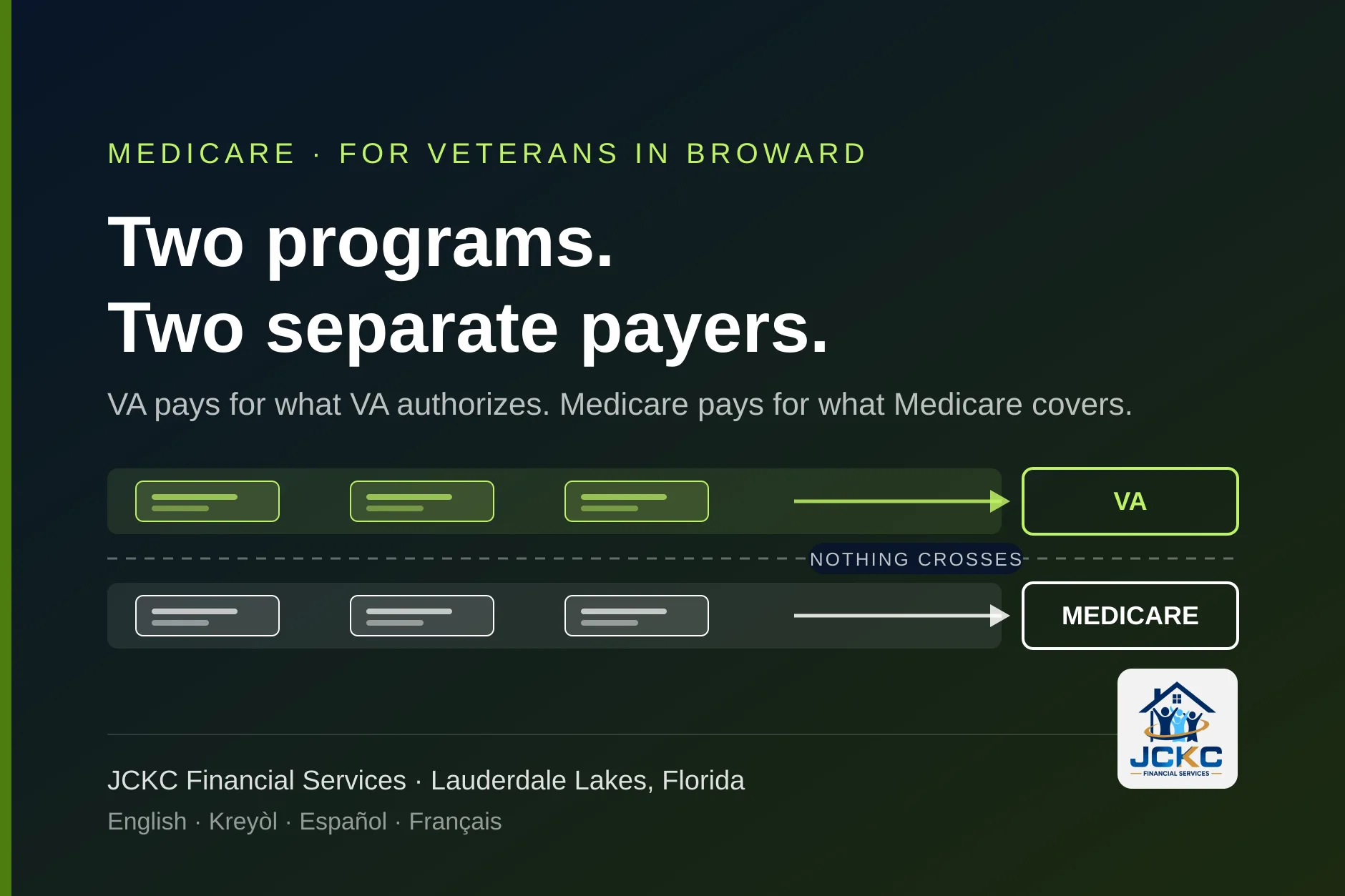
With an employer plan and Medicare, one pays first and the other pays what is left. VA and Medicare are not like that. Medicare.gov puts it in one line: Medicare and the Department of Veterans Affairs generally cannot pay for the same items or services, and each time you get care you have to choose which benefit to use. The rule that follows from it is simple:1
- Medicare pays for Medicare-covered items and services, under Medicare’s rules, with Medicare’s deductibles and coinsurance.
- VA pays for VA-authorized items or services, in a VA facility or in a non-VA one that VA has approved in advance.
- When VA authorizes only part of a stay — a non-VA hospital admission, say, where VA approves some services and not others — Medicare may pay for the Medicare-covered services VA did not authorize.
| Where you get care | Who pays | What you owe |
|---|---|---|
| A VA clinic or VA medical center | VA | Any VA copay for your priority group |
| A non-VA doctor VA approved in advance (community care) | VA | Any VA copay for your priority group |
| A non-VA doctor or hospital VA did not approve | Medicare, if you have it | Medicare’s deductible and coinsurance, or your plan’s copays |
| A non-VA hospital stay VA authorized only in part | VA for its part; Medicare may pay for the rest | Each program’s own share |
| A non-VA doctor, no VA approval, and no Part B | Nobody | The whole bill |
The last row is the one that costs people money. And notice what is missing from the table: VA does not send its bills to Medicare. VA’s own page says so plainly — it does not bill Medicare or Medicaid, though it may bill a Medicare supplement policy, and it is required by law to bill private health insurance for care of conditions not connected to your service. Medicare, for its part, does not pay your VA copays.2
2. Why VA tells you to take Part B anyway
Because VA covers so much, many veterans turn down Part B at 65 to save the premium. VA does not recommend that. Its own pages encourage you to sign up for Medicare as soon as you can, for reasons it lists itself:23
- Medicare covers you outside VA. If you need a non-VA hospital or doctor, Medicare gives you more options.
- Your VA coverage can change. VA says funding may change in future years, and that veterans in the lower priority groups could lose VA health benefits. Your priority group, local wait times and health needs can also shift.
- Waiting costs money for life. If you delay Part B and sign up later because you lose VA benefits or want more choice, you pay a penalty that gets bigger for each year you waited, and you pay it every year for as long as you have Part B.
- Dropping Part B is hard to undo. VA warns that if you cancel Part B you cannot get it back until January of the following year, and may owe a penalty.
The penalty itself is set by Medicare: 10% of the standard premium for each full 12-month period you could have had Part B and did not. Medicare.gov’s own example is a two-year delay — a 20% penalty, which turned the 2026 standard premium of $202.90 into $243.50 a month. That is not a one-time fee. It rides on the premium for as long as you have Part B. The full rules are in our guide to Medicare late enrollment penalties.4
VA coverage does not open a late-signup window
People who work past 65 can delay Part B and sign up later without a penalty, through a Special Enrollment Period tied to group health coverage from a current job. VA health care is not job-based coverage, so it does not give you that window. Miss your seven-month Initial Enrollment Period and the next chance is the General Enrollment Period, January 1 to March 31, with coverage starting the month after you sign up — and the penalty attached. See how the Medicare enrollment periods work.
3. What each side costs you in 2026
Part A is premium-free for most people who worked long enough. Part B is the one with a monthly bill. For 2026 the standard Part B premium is $202.90 a month, with an annual deductible of $283, as CMS announced on November 14, 2025. The 2027 figures had not been published when we checked on October 30, 2026; CMS normally announces them in November, and we will not guess at them.46
On the VA side, what you pay depends on your priority group and your disability rating. These are the rates VA lists as effective January 1, 2026. VA had not posted 2027 rates on that page when we checked.7
| VA service (2026) | Copay | Who pays nothing |
|---|---|---|
| Primary care visit | $15 | Service-connected rating of 10% or higher |
| Specialty care visit or specialty test (MRI, CT) | $50 | Service-connected rating of 10% or higher |
| Medication, 1–30 day supply (tiers 1 / 2 / 3) | $5 / $8 / $11 | Priority group 1 |
| Medication copays in a calendar year | Capped at $700 | Priority group 1 |
| X-rays, lab tests, screenings and immunizations | $0 | Everyone |
Put the two side by side and the trade is clear. A veteran whose care comes entirely from VA, at no copay, pays $202.90 a month in 2026 for Part B they may barely use. A veteran who sees a non-VA cardiologist, or lives far from a VA clinic, or simply wants a backstop, is paying for real coverage. Neither answer is wrong. What is wrong is making the choice at 65 without knowing about the penalty, because the penalty removes the option of changing your mind cheaply.67
4. VA drug coverage and Part D
Prescription drugs work differently from Part B, and better for most veterans. Medicare.gov lists coverage from the Department of Veterans Affairs as creditable prescription drug coverage — coverage expected to pay, on average, at least as much as Medicare’s. That changes the arithmetic:8
- While you have VA drug coverage, you can wait to join a Medicare drug plan without a penalty.
- The condition is that you never go 63 days or more without creditable coverage. Lose VA health care, and the 63 days start.
- If you do go 63 days or more without it, the Part D penalty is 1% of the national base premium for each month without coverage — the base was $38.99 in 2026 — and it lasts as long as you have Medicare drug coverage.
- When you join a drug plan later, it may send you a letter asking about your past coverage. Return it by the deadline in the letter, or the plan may charge the penalty anyway.
You may also choose to have both. VA says a Medicare drug plan lets you fill prescriptions from non-VA doctors at a local pharmacy, rather than only through VA. Medicare.gov adds the limit: you cannot use both types of coverage for the same drug at the same time. And VA’s own drug copays are low by any standard — $5 to $11 for a supply of up to 30 days in 2026, capped at $700 a year — so a drug plan earns its premium mainly for veterans who are already seeing non-VA prescribers. Our guide to Part D explains how the plans themselves work.127
Keep the proof
If you ever join a Medicare drug plan after 65, you may need to show you had creditable coverage in the meantime. Keep your VA enrollment letter and anything that shows the dates you had VA health care. It is the one document that protects you from a penalty you do not owe.
5. The emergency room problem
This is where the two-program system hurts most often in South Florida. VA says it plainly: if your life or health is in danger, call 911 or go to the nearest emergency department, and do not check with VA first. But if that department is not a VA one — even one in VA’s community care network — VA can cover the visit only if its rules are met:9
- VA must be notified within 72 hours of when your emergency care starts. VA prefers the hospital to do it; if it does not, you or someone acting for you can.
- You must be enrolled in VA health care (or have a qualifying exemption).
- A VA or other federal facility must not have been feasibly available — too far away to reach in time.
- A prudent layperson would have believed that a delay put your life or health in danger.
- VA covers non-VA emergency care only until it can safely transfer you to a VA or other federal facility.
Miss the 72 hours and VA does not automatically deny the claim, but you then have to meet the stricter tests for unauthorized emergency care. If you have Medicare, the hospital can instead bill Medicare for the Medicare-covered services under Medicare’s own rules, whether or not VA was ever told. For a veteran in Lauderdale Lakes, where the nearest emergency room is almost never a VA one, that difference is not theoretical.19
Tell them at the door
In any emergency room, tell the staff you are a veteran and ask them to notify VA right away. Then make sure they also have your Medicare card. You do not have to decide in the waiting room which program will pay; you only have to make sure both are possible.
6. Community care is VA, not Medicare
VA can pay for care from a non-VA provider in its community care network. People sometimes confuse this with Medicare. It is not: community care is VA coverage, paid by VA, on VA’s terms. You must be enrolled in or eligible for VA health care and, except in cases like urgent or emergency care, have approval from your VA care team before you go. At least one of these must also be true:10
- You need a service VA does not provide at any of its facilities.
- VA cannot meet its access standards: for primary care and mental health, an average drive of more than 30 minutes or a wait of more than 20 days; for specialty care, more than 60 minutes or 28 days.
- You and your VA provider agree it is in your best medical interest.
- VA cannot provide the service in a way that meets its quality standards.
If VA approves community care, VA pays and Medicare does not. If you go to the same non-VA doctor without VA approval, the visit is a Medicare visit — if you have Medicare. The doctor and the treatment can be identical; the payer depends entirely on whether VA said yes first.110
Veteran turning 65, or already on Medicare?
We will go through your VA card, your Medicare card and your doctors, and show you where each one pays. In your language, at no cost.
7. TRICARE For Life is a different program
Military retirees often have a third program in the picture, and it follows different rules. TRICARE For Life is the Defense Department coverage for Medicare-eligible uniformed services retirees aged 65 or older, their eligible family members and survivors, and certain former spouses. Unlike VA care, it is built to work with Medicare: if you are not on active duty, Medicare pays first for Medicare-covered services and TRICARE may pay second. Medicare.gov is unambiguous about the price of entry: you must have Medicare Part A and Part B to get TRICARE For Life benefits.1
That makes the Part B decision different for a retiree than for a veteran with VA care alone. Skipping Part B does not just risk a penalty; it can cost you the TRICARE coverage itself. On drugs, Medicare.gov says that if you have TRICARE you do not need to join a Medicare drug plan, and that TRICARE drug coverage counts as creditable. If you do join one, the Medicare drug plan pays first and TRICARE second. We could not read tricare.mil from our systems when we wrote this, so for anything about TRICARE’s own enrollment and costs, confirm with TRICARE directly.18
8. Medicare Advantage for veterans
A Medicare Advantage plan is a way of receiving your Medicare through a private plan approved by Medicare. It does not touch your VA benefits. To join one you need both Part A and Part B, so the Part B question comes first. After that, the plan works exactly like the Medicare row in the table above:111
- The plan pays for Medicare-covered care under its own rules — its network, its copays, its yearly out-of-pocket maximum.
- VA keeps paying for care VA provides or authorizes. Neither the plan nor VA pays the other’s share.
- Your VA clinic is not “in network” or “out of network” for the plan; it sits outside the plan entirely. What the plan’s network decides is which non-VA doctors and hospitals you can use.
For 2027, CMS’s landscape file lists 106 Medicare Advantage and other Medicare health plan options in Broward County, special needs plans included. Eight of them include no Part D drug coverage at all, which some veterans choose deliberately because VA already covers their prescriptions; the in-network out-of-pocket maximums on those eight run from $3,400 to $9,250 for 2027. Several plans carry names that suggest they were built for veterans. A name is marketing. What decides whether a plan fits is whether its network includes the hospital you would be taken to in an emergency and the specialists you already see outside VA. For what the extra benefits in these plans are worth, see our post on Medicare Advantage extras for 2027.12
Annual Enrollment runs from October 15 to December 7, with changes taking effect January 1. If you are already in a Medicare Advantage plan, the Medicare Advantage Open Enrollment Period from January 1 to March 31 gives you one more chance to switch plans or return to Original Medicare.11
9. VA in Broward County
Broward is home to 63,053 veterans, according to the Census Bureau’s 2019–2023 American Community Survey (margin of error about 2,700). More than half — 32,237 — are 65 or older, and 19,903 served in the Vietnam era. For this county, the VA-and-Medicare question is not a niche one.15
The local fact that changes the answer is this: Broward has VA clinics but no VA hospital. Its four clinics all belong to VA Miami Health Care, and all four keep weekday office hours, 8:00 a.m. to 4:30 p.m. The two VA medical centers open around the clock are outside the county.1314
| Location | Address | Hours |
|---|---|---|
| William “Bill” Kling VA Outpatient Clinic (multi-specialty) | 9800 West Commercial Boulevard, Sunrise | Mon–Fri, 8:00 a.m.–4:30 p.m. |
| Hollywood VA Clinic | 3702 Washington Street, Suite 201, Hollywood | Mon–Fri, 8:00 a.m.–4:30 p.m. |
| Pembroke Pines VA Clinic | 7369 Sheridan Street, Suite 102, Hollywood | Mon–Fri, 8:00 a.m.–4:30 p.m. |
| Deerfield Beach VA Clinic | 2100 Southwest 10th Street, Deerfield Beach | Mon–Fri, 8:00 a.m.–4:30 p.m. |
| Bruce W. Carter VA Medical Center | 1201 Northwest 16th Street, Miami | 24/7 |
| Thomas H. Corey VA Medical Center | 7305 North Military Trail, West Palm Beach | 24/7 |
So for a veteran in Lauderdale Lakes, Lauderhill or Tamarac, a heart attack on a Saturday night almost certainly means a non-VA emergency room — the 72-hour notification rule, the feasibility test, and a transfer when VA can take you. And a specialist appointment more than 28 days out may qualify you for community care, but only once VA approves it. Medicare is what covers the gaps between those rules. See our Broward County page for how we work with clients across the county.910
10. What to check before December 7
Here is the short list, done, still to do and by when:
- Find your VA enrollment letter and priority group. It tells you which VA copays apply and is your proof of creditable drug coverage.
- If you are within three months of 65: decide on Part B inside your seven-month Initial Enrollment Period. You sign up through Social Security. Read our turning-65 guide first.
- If you turned down Part B earlier: the next window is January 1 to March 31, 2027, with the penalty. Know the figure before you decide.
- If you are a military retiree: confirm you have both Part A and Part B, because TRICARE For Life requires them.
- List the non-VA doctors and hospitals you actually use, including the nearest emergency room to your home.
- If you are considering a Medicare Advantage plan for 2027: check those doctors and that hospital against the plan’s network before December 7, 2026.
- Keep both cards together and show both in any emergency room.
We are an independent brokerage, and Medicare plans are part of what we sell, so we are not a neutral party to a plan decision. What we can do is lay out what VA covers, what Medicare would add and what it would cost, from the carriers we represent, in English, Haitian Creole, French or Spanish. Asking questions does not commit you to anything.
11. Frequently asked questions
Do VA and Medicare work together like primary and secondary insurance?
No. Medicare.gov says Medicare and VA generally cannot pay for the same items or services. Medicare pays for Medicare-covered care; VA pays for care it authorizes, in a VA facility or a non-VA one. Each time you get care you choose which benefit you are using. VA does not bill Medicare for the care it gives you, and Medicare does not pay your VA copays.
I have VA health care. Do I really need Medicare Part B?
VA encourages you to sign up when you are first eligible, and gives its reasons: Part B covers you at non-VA doctors and hospitals, your VA priority group and funding can change, and if you wait and want Part B later you pay a late enrollment penalty for as long as you have it. Whether the premium is worth it for you depends on how much of your care comes from outside VA, which is the conversation we have with veterans every autumn.
Does VA health care count as creditable drug coverage?
Yes. Medicare.gov lists the Department of Veterans Affairs among the sources of creditable prescription drug coverage. As long as you keep VA drug coverage you can wait to join a Medicare drug plan without a penalty, provided you never go 63 days or more without creditable coverage.
Does VA health care let me sign up for Part B late without a penalty?
No, and this is the trap. The Part B Special Enrollment Period that protects people from the penalty is built around group health coverage from current employment. VA health care is not that, which is why VA itself warns that delaying Part B leads to a penalty that grows each year you wait and lasts as long as you have Part B.
What is the Part B premium for 2027?
It had not been published when this was written on October 30, 2026. CMS announces the next year’s Part B premium in the autumn; the 2026 figure of $202.90 a month was released on November 14, 2025. We will not print a 2027 figure until CMS does.
I am a military retiree. Is TRICARE For Life the same as VA care?
No. TRICARE For Life is the Defense Department program for Medicare-eligible uniformed services retirees and their eligible family members. Medicare.gov is explicit that you must have both Part A and Part B to get TRICARE For Life benefits, and that Medicare pays first. VA health care is a separate program with its own eligibility.
Can I have a Medicare Advantage plan and still use the VA?
Yes. A Medicare Advantage plan is one way of getting your Medicare, and it does not take away your VA benefits. The plan pays for Medicare-covered care under its own network rules; VA continues to pay for care VA provides or authorizes. Neither pays the other’s share. What matters is whether the plan’s network includes the non-VA doctors and hospitals you would actually use.
Where is the nearest VA hospital to Lauderdale Lakes?
Broward has four VA clinics, all part of VA Miami Health Care: Sunrise, two in Hollywood (one named the Pembroke Pines VA Clinic) and Deerfield Beach. They are open weekdays from 8:00 a.m. to 4:30 p.m. The two VA medical centers open around the clock are the Bruce W. Carter VA Medical Center in Miami and the Thomas H. Corey VA Medical Center in West Palm Beach.
What happens if I end up in a non-VA emergency room?
Go. If your life or health is in danger, VA says not to check with it first. But for VA to cover the visit, VA must be notified within 72 hours and several conditions must be met, including that a VA facility was not feasibly available. If you have Medicare, the hospital can bill Medicare under Medicare’s own rules instead, which is one of the plainest reasons to have it.
12. Sources
- Medicare.gov, Who pays first? — the Veterans’ benefits answer (Medicare and VA cannot pay for the same items or services; VA-authorized care; partial authorization; Medicare drug plan limits) and the TRICARE answer (Part A and Part B required for TRICARE For Life; Medicare pays first off active duty). Read October 30, 2026.
- U.S. Department of Veterans Affairs, VA health care and other insurance, last updated July 14, 2025 — VA does not bill Medicare; reasons to sign up for Medicare at 65; Part B penalty and cancellation; Part D and VA. Read October 30, 2026.
- U.S. Department of Veterans Affairs, About VA health benefits — common questions, including whether to enroll in Medicare. Read October 30, 2026.
- Medicare.gov, Avoid late enrollment penalties — Part B penalty of 10% per full 12-month period, the 2026 worked example ($202.90 to $243.50), and the Part D penalty of 1% a month on the $38.99 national base beneficiary premium for 2026. Read October 30, 2026.
- Medicare.gov, When does Medicare coverage start? — Initial Enrollment Period, General Enrollment Period (January 1 to March 31), and the Special Enrollment Periods, including the one for group health coverage based on current employment. Read October 30, 2026.
- Centers for Medicare & Medicaid Services, 2026 Medicare Parts A & B Premiums and Deductibles, published November 14, 2025 — standard Part B premium of $202.90 and deductible of $283. The 2027 figures were not yet published on October 30, 2026. Read October 30, 2026.
- U.S. Department of Veterans Affairs, Current VA health care copay rates, effective January 1, 2026 — outpatient, medication tiers and the $700 annual medication cap. Read October 30, 2026.
- Medicare.gov, Creditable prescription drug coverage — VA and TRICARE listed as creditable coverage; the 63-day rule; the plan letter about past coverage. Read October 30, 2026.
- U.S. Department of Veterans Affairs, Getting emergency care at non-VA facilities — the 72-hour notification, eligibility requirements and transfer rule. Read October 30, 2026.
- U.S. Department of Veterans Affairs, Eligibility for community care outside VA, last updated September 11, 2025 — approval requirement and the drive-time and wait-time access standards. Read October 30, 2026.
- Medicare.gov, Joining a plan — Part A and Part B required to join a Medicare Advantage Plan; Open Enrollment (October 15 to December 7) and Medicare Advantage Open Enrollment (January 1 to March 31). Read October 30, 2026.
- Centers for Medicare & Medicaid Services, CY2027 Medicare Advantage / Part D landscape source file (September 2026 release), cms.gov — Part D landscape source files — Broward County plan options, plans without drug coverage, and in-network out-of-pocket maximums for 2027. Read October 30, 2026.
- U.S. Department of Veterans Affairs, VA Miami Health Care locations, with the facility pages for the Kling clinic in Sunrise, the Hollywood VA Clinic, the Pembroke Pines VA Clinic, the Deerfield Beach VA Clinic and the Bruce W. Carter VA Medical Center. Read October 30, 2026.
- U.S. Department of Veterans Affairs, VA West Palm Beach Health Care locations and the Thomas H. Corey VA Medical Center. Read October 30, 2026.
- U.S. Census Bureau, American Community Survey 2019–2023 5-year estimates, table S2101, Veteran Status, Broward County, Florida — 63,053 civilian veterans (margin of error ±2,701), of whom 13,776 are aged 65 to 74, 18,461 are 75 or older, and 19,903 served in the Vietnam era. Read October 30, 2026.
For general information only. This article explains rules published by the U.S. Department of Veterans Affairs, the Centers for Medicare & Medicaid Services and Medicare.gov, as read on October 30, 2026. It is not a determination of your VA eligibility, priority group or copays, which only VA can make, or of your Medicare enrollment, which Social Security handles. Figures are labelled with their year; 2027 Medicare and VA amounts not yet published are marked as such. Plan availability, networks and costs vary by plan and change each year. JCKC Financial Services is an independent insurance brokerage and tax practice and is not affiliated with VA or the Department of Defense.