

We prepare taxes. We are not the property appraiser, and not a law firm
Everything below describes Florida statutes as published, with a link to each section so you can read it yourself. The exemption is granted or refused by your county property appraiser, not by us and not by the state, and only that office can tell you how it will treat your application. For anything involving a trust, a deed change, a probate estate or an immigration question, take advice from a Florida attorney.
1. What the exemption actually is, in two layers
The homestead exemption is not one exemption. It is two, stacked, and they behave differently — which is why the saving on a tax bill is never quite the number people expect:1
- The first $25,000 comes off the assessed value of the residence and contiguous property, for all taxation except assessments for special benefits. It goes to a person who, on January 1, holds legal or beneficial title and in good faith makes the property their permanent residence.
- A second $25,000 applies to assessed value greater than $50,000, and only to levies other than school district levies. Value between $25,000 and $50,000 is not exempt at all, and school taxes are not reduced by this layer.
- The second amount is no longer fixed. The statute now provides that it is adjusted every January 1 for inflation, by the change in the consumer price index, where that change is positive. There is therefore no permanent dollar figure to quote; your property appraiser publishes the current one.
- The deed has to be recorded in the county’s official records before the exemption may be granted, and the appraiser may ask for further ownership documents.
For a household in Broward or Miami-Dade, the first-year saving is real but modest. The reason to care disproportionately is the assessment cap that comes with it, which is section five below, and which is worth more every year you stay.1
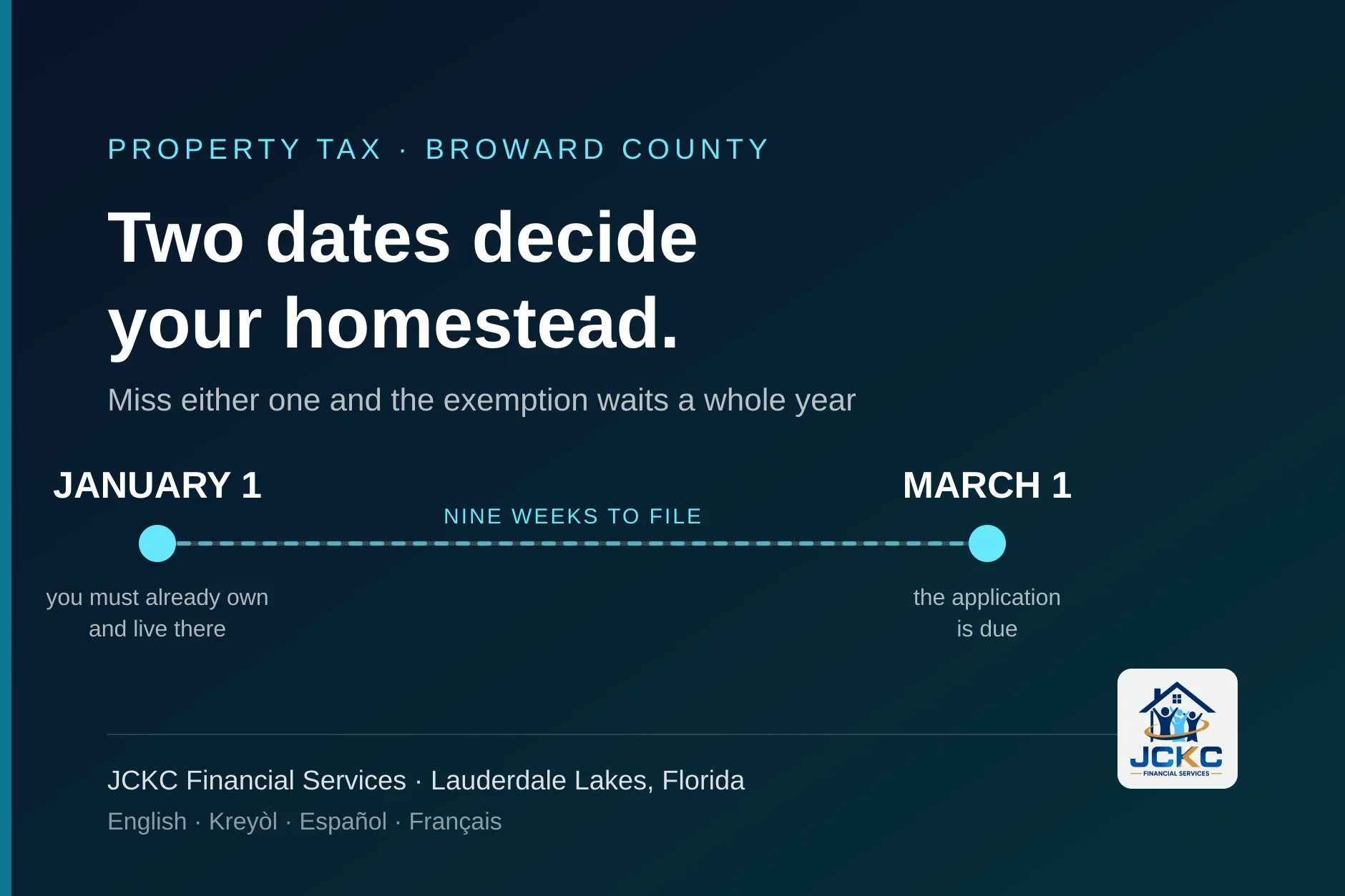
2. January 1 is a test, not a starting line
Read the opening words of the statute slowly, because they are the whole thing: the exemption goes to a person who, on January 1, has title and in good faith makes the property their permanent residence. That is a status on a single day. It is not a date you start from and it cannot be met in arrears.1
A closing in February, a move in July, a divorce that changes who lives there in September — none of these produce an exemption for that year, however promptly you file. They produce an exemption for the following year, claimed by the March 1 after that January 1. People who buy in spring routinely file immediately, hear nothing, and assume they have it. Mark the next January instead, and in the meantime make sure the facts the appraiser will look at in January are actually true of you by then.3
3. How the appraiser decides you really live here
Permanent residence is not self-declared. The statute makes it a factual determination by the property appraiser, and lists ten relevant factors, with the warning that no single one is conclusive. This is the checklist to work through before January rather than after a refusal:3
- A formal declaration of domicile recorded in the county’s public records.
- Where your dependent children are registered for school.
- Your place of employment.
- Where you were permanently resident before — another state or another country — and the date that residency ended.
- Florida voter registration, with the address matching the property.
- A valid Florida driver license or Florida identification card, together with evidence that licenses from other states were relinquished.
- A Florida license tag on any vehicle you own.
- The address on the federal income tax returns you file.
- Where your bank statements and checking accounts are registered.
- Proof that you pay the utilities at the property.
4. March 1, and the one week of grace nobody knows about
The application goes to the county property appraiser, and the statute is blunt about timing: it must be filed on or before March 1 of each year, and failure to do so “shall constitute a waiver of the exemption privilege for that year”. A waiver, not a delay:2
- There is no partial credit for a late application. The year is simply gone, and you file again for the next one.
- The saving you lose is not only the first year’s tax. It is also a year of the assessment cap, which starts when the exemption does.
- January and February are the two months in which this is actually fixable, which is why this article is published in November.
The April 1 cure applies to one thing only
There is a single statutory second chance, and it is narrow. If you filed a timely application and it was incomplete only because the required social security number was missing, the property appraiser must contact you, and you may refile a complete application by April 1. Miss that and the waiver applies as normal. It does not rescue an application that was late, and it does not rescue one missing anything else.
5. Save Our Homes: the part that compounds
This is the part that makes the exemption worth keeping rather than merely worth having. Once homestead is on the property, the annual reassessment on January 1 cannot increase by more than the lower of three per cent or the change in the consumer price index for the preceding year:4
| What happens | What the statute does |
|---|---|
| The market rises 9% in a year | Your assessed value rises by the lower of 3% or CPI |
| CPI for the year comes in at 2% | The cap is 2% that year, not 3% — the statute takes the lower |
| The calculated value would exceed just value | The assessed value is lowered to just value |
| You sell, or title otherwise changes hands | The property is assessed at just value on January 1 of the following year |
| You correct an error on the deed, with the same person entitled | Not treated as a change of ownership |
In a market like South Florida’s, the gap between just value and assessed value is the real money. It is also why the exemption rewards filing at the first opportunity in a household’s life rather than the first time somebody mentions it: every year of cap is compounding, and a change of ownership starts the whole thing over.4
Bought a home this year?
The exemption starts with next January, not with your closing date. There is work to do before then.
6. Moving within Florida without losing the cap
The obvious fear about a cap that resets on sale is that moving across town destroys twenty years of it. Portability is the answer, and it is more generous than most people assume:5
- You may reduce the assessed value of a new Florida homestead by the difference between just value and assessed value on the old one, up to $500,000.
- You qualify if you received a homestead exemption as of January 1 of any of the three immediately preceding years — not just the year before.
- Where the new home is worth as much as or more than the old one, the whole differential moves across, subject to the cap.
- Where the new home is worth less, the benefit is scaled by the ratio of the two just values rather than carried whole.
- A married couple who both lived on the previous homestead are each treated as having received the exemption, even if only one of them applied for it.
What portability is not is automatic. It is claimed, alongside the homestead application on the new property, and it is the single most valuable thing a Florida household moving within the state can forget to ask for.5
7. The 65-and-over exemptions, which are a local decision
There are two further exemptions for owners aged 65 and over, and the thing to understand first is that they are permissive rather than universal: the statute allows a county or a municipality to adopt them by ordinance, and some have and some have not:6
- Up to $50,000 for an owner who has reached 65 and whose household income does not exceed a statutory limit.
- Separately, an exemption equal to the assessed value, for an owner aged 65 or over who has kept the property as a permanent residence for at least 25 years, where the home’s just value was under $250,000 in the first year of eligibility, and whose household income is within the same limit.
- Household income means the adjusted gross income of everyone in the household, and the income limit is adjusted every January for the change in the cost-of-living index.
- Both sit on top of the ordinary homestead exemption rather than replacing it.
Whether your county and your municipality have adopted either, and what the current income limit works out to, is a local question with a local answer. Ask the property appraiser for the county the property is in — for a home in Broward, that is the Broward County Property Appraiser, and the question takes one phone call. Our Broward County page has the rest of what we cover locally.9
8. What claiming one you are not owed costs
The counterweight to a generous exemption is a hard penalty for taking one you were not owed, and the lookback is long. Where the property appraiser determines that a homestead exemption was granted for any year within the prior ten to a person not entitled to it:7
- The property becomes subject to the taxes that were exempted, for each of those years.
- Plus a penalty of fifty per cent of the unpaid taxes for each year.
- Plus fifteen per cent interest a year.
- The owner must be served with a notice explaining why the exemption was not due, for which years, and how the figure was calculated, and must be given thirty days to pay before a lien is recorded.
The situations that produce this are rarely fraud and almost always drift: a homestead kept after moving out, a second property claimed in another state, a rental that quietly stopped being a residence, an exemption that survived the death of the person who qualified for it. All of them are fixable by telling the property appraiser before the appraiser tells you.7
9. The statute does not mention citizenship
This question comes up in our office more than any other property-tax question, and the honest answer starts with the text. The statute grants the exemption to “a person who, on January 1, has the legal title or beneficial title in equity to real property in this state and who in good faith makes the property his or her permanent residence”. There is no citizenship test in that sentence, and none elsewhere in the section.1
What there is instead is the permanent-residence determination, which the property appraiser makes on the ten factors in section three. Several of those factors — voter registration, a Florida driver license, a declaration of domicile — are easier for some households to satisfy than others, and no single one is conclusive. The practical answer is therefore an administrative one rather than a legal one: ask the property appraiser what evidence that office wants to see.3
If your status is unsettled, take advice before you file
An application is a signed statement to a government office about where you permanently live. For most households that is unremarkable. Where immigration status is in process or in question, it is worth a conversation with an immigration attorney first — not because the exemption is unavailable, but because what you sign should be considered. We prepare taxes and we will help you assemble the documents; we do not give immigration advice. If you file with an ITIN, our guide to tax filing for immigrant families covers the return side.
10. What to have ready
Most applications are refused or delayed for want of a document rather than for want of a right. Assemble these before January so that filing in the first week of the year is a twenty-minute job:8
- The recorded deed, or the closing statement if the recording is recent — recording must have happened before the exemption can be granted.
- Social security numbers for you and your spouse. This is the one omission the statute singles out, and the one that triggers the April 1 cure rather than an outright waiver.
- Your Florida driver license or Florida identification card, showing the property address.
- Florida vehicle registration for any vehicle you own.
- Your Florida voter registration, if you are registered.
- A utility bill in your name at the property.
- The date you ended residency in another state or country, and evidence of having given up any out-of-state license.
- For portability, the address of the previous Florida homestead and the year you last held the exemption on it.
11. What to do between now and March
November and December are the quiet months in which this is easy, and February is the month in which it is a scramble. If you bought a home this year, moved, turned 65, or have never got round to it:
- Check whether the exemption is already on the property. The property appraiser’s record is public and searchable by address. A surprising number of households discover it lapsed at a sale years ago.
- Make the January 1 facts true before January 1. The license, the registration, the utility account, the address on the return you will file. These take weeks, not days, and they are the evidence the determination rests on.
- Record the deed if it is not recorded. The exemption cannot be granted before it is.
- File in the first fortnight of January. Not February. The deadline is March 1 and the appraiser’s office is busiest in the last two weeks before it.
- Claim portability in the same application if you held a Florida homestead in any of the last three years.
- Ask about the senior exemptions if anyone on the title is 65 or over, because they are local ordinances and nobody will volunteer them.
- Tell the appraiser about anything that changed — a move, a rental, a death, a new name on the deed — before the ten-year lookback finds it for you.
12. Frequently asked questions
I bought my house in March. Can I claim the exemption this year?
No, and this is the single most common disappointment. The statute gives the exemption to a person who, on January 1, holds title and in good faith makes the property their permanent residence. January 1 is a test, not a starting line: if you did not own and occupy the home that day, the exemption begins with the following year. Buying in March means filing by March 1 of the next year, for the year after that bill.
What is the deadline to apply?
March 1. The statute says the application must be filed with the county property appraiser on or before March 1 of each year, and that failing to do so is a waiver of the exemption privilege for that year. There is one narrow reprieve: if you filed on time and the application was incomplete only because a social security number was missing, the appraiser contacts you and you may refile a complete application by April 1.
How much is it worth?
Less than the headline, and more than you think. The first $25,000 comes off the assessed value for all levies. A second $25,000 applies only to assessed value above $50,000, and only for levies other than school district levies — which is why your school taxes do not fall by as much. Since 2025 the second amount is adjusted every January for inflation, so there is no fixed figure to quote. Your property appraiser publishes the current one.
What is Save Our Homes?
It is the cap that makes the exemption worth far more over time than it is worth in year one. Once homestead is on the property, the annual reassessment cannot rise by more than the lower of three per cent or the change in the consumer price index. In a market that moves faster than that, the gap between what the house is worth and what you are taxed on widens every year. It also resets: after a change of ownership, the property is assessed back at just value on the following January 1.
If I move, do I lose the cap?
Not if you move within Florida and act in time. Portability lets you carry up to $500,000 of the difference between just value and assessed value to a new Florida homestead. The window is longer than most people believe: you qualify if you held a homestead exemption as of January 1 of any of the three immediately preceding years. It is not automatic, though. You apply for it.
Is there extra relief if I am over 65?
There may be, and it depends on where you live rather than on state law alone. The statute lets a county or a municipality adopt an ordinance granting an additional exemption of up to $50,000 for an owner aged 65 or over whose household income is at or below a limit, and separately a full exemption for a home under $250,000 in just value held as a permanent residence for at least 25 years. The income limit is adjusted annually. Whether your county and your city adopted either is a local question for the property appraiser.
What happens if I claim it and I should not have?
It is expensive and it reaches back. If the property appraiser determines that an exemption was granted for any year in the prior ten to someone not entitled to it, the property becomes subject to the taxes that were exempted, plus a penalty of fifty per cent of the unpaid taxes for each year and fifteen per cent interest a year. You are given thirty days to pay before a lien is recorded. This is the reason to be straightforward about a second home or a property claimed in another state.
Can I claim it if I am not a US citizen?
The statute does not mention citizenship. It gives the exemption to a person who holds title and in good faith makes the property their permanent residence, and whether a permanent residence has been established is a factual determination the property appraiser makes using a list of ten relevant factors. In practice appraisers ask for evidence of permanent residency, so a household where status is unsettled should ask the appraiser directly what it needs, and take immigration advice before filing anything if the situation is sensitive.
Do I have to reapply every year?
Generally no — once granted, most counties renew it automatically and send you a receipt or a card to check. What you must do is tell the property appraiser when something changes: you move out, you rent it, the ownership changes, or the person who qualified dies. Staying silent is how a household ends up inside the ten-year lookback in the previous question.
13. Sources
- Florida Statutes, s. 196.031, Exemption of homesteads — paragraph (1)(a) on the first $25,000, title and permanent residence on January 1, and the recording requirement; paragraph (1)(b) on the additional $25,000 above $50,000 of assessed value, excluded from school district levies and adjusted annually on January 1 for inflation. Read October 27, 2026.
- Florida Statutes, s. 196.011, Annual application required for exemption — subsection (1)(a) on filing on or before March 1 and the waiver of the exemption privilege for that year; subsection (1)(b) on an application incomplete for a missing social security number and refiling by April 1. Read October 27, 2026.
- Florida Statutes, s. 196.015, Permanent residency; factual determination by property appraiser — the ten relevant factors, and that no one factor is conclusive. Read October 27, 2026.
- Florida Statutes, s. 193.155, Homestead assessments — subsection (1) capping the annual change at the lower of three per cent or the consumer price index; subsection (2) lowering the assessed value to just value where the calculation exceeds it; subsection (3)(a) reassessing at just value on January 1 following a change of ownership, with the listed exceptions. Read October 27, 2026.
- Florida Statutes, s. 193.155(8), portability — a reduction of up to $500,000 for a person who received a homestead exemption as of January 1 of any of the three immediately preceding years, with paragraph (a) for an equal or higher-valued new homestead and paragraph (b) for a lower-valued one. Read October 27, 2026.
- Florida Statutes, s. 196.075, Additional homestead exemption for persons 65 and older — a county or municipality may adopt either or both by ordinance; up to $50,000 on a household income within the limit, and an exemption equal to assessed value for a home under $250,000 just value held 25 years; the income limit is adjusted annually. Read October 27, 2026.
- Florida Statutes, s. 196.161, Homestead exemptions; lien imposed — taxes exempted for any year within the prior ten, a penalty of fifty per cent of the unpaid taxes for each year, fifteen per cent interest per annum, and thirty days to pay before a lien is recorded. Read October 27, 2026.
- Florida Department of Revenue, Property Tax Exemptions and Additional Benefits — the state overview and the application forms. Read October 27, 2026.
- Broward County Property Appraiser, bcpa.net — the office that grants or refuses the exemption for property in Broward, publishes the current exemption amounts, and can say whether the county or your municipality adopted a senior exemption. Read October 27, 2026.
For general information only, and not legal advice. This article describes Florida statutes as published, with a link to each section. JCKC Financial Services is a licensed insurance brokerage and tax preparation practice, not a law firm and not a taxing authority. The homestead exemption is granted or refused by your county property appraiser, which alone determines permanent residency and the amount of any exemption; the figures and limits in this article change by statute and by local ordinance. Consult a Florida attorney for anything involving a trust, a deed change, a probate estate or an immigration question, and confirm current amounts and deadlines with your property appraiser before relying on them.