

1. Why "one plan for the whole family" is often the wrong answer
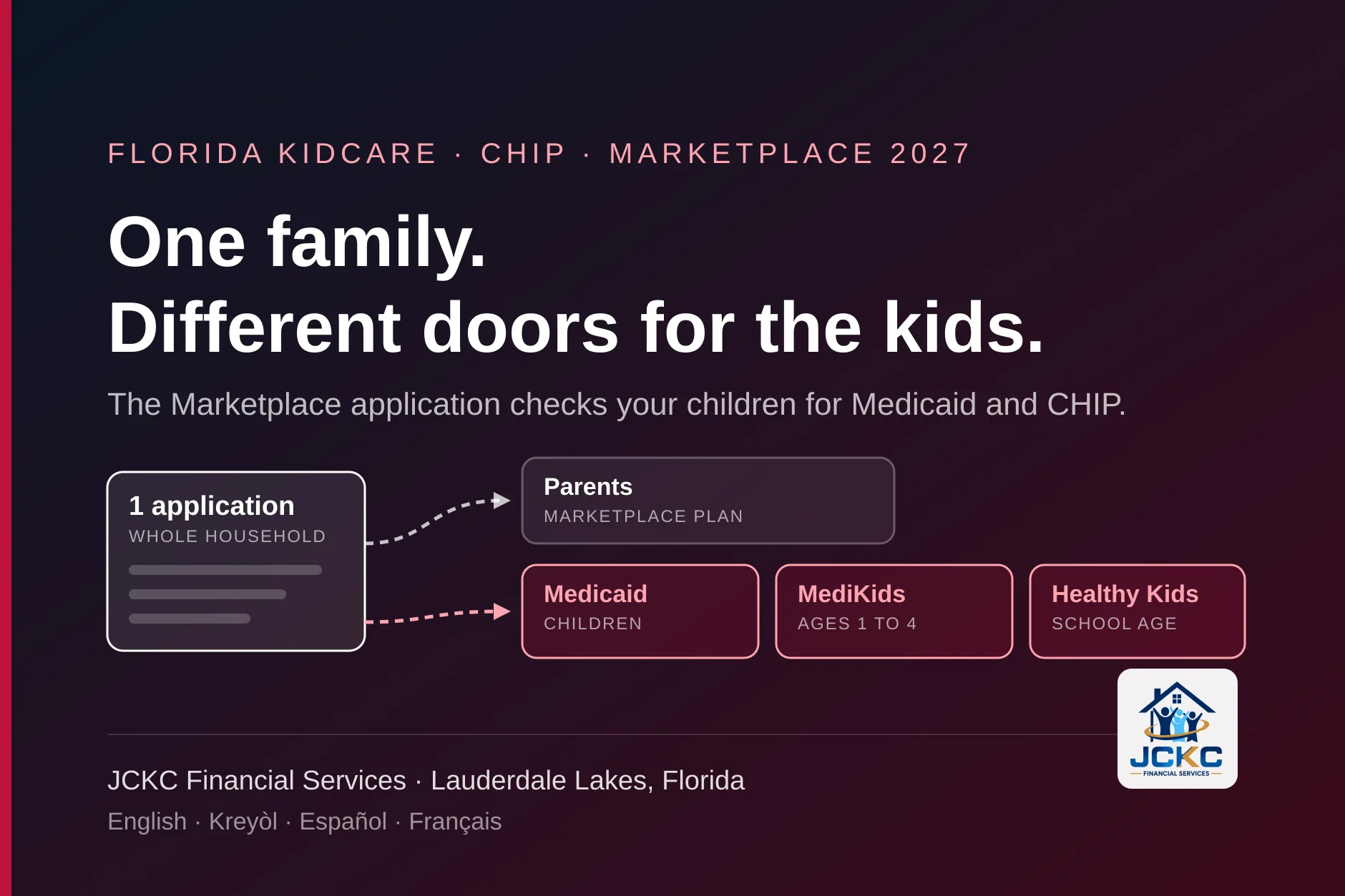
Marketplace eligibility is decided person by person, not family by family. The same household can contain adults who qualify for a Marketplace plan with a premium tax credit and children who qualify for Medicaid or CHIP, the Children’s Health Insurance Program. HealthCare.gov puts it plainly: in many cases, if you qualify for savings on a Marketplace plan, your children will qualify for either Medicaid or CHIP. The reason is that the income limits for children are set well above the limits for adults.12
What if the children go on your Marketplace plan anyway? HealthCare.gov answers that too, and the answer is expensive:1
- No savings for a CHIP-eligible child. If your children are eligible for CHIP, they will not be eligible for any savings on a Marketplace plan. You would pay their share of the premium in full.
- No savings for a Medicaid-eligible child either. Anyone who qualifies for Medicaid is not eligible for Marketplace savings.
- CHIP can be lost. HealthCare.gov warns that you may no longer qualify for CHIP if you keep a Marketplace plan.
- The adults are a separate question. You and other family members may still qualify for savings on Marketplace coverage. The children’s eligibility does not take the parents’ credit away.
This is not the same thing as the adult coverage gap. Florida has not expanded Medicaid for adults, and a parent can earn too little for a subsidy and too much for adult Medicaid while the children are fully covered. That problem has its own article, the Florida coverage gap. This one is about the far more common case: a working family whose parents qualify for a Marketplace plan and whose children qualify for something better.
2. Florida KidCare: four doors, one program
In Florida, CHIP and children’s Medicaid are marketed together as Florida KidCare. The statute that creates it lists the components. Which one a child lands in depends mainly on age and family income, and the family does not pick the door; the eligibility rules do:3
| KidCare component | Who it is for, per Florida law | Run by |
|---|---|---|
| Medicaid | Children whose family income is within Medicaid’s limits. A child who is eligible for Medicaid must be enrolled in Medicaid, not another KidCare component. | Agency for Health Care Administration (AHCA), with eligibility through the state’s Medicaid process |
| MediKids | Children aged 1 to under 5 whose family income is above the Medicaid level. Same benefits as children’s Medicaid, using Medicaid’s provider network. | AHCA |
| Florida Healthy Kids | Primarily school-age children whose family income is above Medicaid’s and who do not qualify for Medicaid. | Florida Healthy Kids Corporation, which also determines eligibility for the CHIP-funded components |
| Plan for children with special health care needs | Children identified through a medical or behavioral screening as having special health care needs. They are assigned to it and may opt out. Long known as the Children’s Medical Services (CMS) Health Plan. | Plans under contract with AHCA |
Two details matter. A MediKids child may join Florida Healthy Kids instead only if a sibling is already in it and the county allows it. And every component other than Medicaid applies "if such coverage is approved and available in the county in which the child resides"; only Medicaid is an entitlement.456
3. Income bands, and what we could not confirm
We are not printing a chart of dollar limits, and here is why. The official Florida KidCare and Florida Healthy Kids sites were not readable from our systems on November 2, 2026, and we do not copy figures from secondary sites. The most recent official table we could read is Medicaid.gov’s, which shows each state’s limits as of December 1, 2023, as a percentage of the federal poverty level (FPL), including a 5% disregard. For Florida:8
| Group (Florida, as of December 1, 2023) | Income limit, % of FPL |
|---|---|
| Children’s Medicaid, under age 1 | 206% |
| Children’s Medicaid, ages 1 to 5 | 140% |
| Children’s Medicaid, ages 6 to 18 | 133% |
| Separate CHIP, age 1 up to 19 | 210% |
| Pregnant women, Medicaid | 191% |
| Parents and caretaker relatives, Medicaid | 24% |
The law has moved since that table. The 2026 Florida Statutes say a child under 19 whose family income is at or below 300% of the poverty level is eligible for KidCare, and the MediKids and Healthy Kids sections use the same 300% figure. Above 300%, a family may buy in at the full premium. But each of those sections carries the same note: putting the 2023 law that wrote in 300% into effect is "contingent upon federal approval through a Medicaid waiver or a state plan amendment". We could not confirm on an official page we could read whether, or from when, that approval applies. So: the statute says 300%, the last federal table we can read says 210% for CHIP, and the band that applies today is the one Florida KidCare publishes.456
To turn a percentage into dollars you need the poverty guidelines. HHS has published the 2026 guidelines; for the premium tax credit, the IRS uses the guidelines in force on the first day of Open Enrollment, so 2027 Marketplace credits use these. 100% of the poverty level in 2026, in the 48 contiguous states:910
- household of 2: $21,640
- household of 3: $27,320
- household of 4: $33,000
- household of 5: $38,680
- household of 6: $44,360
Where to check the current KidCare bands
Florida KidCare publishes its current income bands and monthly premiums on its official site, floridakidcare.org. We could not read it from our systems, so no figure in this article comes from it. When we sit with you, we look at it together with your income, on the day.
4. What Florida law lets KidCare charge
Florida law does not print a price list, but it does set firm limits on what a child’s coverage can cost. They are in one short section of the KidCare Act:7
- Medicaid: nothing. Children covered by Medicaid may not be charged enrollment fees, premiums, copayments, deductibles or coinsurance.
- At or below 150% of the poverty level, outside Medicaid: premiums and similar charges may not exceed the federal maximum, and copays only a nominal amount.
- Above 150%: premiums and cost sharing may follow a sliding scale tied to income, set in at least three and no more than six tiers, but the total annual cost sharing for all the children in a family may not exceed 5% of the family’s income.
- Preventive care is free at every level. No copays, deductibles or coinsurance for well-baby and well-child care, age-appropriate immunizations, and routine hearing and vision screenings.
- Above the subsidized band: the family pays the full premium, including administrative costs, and gets no premium assistance.
Two more rules are worth knowing before you enroll. Once a child is in KidCare, Florida law keeps the child covered for 12 months without a new eligibility check, as long as the family keeps paying the premium; a child under 5 found eligible for Medicaid also keeps 12 months. And if you cancel by not paying, MediKids and Healthy Kids can impose a 30-day wait before coverage is reinstated. HealthCare.gov’s federal summary matches the cap: you will not pay more than 5% of family income for CHIP in a year, and routine well-child doctor and dental visits are free.1456
5. How the Marketplace application screens your children
You do not need a separate trip to the state to find out whether your children qualify. The Marketplace application on HealthCare.gov, which is where we enroll our clients, screens every person in the household. In HealthCare.gov’s own words, if it looks like anyone in your household qualifies for Medicaid or CHIP, it securely sends your information to your state agency, which contacts you about enrollment. In order, what happens:12
- You list everyone in the tax household, including children you are not asking to cover, and the household’s expected 2027 income.
- The application assesses each person. Adults who qualify get a Marketplace eligibility result with any premium tax credit. A child who appears eligible for Medicaid or CHIP is flagged and referred to Florida.
- Florida decides the child’s eligibility, not HealthCare.gov and not us. Under Florida law income is checked electronically first, with pay stubs, a W-2 or a tax return asked for only if that fails, and there is no assets test for children.
- If the state says no, it sends your contact information back to the Marketplace, which mails you a letter about Marketplace coverage for that child.
- Parents enroll in their plan by the Open Enrollment deadline, without waiting on the children’s decision.
One IRS rule protects you while the state decides. If the Marketplace assesses someone as not eligible for Medicaid or CHIP and enrolls them with advance credit payments, that person is treated as not eligible for Medicaid or CHIP for purposes of the credit for the rest of that coverage period, even if Medicaid later approves them. You still have to act on it: if you find a child has both, the IRS says to tell the Marketplace right away, and HealthCare.gov says to end the Marketplace plan for the person when Medicaid starts.10
Answer the household questions fully
The most common error we see is leaving a child off the application because "the kids already have something". List them anyway. The household size changes the poverty-level percentage used for everyone, including the parents’ credit; a missing child can make the adults look richer than they are. Who qualifies for a $0 plan, and why, is on our page who qualifies for a $0 Marketplace plan in Florida.
6. Children can enroll any day of the year
The Marketplace has a calendar. Medicaid and CHIP do not. HealthCare.gov says you can apply for free or low-cost coverage through Medicaid or CHIP at any time, and Florida law says enrollment in MediKids may occur at any time throughout the year. Medicaid may even pay for care from the last 3 months, depending on income and expenses at the time. Side by side, for 2027:1525
| Coverage | When you can enroll | Notes |
|---|---|---|
| Parents’ Marketplace plan | Open Enrollment, November 1, 2026 to January 15, 2027 | Enroll by December 15 for January 1; December 16 to January 15 starts February 1. After that, only with a Special Enrollment Period. |
| Children’s Medicaid | Any day of the year | Coverage can start immediately if eligible; may reach back up to 3 months. |
| MediKids, Florida Healthy Kids | Any day of the year | Premiums apply above the levels in section 4; a missed premium can mean a 30-day wait to reinstate. |
| A child turning 19 | Plan ahead | CHIP-funded KidCare ends at 19. Losing coverage is a life change that can open a Marketplace Special Enrollment Period. |
In practice this means the parents’ deadline is the one that cannot slip. If November is busy, enroll the adults by December 15 and finish the children’s paperwork in the following weeks; their door does not close. Our page on when ACA Open Enrollment ends for 2027 has the Marketplace dates in detail.456
Open Enrollment runs November 1 to January 15
Parents on one coverage, children on another? Bring the household’s income and we will sort it with you, in your language.
7. Job-based family coverage and the "family glitch" fix
Families with a job offer used to hit a wall. Until 2022, whether an employer’s plan was "affordable" for a spouse and children was judged on what the employee paid for employee-only coverage. A worker could be offered cheap self-only coverage and very expensive family coverage, and the family was still locked out of Marketplace help. That was the "family glitch". The IRS changed the rule in final regulations published October 13, 2022, effective December 12, 2022: affordability for family members is now based on the employee’s share of the cost of covering the employee and those family members.1011
How the test works today, from the IRS’s own questions and answers:10
- For the employee: coverage is affordable if the employee’s share for the lowest-cost self-only plan that provides minimum value is not more than a set percentage of household income: 9.96% for plan years beginning in 2026. The IRS page, last reviewed September 21, 2026, does not yet show the 2027 percentage; the IRS publishes each year’s figure in a revenue procedure, usually in the summer or early fall before the year.
- For the spouse and children: the same percentage, applied to what the employee must pay for the lowest-cost family coverage that covers everyone offered it and provides minimum value.
- If the family cost is above the line, the spouse and children may qualify for a premium tax credit on a Marketplace plan, even while the employee keeps the job plan.
- The trap: if the family coverage is affordable but the plan lets family members join only when the employee does, and the employee declines, the family still gets no credit (IRS Q18).
Children add one more layer, because Florida KidCare has its own employer test. Under Florida law a child covered by a family member’s group plan gets no KidCare premium assistance if the child’s cost on that plan is not more than 5% of family income. Dropping a child’s job coverage in the 60 days before applying can also block assistance, unless the law’s good causes apply, such as a job loss or job coverage costing more than 5% of family income. Medicaid is outside these limits. If you have a job offer, HealthCare.gov’s advice is to update your Marketplace application with it before deciding, to see how it changes the household’s savings.416
Bring the employer’s numbers
For an accurate answer we need the employee’s monthly cost for self-only coverage and for family coverage on the cheapest plan that meets minimum value, which is on the employer’s Summary of Benefits and Coverage or from human resources. How the credit itself is calculated is in our guide to premium tax credits.
8. Immigrant children: what the official pages say
This is the section to read slowly, because the rules changed this year and a lot of what circulates is wrong in both directions. HealthCare.gov now carries a warning on its Medicaid and CHIP pages: due to a law change, only people with three immigration statuses are eligible for full Medicaid or CHIP coverage: Lawful Permanent Residents (green card holders), Cuban or Haitian entrants, and Compact of Free Association (COFA) migrants. The same banner adds the part that matters most for children: depending on the state, "lawfully residing" pregnant women and children may also be eligible.112
Florida is one of those states for children. Medicaid.gov’s list, updated as of April 2, 2026, shows Florida covering lawfully residing children in CHIP and in Medicaid, up to age 19. Florida law defines a "lawfully residing child" as a child who is lawfully present in the United States, meets Medicaid or CHIP residency rules, and may be eligible under section 214 of the 2009 CHIP reauthorization law, the federal option that lets states skip the five-year wait for children. What that means, and does not mean:13144
- A child who is a U.S. citizen is assessed like any other citizen child, whatever the parents’ status. In a mixed-status family the citizen children are often the ones who qualify.
- A lawfully present child may qualify in Florida as a lawfully residing child, without the five-year waiting period that applies to many adults.
- An undocumented child is not eligible for KidCare. Florida law says so in terms: the rule does not extend KidCare to an undocumented immigrant.
- Emergency Medicaid may cover treatment of an emergency medical condition for someone who meets Medicaid’s other rules but does not have an eligible status.
The parents’ side is a different rule and a different date. From January 1, 2027, the premium tax credit on a Marketplace plan is limited to the same three statuses, and other lawfully present immigrants can enroll but pay full price. We explained that change, and the December 15 document trap that comes with it, in our article on the 2027 subsidy rule for immigrants; we will not repeat it here. HealthCare.gov also notes new "public charge" guidance from the Department of Homeland Security for anyone seeking a visa or a green card; that is a question for an immigration attorney, not an insurance agent.12
9. What this looks like in Broward
Florida does not run its own exchange. Families in Lauderdale Lakes, Lauderhill, Sunrise, North Lauderdale, Fort Lauderdale and the rest of Broward County enroll on the federal Marketplace at HealthCare.gov, where we enroll you, and the federal screening described in section 5 is the one that applies here. The children’s decision then goes to Florida.
The household we see most often in November is two working parents, three children of different ages and income that moves with the season: hospitality, home health, construction, rideshare. Their children can land in different KidCare doors by age alone: the baby on Medicaid, the 3-year-old on MediKids, the 10-year-old on Healthy Kids. Three cards, three member numbers, sometimes three letters in English that arrive on different days. Much of our work is reading those letters with the family in Kreyòl, Spanish or French.
10. What to do before December 15
For a family that wants every child covered on January 1 and the parents’ credit right, the order of work is short:
- Write down your 2027 household income estimate, both parents, overtime and side work included. The same number drives the parents’ credit and the children’s screening.
- List every member of the tax household with a date of birth and, for anyone not a citizen, the immigration document.
- If anyone has a job offer, get the employee’s monthly cost for self-only and for family coverage on the cheapest plan that meets minimum value.
- Apply on HealthCare.gov for the whole household and let the application screen the children. Do not enroll a child in a Marketplace plan just to "be safe" until you see the result.
- Enroll the parents by December 15 for coverage on January 1.
- Answer the state’s letters about the children quickly, and keep copies. If a child is approved for Medicaid while on a Marketplace plan, end the Marketplace coverage for that child.
- Note two dates for 2027: each child’s KidCare renewal, and any child turning 19.
11. Frequently asked questions
Can my children get Florida KidCare or Medicaid if I buy a Marketplace plan?
Yes, and often that is exactly how it works. Eligibility is decided person by person, so the parents can have a Marketplace plan with a premium tax credit while the children are covered through Medicaid or Florida KidCare. HealthCare.gov says that in many cases, if you qualify for Marketplace savings, your children qualify for Medicaid or CHIP. One Marketplace application starts both.
Can I just put my children on my Marketplace plan instead?
You can enroll them, but a child who is eligible for CHIP or Medicaid gets no Marketplace savings, so you would pay that child’s full premium. HealthCare.gov says CHIP will probably be more affordable, and warns that a child may lose CHIP if you keep the Marketplace plan for them.
What are the Florida KidCare income limits for 2027?
We could not read a current figure on an official page, so we do not print one. The latest official table we could read, Medicaid.gov’s as of December 1, 2023, shows Florida CHIP at 210% of the poverty level for ages 1 to 19. Florida law now says 300%, but notes that putting that change into effect depends on federal approval. Florida KidCare publishes the bands it applies today.
How much does Florida KidCare cost?
Florida law sets limits rather than prices. Medicaid: no premiums and no copays. Above 150% of the poverty level, a sliding scale, but total yearly cost sharing for all the children may not exceed 5% of family income, and preventive care has no copay. We could not read the current dollar premiums, so we do not quote them.
Do I have to wait for Open Enrollment to sign up my children?
No. You can apply for Medicaid and CHIP at any time of year, and Florida law lets MediKids enrollment happen at any time. The November 1 to January 15 Open Enrollment, with December 15 for a January 1 start, governs the parents’ Marketplace plan.
My employer’s family coverage is too expensive. Can my spouse and children get Marketplace help?
Possibly. Since the IRS family glitch fix, effective December 12, 2022, affordability for family members is judged on what the employee pays for family coverage. If that is above the IRS percentage of household income, 9.96% for 2026 plan years, family members may qualify for a premium tax credit. The children may qualify for Medicaid or KidCare first.
Can my child get KidCare if they are not a U.S. citizen?
It depends on status. Full Medicaid and CHIP are now limited to green card holders, Cuban or Haitian entrants and COFA migrants, plus, depending on the state, lawfully residing children. Medicaid.gov lists Florida, as of April 2, 2026, as covering lawfully residing children in CHIP and Medicaid. Florida law does not extend KidCare to an undocumented child.
What happens to my child’s KidCare when they turn 19?
The CHIP-funded parts of KidCare end at 19. Losing coverage is a life change that can open a Marketplace Special Enrollment Period, so plan the move a couple of months ahead.
Does JCKC enroll children in Florida KidCare?
The State of Florida decides a child’s Medicaid or KidCare eligibility, not us or any agent. We handle the Marketplace side: we complete your household’s HealthCare.gov application with you; it screens each child and refers a likely match to the state, and we help you read the letters that follow, in English, Kreyòl, French or Spanish. The review is free.
12. Sources
- HealthCare.gov, The Children’s Health Insurance Program (CHIP). Read November 2, 2026.
- HealthCare.gov, Medicaid & CHIP coverage. Read November 2, 2026.
- Florida Statutes (2026), s. 409.813, program components. Read November 2, 2026.
- Florida Statutes (2026), s. 409.814, Eligibility, including the note on federal approval of ch. 2023-277. Read November 2, 2026.
- Florida Statutes (2026), s. 409.8132, Medikids. Read November 2, 2026.
- Florida Statutes (2026), s. 624.91, Florida Healthy Kids Corporation Act. Read November 2, 2026.
- Florida Statutes (2026), s. 409.816, Limitations on premiums and cost sharing. Read November 2, 2026.
- Medicaid.gov, Medicaid, CHIP and BHP Eligibility Levels, as of December 1, 2023. Read November 2, 2026.
- HHS ASPE, 2026 Poverty Guidelines. Read November 2, 2026.
- IRS, Questions and answers on the Premium Tax Credit, Q5, Q7, Q11, Q12, Q18, Q33. Read November 2, 2026.
- Federal Register, Affordability of Employer Coverage for Family Members of Employees, 87 FR 61979, October 13, 2022. Read November 2, 2026.
- HealthCare.gov, Coverage for lawfully present immigrants. Read November 2, 2026.
- Medicaid.gov, Coverage of Lawfully Residing Children & Pregnant Women, updated April 2, 2026. Read November 2, 2026.
- Florida Statutes (2026), s. 409.811(16), "lawfully residing child". Read November 2, 2026.
- HealthCare.gov, When can you get health insurance?. Read November 2, 2026.
- HealthCare.gov, Options if you have job-based health insurance. Read November 2, 2026.
- Florida KidCare, floridakidcare.org, the official site for current bands and premiums. Not readable from our systems on November 2, 2026; no figure here comes from it.
For general information only. This article explains federal and Florida rules as published by HealthCare.gov, Medicaid.gov, the IRS, HHS and the Florida Legislature; it is not tax, legal or immigration advice and it is not a determination of eligibility. Only the Marketplace can decide eligibility for a Marketplace plan or a premium tax credit, and only the State of Florida can decide a child’s eligibility for Medicaid or Florida KidCare. Income bands, premiums and rules can change; check the current figures with the official programs. JCKC Financial Services is an independent insurance brokerage and tax practice; we enroll you on HealthCare.gov and review plans from the carriers we represent.