

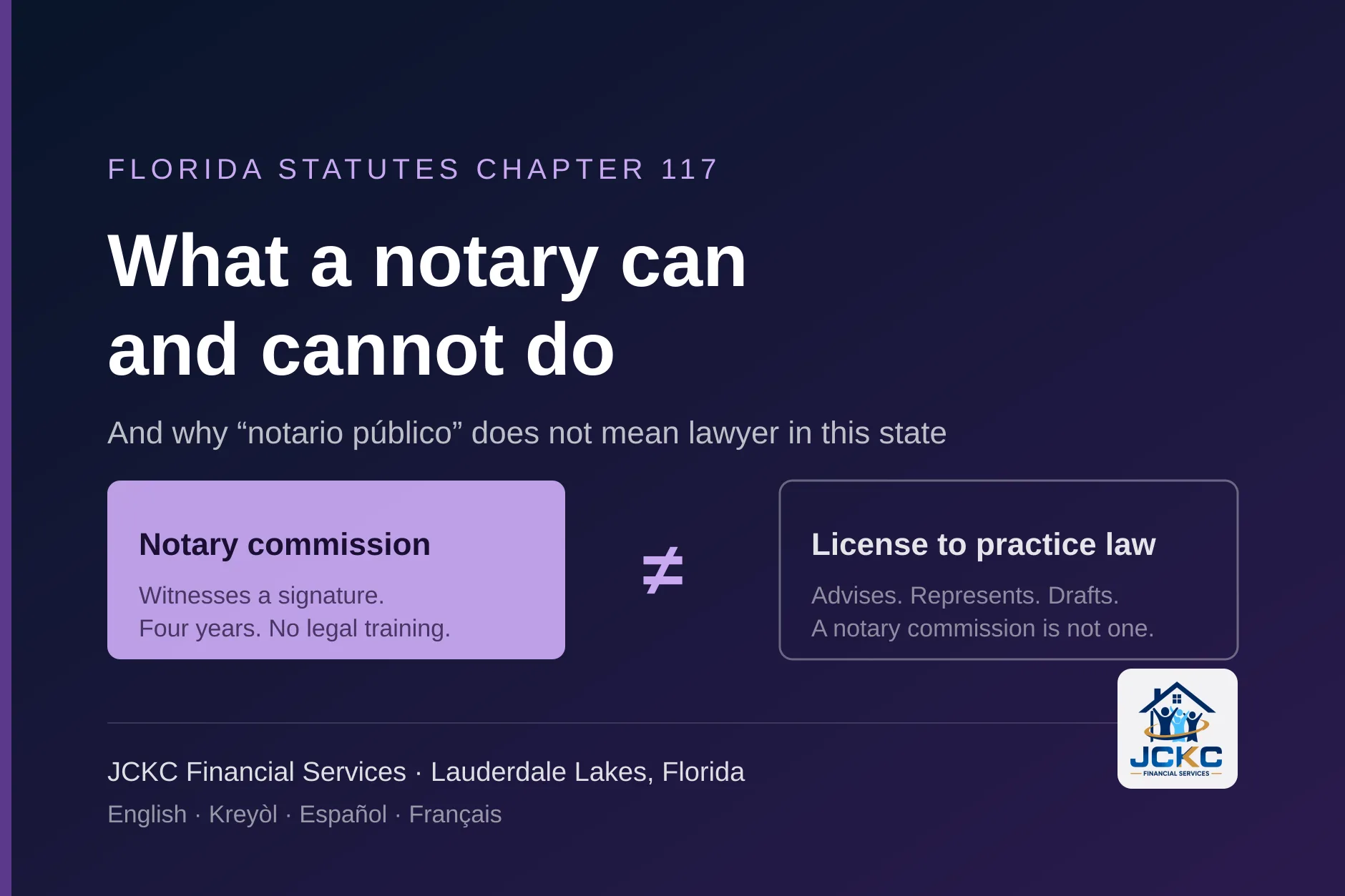
1. What a Florida notary is actually for
Start with the appointment, because the shape of the job follows from it. A Florida notary public is appointed by the Governor for a term of four years. The applicant must be at least 18 and a legal resident of Florida, and must keep that residency for the whole term. They post a bond of $7,500, approved and filed with the Department of State and written by a surety company, payable to anyone harmed by a breach of their duty. They swear an oath that includes having read chapter 117. That is the whole qualification.1
- Take acknowledgments. The notary confirms that the person in front of them is who they say they are and that they signed the document willingly. That is a statement about the signer, not about the document.
- Administer oaths and affirmations. This is what turns a page of text into an affidavit: you swear the contents are true, and the notary records that you did.
- Attest to photocopies — but only in a narrow set of cases, covered in section 7 below, which excludes exactly the documents people most often ask for.
- Solemnize a marriage. Genuinely. Florida is one of the few states where a notary can perform the ceremony.
Read that list again and notice what is not on it. Nothing there involves deciding what a document means, choosing which form you need, filling one in on your behalf, or telling you whether signing is a good idea. The commission is an authority to witness. It is not an authority to advise, and the fee cap tells you how the Legislature values the work: ten dollars an act.2
2. The twelve things the statute forbids
Section 117.107 is titled, flatly, “Prohibited acts”, and it runs to twelve subsections. Most of them exist because somebody tried it. These are the ones an ordinary person is likely to meet across a desk:3
- No signer, no notarization. The notary may not notarize a signature unless you appear before them, physically or by the audio-video technology authorized for online notarizations. A violation is a civil infraction with a penalty of up to $5,000, and the statute states that lack of intent to defraud is not a defense.
- Nothing blank. A notary may not notarize a signature on a document that is incomplete or blank, and may not sign a blank acknowledgment form and hand it to someone else to use.
- No edits after the fact. A notary may not change anything in a written instrument after a person has signed it, and may not amend the notarial certificate once the notarization is finished.
- No close family. A notary may not notarize the signature of their own spouse, son, daughter, mother or father.
- No stake in the outcome. A notary may not notarize where they have a financial interest in, or are a party to, the underlying transaction. There are narrow carve-outs for an employee notarizing for an employer and an attorney for a client of record.
- No signing you do not understand. The notary may not take an acknowledgment from someone who does not speak or understand English unless the nature and effect of the document is translated into a language they do understand — and may not notarize at all if the signer appears unable to understand what they are signing.
If you are not in the room, it is not a notarization
The single most common offer we hear described is a notary who will stamp a document a relative signed somewhere else. It is not a shortcut and it is not a favor: it is the violation the Legislature attached a $5,000 penalty to, and the resulting document can be challenged by anyone who later has a reason to.
3. Why the word notario is the problem
Here is the collision. In Mexico, Colombia, Brazil, Haiti, France and much of the rest of the civil-law world, a notary is a senior licensed lawyer. Becoming one takes years of legal study and often a competitive appointment. They draft contracts, authenticate deeds and advise clients, and their signature carries weight a witness’s never could. A person who grew up with that meaning and sees a Florida storefront reading notario público is not being careless when they assume they have found a lawyer. They are reading the word correctly, in the only sense they have ever known.
Florida treats this as a consumer-protection problem rather than a misunderstanding, and legislated accordingly. A literal translation of the phrase “Notary Public” into a language other than English is prohibited in advertising for notarial services. Separately, a notary who is not authorized to represent people in immigration matters may not use notario público, notario, immigration assistant, immigration consultant or immigration specialist in advertising, in any language. Those two rules exist because the word itself does the deceiving, before anyone has said anything false out loud.6
4. The notice the law makes them print
There is a third rule, and it is the one you can use. If a notary who is not an attorney advertises notary services in any language other than English, the advertisement must carry a specific notice — in English and in the language of the advertisement:2
Required by section 117.05(10), Florida Statutes
“I AM NOT AN ATTORNEY LICENSED TO PRACTICE LAW IN THE STATE OF FLORIDA, AND I MAY NOT GIVE LEGAL ADVICE OR ACCEPT FEES FOR LEGAL ADVICE.”
A single desk plaque is exempt, and radio and television advertisements may modify the wording so long as they convey substantially the same message. Everything else — the window sign, the flyer, the Facebook post, the business card — is covered. So if you are looking at an advertisement in Creole, Spanish or French for notary services and that sentence is nowhere on it, you have learned something about the business before you have walked in.2
Two things to look for before you sit down
First, is the notice there, in both languages? Second, does the sign translate “Notary Public” into another language, or use the word notario? The first is required. The second two are prohibited. Either way the sign is telling you how carefully this office reads the rules it works under.
5. Who may legally help with an immigration form
This is the question underneath most of the others, so it is worth answering precisely. Two kinds of people may represent you before the immigration authorities: an attorney, and a non-attorney Accredited Representative. Accredited Representatives come from a Department of Justice program set out at 8 C.F.R. sections 1292.11 to 1292.20, run by the Executive Office for Immigration Review. They may represent people before the Department of Homeland Security and before the immigration courts and the Board of Immigration Appeals.7
The conditions matter. An Accredited Representative may only provide services through a Recognized Organization, and only non-profit, federally tax-exempt entities can be recognized. Accreditation lasts three years and must be renewed. Both the organization roster and the representative roster are published, which means you can check a claim rather than weigh it. A notary commission appears on neither roster, and no amount of experience converts one into the other.7
Notary services in Lauderdale Lakes
Not sure whether you need a notary or an attorney? We will tell you which, and not charge you for the sentence.
6. What it is allowed to cost
Price is the fastest tell, because the statute sets it and most people have never been told what it is:
| What you are asking for | What the law allows | Where it says so |
|---|---|---|
| Any one notarial act, in person | Not more than $10 | s. 117.05(2)(a) |
| One online notarization | Not more than $25, plus any platform fee | s. 117.275 |
| Solemnizing a marriage | No more than clerks of the circuit court may charge for like services — ask the clerk for the figure | s. 117.045 |
| Legal advice from a non-attorney notary | Nothing. They may not accept a fee for it | s. 117.05(10) |
| Attesting a copy of a birth certificate | Not permitted at any price | s. 117.05(12) |
Notice that section 117.045 does not name a dollar amount at all: it ties the marriage fee to what the clerk of the circuit court may charge for comparable services. We are not going to print a number the statute does not contain, so if you need it, ask the clerk of court in your county. Anything quoted well above the figures that are in the statute is worth a question before it is worth a payment.25
7. The birth certificate they cannot copy
This one disappoints people at the counter almost daily, so it is better learned here. A Florida notary may attest to a photocopy only where the document is neither a vital record nor a public record a copy of which can be made by its custodian. A birth certificate is a vital record. So is a death certificate and a marriage certificate. A court record is a public record whose custodian can issue a copy. All of them are outside what a notary may do.2
The route is the issuing agency, not the notary. For a Florida birth or death record that is the Florida Department of Health; for a court record it is the clerk of court; for a marriage certificate it is the clerk who issued the license. A notary who agrees to attest to a copy of your birth certificate is either unaware of the rule in their own enabling statute or indifferent to it, and neither is a good sign for whatever you came in to sign.
8. The one thing that surprises people
Florida is unusual here, and it is the happiest part of the chapter. Section 117.045 authorizes a notary public to solemnize the rites of matrimony. Most states reserve that to clergy and judicial officers; Florida does not. If you have a marriage license from a Florida clerk of court, a notary can perform the ceremony.4
The fee is capped by the same section, at no more than what the law allows clerks of the circuit court for like services. That is the one place in this article where we deliberately leave a blank: the statute sets a ceiling by reference rather than by number, and the number belongs to the clerk, not to us. Ask them, and you will have the current figure from the office that sets it.4
9. Notarizing without being in the room
Since 2020 Florida has allowed online notarization under part II of chapter 117, with its own registration, its own technology standards and its own fee cap of $25 per act. The RON platform may charge its own fees separately, which is why an online signing can cost more than the statutory figure without anyone breaking a rule — ask what the total is before you start, not after.5
What online notarization does not do is relax the appearance requirement. The signer still appears before the notary; they appear by audio-video communication technology rather than in person, and the notarial certificate has to say which of the two it was. Convenience changed. The rule that you must actually be there, in one sense or the other, did not.3
10. If it has already gone wrong
If someone with a notary stamp has already charged you for legal advice, filled in an immigration form for you, or told you what your options are, there are two separate tracks and you can use both at once. Neither requires a lawyer to start.68
- File an unlicensed practice of law complaint with The Florida Bar. There is no fee, the complaint does not have to be notarized, and the Bar’s UPL line is 850-561-5840. Send it to the office nearest the non-lawyer; the Bar has offices in Tallahassee, Fort Lauderdale, Miami, Orlando and Tampa.
- Consider a report to the state attorney. Practicing law in Florida without a license, or holding yourself out as qualified to, is a felony of the third degree under section 454.23.
- Keep the evidence, especially the advertising. Because section 117.05 regulates the wording, a flyer or window sign using notario, or missing the required notice, is itself part of the picture. Photograph it before it changes.
- Get the underlying matter looked at by someone who may actually handle it. A complaint does not fix a form that was filed wrong. If immigration is involved, check the Executive Office for Immigration Review rosters for an accredited representative or find an attorney.
11. What to bring, and what to check
The checking takes under a minute, and the preparation saves a second trip:9
- Bring photo identification and bring the whole document, not the signature page. A notary cannot notarize anything incomplete or blank.
- Do not sign it in advance. You sign in front of the notary; that is the entire point of the appearance requirement.
- Know what you are signing. If you cannot follow the document in your own language, say so. The statute is on your side: the nature and effect has to be translated into a language you understand before an acknowledgment can be taken.
- Ask the price first. Ten dollars an act in person, twenty-five for an online act plus any platform fee. A larger number deserves an explanation.
- If the question is legal, immigration or tax, ask who is answering it. A notary witnessing your signature and a person advising you on your case are two different jobs, and in Florida only one of them can be done without a license.
12. Frequently asked questions
Is a notary public the same as a lawyer in Florida?
No, and the difference is larger than most people expect. A Florida notary public is appointed by the Governor for four years, must be a legal resident of the state and at least 18, must post a $7,500 bond and must swear they have read chapter 117 of the Florida Statutes. Nothing in that list is legal training, and the commission does not confer any authority to give legal advice, draft a document for someone else or represent anyone. Practicing law in Florida without a license is a felony of the third degree.
Why does "notario publico" cause so much trouble?
Because the phrase means something else almost everywhere it comes from. In many civil-law countries a notario publico is a senior licensed attorney with years of legal training and real authority over contracts and property. Someone arriving in Florida reasonably reads a sign saying "notario" as "lawyer". Florida law treats this seriously enough to regulate the wording: a literal translation of "Notary Public" into another language is prohibited in advertising, and a notary who is not authorized to represent people in immigration matters may not advertise as a notario publico, notario, immigration assistant, immigration consultant or immigration specialist in any language.
What does a Florida notary actually do?
Four things, mostly. They take acknowledgments, which is witnessing that you are the person signing and that you signed willingly. They administer oaths and affirmations, which is what makes an affidavit an affidavit. They attest to photocopies in a narrow set of cases. And, unusually for a US state, they can solemnize a marriage. That is the job: verifying who signed, not what the document says or whether signing it is a good idea.
How much can a Florida notary charge?
The fee for any one notarial act may not exceed $10 under section 117.05(2)(a). An online notarization is capped separately at $25 under section 117.275, though a remote online notarization platform may charge its own fees on top of that. The fee for solemnizing a marriage is capped at what circuit court clerks may charge for comparable services, so ask the clerk of court for the current figure rather than taking a number from anyone else. A non-attorney notary may not accept a fee for legal advice at all.
Can a notary notarize a document if I am not there?
No. Section 117.107(9) prohibits notarizing a signature unless the signer appears before the notary, either physically or through the audio-video technology authorized for online notarizations. A violation is a civil infraction carrying a penalty of up to $5,000, and the statute says lack of intent to defraud is no defense. If someone offers to notarize a document your relative signed last week in another city, they are offering to break the law.
Can a notary notarize a copy of my birth certificate?
No. Under section 117.05(12) a notary may attest to a photocopy only when the document is neither a vital record nor a public record a copy of which can be made by its custodian. A birth certificate is a vital record. For a certified copy you go to the agency that issued it, which for a Florida birth is the Florida Department of Health. The same logic covers death certificates, marriage certificates and court records.
Can my sister notarize my signature?
Not if she is in the list. Section 117.107(11) prohibits a notary from notarizing the signature of their spouse, son, daughter, mother or father. A sibling is not named in that subsection, but section 117.107(12) separately prohibits notarizing where the notary has a financial interest in or is a party to the transaction. In practice, if the notary stands to gain from the document, find a different notary: a notarization that gets challenged later is worth less than the ten dollars it saved.
I do not speak English well. Can a notary still help me?
Yes, with one condition that exists for your protection. Section 117.107(6) prohibits a notary from taking an acknowledgment from a person who does not speak or understand English unless the nature and effect of the document is translated into a language that person does understand. So the notary cannot simply point at the line and ask you to sign. If nobody in the room can explain the document in your language, that is a reason to stop, not a formality to wave through.
Who can actually help me with an immigration form?
An attorney, or a non-attorney Accredited Representative working through a Recognized Organization under the Department of Justice program set out at 8 C.F.R. sections 1292.11 to 1292.20. Recognized Organizations must be non-profit and federally tax-exempt, accreditation runs for three years, and both rosters are published by the Executive Office for Immigration Review. If someone claims to be accredited, you can check the roster before you pay anything. A notary commission is not on that list and never has been.
What do I do if a notary already took my money for legal advice?
Two tracks, and you can use both. File an unlicensed practice of law complaint with The Florida Bar: there is no fee, the complaint does not have to be notarized, and the Bar’s UPL line is 850-561-5840. Separately, practicing law without a license is a felony of the third degree under section 454.23, so a report to your local state attorney is available too. Keep the advertisement, the receipt and anything in writing — the advertising rules in section 117.05 mean the sign itself is often the evidence.
13. Sources
- Florida Statutes, s. 117.01, Appointment, application, suspension, revocation, application fee, bond, and oath — four-year term, Governor appoints, legal residency, $7,500 bond. Read October 26, 2026.
- Florida Statutes, s. 117.05, Use of notary commission; unlawful use; notary fee; seal; duties; employer liability; name change; advertising; photocopies; penalties — the $10 fee cap at (2)(a), the non-English advertising notice at (10), the translation and notario prohibitions at (11), and the photocopy limits at (12). Read October 26, 2026.
- Florida Statutes, s. 117.107, Prohibited acts — the twelve subsections, including the appearance requirement and its $5,000 penalty at (9). Read October 26, 2026.
- Florida Statutes, s. 117.045, Marriages — authority to solemnize, with the fee capped by reference to the clerks of the circuit court. Read October 26, 2026.
- Florida Statutes, s. 117.275, Fees for online notarization — the $25 cap. Read October 26, 2026.
- Florida Statutes, s. 454.23, Penalties — practicing law without a license, or holding oneself out as qualified to, is a felony of the third degree. Read October 26, 2026.
- U.S. Department of Justice, Executive Office for Immigration Review, Recognition and Accreditation Program, implementing 8 C.F.R. ss. 1292.11–1292.20, with the published rosters of Recognized Organizations and Accredited Representatives. Read October 26, 2026.
- The Florida Bar, Filing an Unlicensed Practice of Law Complaint — no fee, no notarization required, UPL line 850-561-5840. Read October 26, 2026.
- Florida Department of State, Notary Commissions and Apostille Certification — the state’s own notary pages. Read October 26, 2026.
For general information only. This article describes Florida law as published by the Legislature; it is not legal advice, immigration advice or tax advice, and it is not a substitute for an attorney. Jacky Catule is a Florida-commissioned notary public and a licensed Florida insurance agent. He is not an attorney and is not an accredited representative, and JCKC Financial Services does not give legal or immigration advice or prepare immigration forms. Statutes change; check the current text at the links above before relying on any of it.