

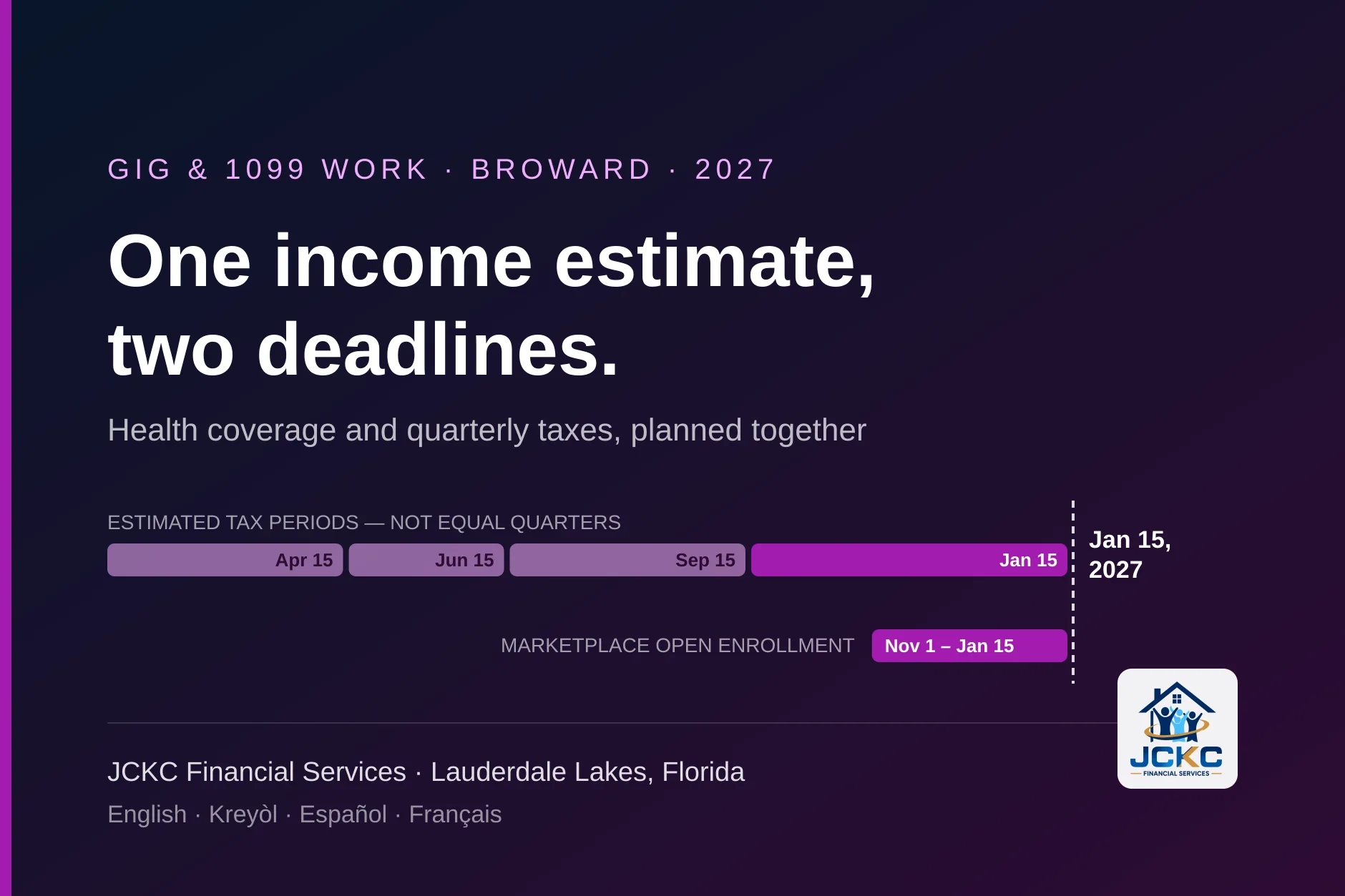
1. January 15, 2027 is two deadlines
Here is what falls on Friday, January 15, 2027:18
- Your fourth estimated tax payment for tax year 2026. It covers what you earned from September 1 through December 31, 2026, and it is due on January 15 of the following year.
- The last day of Open Enrollment for 2027 Marketplace coverage. Enroll by December 15, 2026 for coverage that starts January 1; enroll between December 16 and January 15 and coverage starts February 1.
The tax payment looks backward at 2026. The Marketplace application looks forward at 2027. But you cannot do either well without the same thing in front of you: an honest figure for what your work earns after expenses. If you work out the 2026 profit for the January payment, you have also done most of the work for the 2027 estimate, because the application asks you to start from your past experience and adjust it. Doing them in the same sitting, in December rather than in the second week of January, is the whole plan in one sentence. If buying your own coverage is new to you, start with how self-employed people get health insurance in Florida, and for the deadlines themselves see when 2027 Open Enrollment ends.
2. First, check that you are really self-employed
Rideshare and delivery drivers who set their own hours on an app, and house cleaners who run their own list of clients, are usually exactly what a 1099 says they are: in business for themselves. They owe self-employment tax on their profit and they are expected to pay as they go. The rest of this article is written for them.4
Home health aides and caregivers are the group where the 1099 is most often wrong. The IRS says it directly: caregivers who work in the homes of elderly or disabled people are typically employees of those people, because the family has the right to tell the caregiver what needs to be done. That makes the family a household employer, with its own payroll obligations, rather than a client. Some caregivers really are in business for themselves — the IRS gives the example of someone running an adult day-care business for several clients — but a single family, in its own home, directing the work, is the employee pattern.5
A 1099 is a form, not a ruling
Someone chose to send it. If you care for one person in their home and the family sets your schedule and duties, bring the paperwork before you start making quarterly payments on it. Paying self-employment tax on wages that should have had payroll tax withheld is a mistake you make four times a year.
3. Self-employment tax is not your tax bracket
The commonest shock for a first-year 1099 worker is a tax bill on income that was supposedly too low to tax. The reason is that there are two separate taxes, and only one of them cares about your bracket:4
- Self-employment tax is 15.3% — 12.4% for Social Security and 2.9% for Medicare — figured on Schedule SE once your net earnings from self-employment reach $400. It is the same Social Security and Medicare an employee pays, except that you pay both the employee half and the employer half.
- Income tax is the bracket calculation everyone knows, and a modest gig income may produce little or none of it after the standard deduction.
- For 2026, the Social Security part applies to the first $184,500 of combined wages, tips and net earnings. Few gig workers come near it. The Social Security Administration has announced a higher maximum for 2027, which we cover in our 2027 Social Security COLA guide.
Two consequences for planning. First, a driver who owes no income tax can still owe self-employment tax on every dollar of profit, so “I don’t earn enough to pay tax” is rarely true. Second, you can deduct the employer-equivalent half of the self-employment tax when you figure your adjusted gross income. That deduction lowers your income tax; it does not lower the self-employment tax itself. Estimated payments cover both taxes together, which is why the IRS expects them from almost everyone in business for themselves.4
4. The payment dates, and why they are not quarters
The IRS calls them quarterly payments, but the periods are not quarters. They run three months, two months, three months and four months, which is why the June payment feels like it comes too soon and the January payment is often the largest:1
| Income earned | Payment due | Notes |
|---|---|---|
| September 1 – December 31, 2026 | Friday, January 15, 2027 | Fourth 2026 payment; four months of income |
| January 1 – March 31, 2027 | Thursday, April 15, 2027 | First 2027 payment, same day as the 2026 return |
| April 1 – May 31, 2027 | Tuesday, June 15, 2027 | Only two months after April |
| June 1 – August 31, 2027 | Wednesday, September 15, 2027 | Peak hurricane season; plan it early |
| September 1 – December 31, 2027 | Next business day after Saturday, January 15, 2028 | The 2027 Form 1040-ES, not yet published, will print the exact date |
You generally have to make estimated payments if you expect to owe $1,000 or more when you file. You avoid the underpayment penalty if you pay at least the smaller of 90% of this year’s tax or 100% of last year’s (110% if last year’s adjusted gross income was over $150,000). For people whose prior year was steady, last year’s total divided into the four payments is the simplest safe route. For gig income that swings with the season, the IRS has a method built for you: Form 2210, Schedule AI, the annualized income installment method, which matches what you owe to when you actually earned it.23
You do not have to pay four lump sums
The IRS says you can pay weekly, every two weeks or monthly, as long as enough has been paid by the end of each period. For a driver paid out every week, setting aside a fixed share of each payout and sending it on the same day is easier than finding a large sum four times a year. If the estimate turns out high or low, the IRS tells you to rework the 1040-ES worksheet for the next payment.
5. The 2026 mileage rate is two rates
For rideshare and delivery drivers, mileage is the single biggest deduction, and 2026 has a wrinkle that a lot of year-end advice will miss. The IRS changed the business rate in the middle of the year:6
- January 1 to June 30, 2026: 72.5 cents per business mile.
- July 1 to December 31, 2026: 76 cents per business mile.
- For comparison, 2025: 70 cents per business mile.
- 2027: not published as of November 2, 2026. The IRS normally announces the next year’s rate late in the year; until it does, any “2027 rate” you see is a guess.
So a 2026 mileage log has to be split at July 1. A driver who multiplies the whole year’s miles by 72.5 cents leaves money on the table for the second half; one who uses 76 cents for the whole year overclaims the first half. The fix takes five minutes if your log has dates on it, and it is impossible if it does not. Whatever app or notebook you use, make sure each entry is dated and separates business miles from personal driving. That split also matters for your Marketplace estimate, because the deduction is part of what turns gross app earnings into the net profit the application asks for.6
Open Enrollment ends January 15, 2027, the same day as your last 2026 payment
Bring your app statements and your mileage log. We will build the number once and use it for both.
6. One estimate, two forms
HealthCare.gov asks a self-employed person for estimated net self-employment income for the coverage year, which it defines as the profit you would report on Schedule C. That is the same profit your estimated tax starts from. Here is how we build it for a gig worker, once, for both purposes:7
- Start from gross earnings, platform by platform. Use the app’s annual or monthly earnings statements, not your bank deposits, which may already have fees taken out. Add cash and tips for cleaning or care work from your own records.
- Subtract the platform’s fees and commissions if your statement shows them inside the gross figure.
- Subtract business expenses: the mileage deduction at the right rate for each half of 2026 (or actual car expenses, if that is the method you use), phone and data used for work, supplies for cleaning work, and so on.
- What is left is your net profit. For January, it drives the fourth 2026 payment. For the Marketplace, adjust it for 2027 using only what you already know: a second app you have started, a client you have lost, a car that will need replacing.
- Write the assumptions down beside the number. If the Marketplace asks you to confirm your income, HealthCare.gov says it may ask for a “self-employment ledger”, which can be a spreadsheet, an app export or a handwritten book, as long as it records all income and expenses. The same record supports your tax return.
For how high or low to lean on the Marketplace figure, now that the cap on repaying excess premium tax credit is gone, we have written a whole article and will not repeat it here: guess your income low and you repay every dollar of it. The habit that ties this section together is simple. Each time you make an estimated tax payment, look at the year so far against your estimate. If it has moved, rework the 1040-ES worksheet for the next payment and update your Marketplace application, which HealthCare.gov asks you to do as soon as possible when income turns out higher or lower. Four check-ins a year, on dates you already have to remember.72
7. Where your premiums meet your taxes
If you pay for your own Marketplace plan, your premiums can also show up on your tax return as the self-employed health insurance deduction. Who can take it, and against what, is answered on its own page: can I deduct health insurance premiums if I am self-employed.
The point for this plan is only that the deduction and your premium tax credit affect each other, so the two are worked out together when the return is prepared, not guessed at in advance. The IRS covers that interaction in Publication 974, and our self-employed Marketplace article explains why it belongs with your preparer. For your estimated payments, the practical rule is to leave the deduction out of your quarterly arithmetic unless you already know its size; a slightly high estimate costs you nothing at filing, and a low one can cost a penalty.
8. Form 1099-NEC or 1099-K: what arrives in January
Form 1099-NEC reports nonemployee compensation: a company, agency or business client paying you as a contractor. For tax years beginning after 2025, the minimum amount that triggers the form rose to $2,000, and the IRS says it may be adjusted for inflation beginning in 2027. The payer files it by January 31. Payments made by card or through a payment network do not go on a 1099-NEC; they belong on Form 1099-K.10
Form 1099-K comes from payment apps and online marketplaces, and the IRS names ride-hailing platforms among them. As the IRS states the rule today, the threshold for apps and marketplaces is payments for goods or services of more than $20,000 in more than 200 transactions, though a platform may send the form for less. If clients pay you directly by card, you get a 1099-K from the card processor whatever the amount. The form is due to you by January 31.9
Two things matter for this plan. The first is that a missing form changes nothing: the IRS is explicit that you report all income from goods and services whether or not a 1099 arrives, so a cleaner paid by a dozen households through an app, none over the threshold, still has a business to report. The second is that a 1099-K usually shows gross payments, before the platform’s fees and before your mileage, so it is the top line of your profit calculation, not the bottom one. Form 1099-K has enough traps of its own that we are giving it a full article later this month.
9. The hurricane postponement that skips Broward
This is the local fact that changes the answer. On October 14, 2026 the IRS announced relief for Florida taxpayers affected by Hurricane Isaias: filing and payment deadlines, including estimated tax payments, are postponed to February 8, 2027. The headlines said “Florida”. The relief does not cover all of Florida. It applies to people who live or have a business in 27 named counties in north Florida and the Panhandle, from Escambia to Citrus. Broward is not on the list, and neither are Miami-Dade or Palm Beach.11
So for a driver in Lauderdale Lakes, Plantation or Pembroke Pines, the fourth 2026 payment is still due January 15, 2027. If a storm does reach Broward and FEMA declares it, the IRS can postpone deadlines here too, and it publishes each county list on its disaster relief pages. Separately, the IRS says the underpayment penalty may be removed or reduced when the shortfall results from a casualty, a local disaster or another unusual circumstance where the penalty would not be fair. Neither is something to plan around in advance.3
Read the county list, not the headline
Every IRS disaster release names its counties. If a relief notice reaches you through social media or a group chat, check that your county is on it before you skip a payment. We check it for our clients as part of every January review.
10. Your plan, date by date
Here is the whole plan as a calendar. It is built around dates you already have, so nothing new needs remembering:
- Now through December 15, 2026: pull your app statements and mileage log, build the net profit once, and enroll or renew on the Marketplace with your 2027 estimate. December 15 is the last day for coverage from January 1.
- By December 31, 2026: close the 2026 mileage log, split at July 1, and total each half at its own rate.
- Friday, January 15, 2027: make the fourth 2026 estimated payment. It is also the last day of Open Enrollment, so anyone still without 2027 coverage enrolls by today for February 1.
- By January 31, 2027: watch for Forms 1099-NEC and 1099-K. Check each against your own records rather than assuming it is right.
- Thursday, April 15, 2027: file the 2026 return and make the first 2027 payment. Compare the first quarter of 2027 with your Marketplace estimate and update the application if it has moved.
- June 15 and September 15, 2027: the same check-in, each time you pay.
11. Frequently asked questions
When is my last estimated tax payment for 2026?
January 15, 2027, which is a Friday, so it does not move. It covers income you earned from September 1 through December 31, 2026. That is four months of income in one payment, the longest of the four periods, which is why it is often the biggest. Publication 505 describes an exception to the January payment in its chapter on estimated tax; if you plan to file your 2026 return very early, ask us whether it fits you.
Do I have to pay estimated tax if I only drive part time?
The IRS says individuals generally have to make estimated payments if they expect to owe $1,000 or more when they file. Self-employment tax counts toward that, and it starts once net earnings from self-employment reach $400. A part-time driver with a W-2 job can sometimes cover the gig side by asking the employer to withhold more instead, which the IRS also allows.
I am a home health aide paid on a 1099. Am I self-employed?
Possibly not. The IRS says caregivers who work in the homes of elderly or disabled people are typically employees of those people, because the family has the right to tell them what needs to be done. A 1099 is a form someone chose to send; it does not settle whether you are an employee. Before you build a year of quarterly payments around it, bring the paperwork and we will look at how the work is actually arranged.
Is the number on my Marketplace application the same as my tax estimate?
They start from the same place. HealthCare.gov asks for your estimated net self-employment income for the coverage year, the profit figure that goes on Schedule C. Your estimated tax starts from that same profit, then adds self-employment tax and income tax. Build the profit figure once, carefully, and both forms are consistent with each other, which is exactly what the reconciliation at tax time will check.
Will Uber or DoorDash send me a 1099-K?
Payment apps and online marketplaces, including ride-hailing platforms, must send Form 1099-K when your payments for goods or services exceed $20,000 in more than 200 transactions, and they may send one for less. Pay that a company sends you directly as a contractor, rather than through a payment app or card network, is reported on Form 1099-NEC instead. Either way, the IRS is clear that you report all of your income whether or not a form arrives. Our full guide to Form 1099-K for tax year 2026 is coming later in November.
The IRS postponed deadlines for a Florida hurricane. Does that include me?
Not if you live and work in Broward. The Hurricane Isaias relief announced October 14, 2026 postpones deadlines, including estimated tax payments, to February 8, 2027, but only for 27 named counties in north Florida and the Panhandle. Broward, Miami-Dade and Palm Beach are not among them, so a Broward gig worker’s January 15, 2027 payment stands.
12. Sources
- Internal Revenue Service, When are quarterly estimated tax payments due? — the four payment periods and due dates, the weekend and holiday rule, and the pointer to the January payment exception in Publication 505. Read November 2, 2026.
- Internal Revenue Service, Estimated taxes — the $1,000 test, estimated tax covering self-employment tax, paying weekly or monthly, and refiguring on a new Form 1040-ES worksheet. Read November 2, 2026.
- Internal Revenue Service, Underpayment of estimated tax by individuals penalty — the 90%, 100% and 110% safe harbors, Form 2210 Schedule AI for income that varies, and relief for a casualty or local disaster. Read November 2, 2026.
- Internal Revenue Service, Self-employment tax (Social Security and Medicare taxes) — the 15.3% rate, the 2026 $184,500 Social Security limit, the $400 filing test, the employer-equivalent deduction, and the caregiver rule. Read November 2, 2026.
- Internal Revenue Service, Family caregivers and self-employment tax — caregivers in a client’s home are typically employees; examples of caregivers who are not. Read November 2, 2026.
- Internal Revenue Service, Standard mileage rates — 72.5 cents (January 1 to June 30, 2026), 76 cents (July 1 to December 31, 2026) and 70 cents (2025) per business mile. Read November 2, 2026.
- HealthCare.gov, Reporting self-employment income to the Marketplace — estimated net income for the coverage year, the Schedule C figure, updating when income changes, and the self-employment ledger. Read November 2, 2026.
- HealthCare.gov, When can you get health insurance? — Open Enrollment November 1 to January 15; December 15 for coverage from January 1. Read November 2, 2026.
- Internal Revenue Service, Understanding your Form 1099-K — the $20,000 and 200-transaction threshold for payment apps and online marketplaces, card payments reported at any amount, and the duty to report all income. Read November 2, 2026.
- Internal Revenue Service, Instructions for Forms 1099-MISC and 1099-NEC (12/2026) — the $2,000 threshold for tax years beginning after 2025, the January 31 filing date, and card and network payments belonging on Form 1099-K. Read November 2, 2026.
- Internal Revenue Service, FL-2026-07: tax relief for taxpayers impacted by Hurricane Isaias in Florida, October 14, 2026, updated October 22, 2026 — deadlines including estimated tax payments postponed to February 8, 2027 for 27 listed counties, not including Broward. Read November 2, 2026.
For general information only. This article explains federal rules as published by the IRS and HealthCare.gov on the dates shown; it is not tax, legal or accounting advice and it is not a determination of your worker status or your eligibility. Whether you are an employee or self-employed depends on how your work is actually arranged. Only the Marketplace can decide your eligibility for a premium tax credit; enroll and confirm eligibility at HealthCare.gov. Figures not yet published for 2027, including the 2027 mileage rate and the exact January 2028 payment date, are marked as such. JCKC Financial Services is an independent insurance brokerage and tax practice.