

1. The cap that used to catch you is gone
The premium tax credit is paid in advance, month by month, straight to the insurance company, based on the income you estimated. At tax time it is reconciled against what you actually earned. If the advance payments were too big, you pay the difference back. What changed is how much of that difference is yours:1
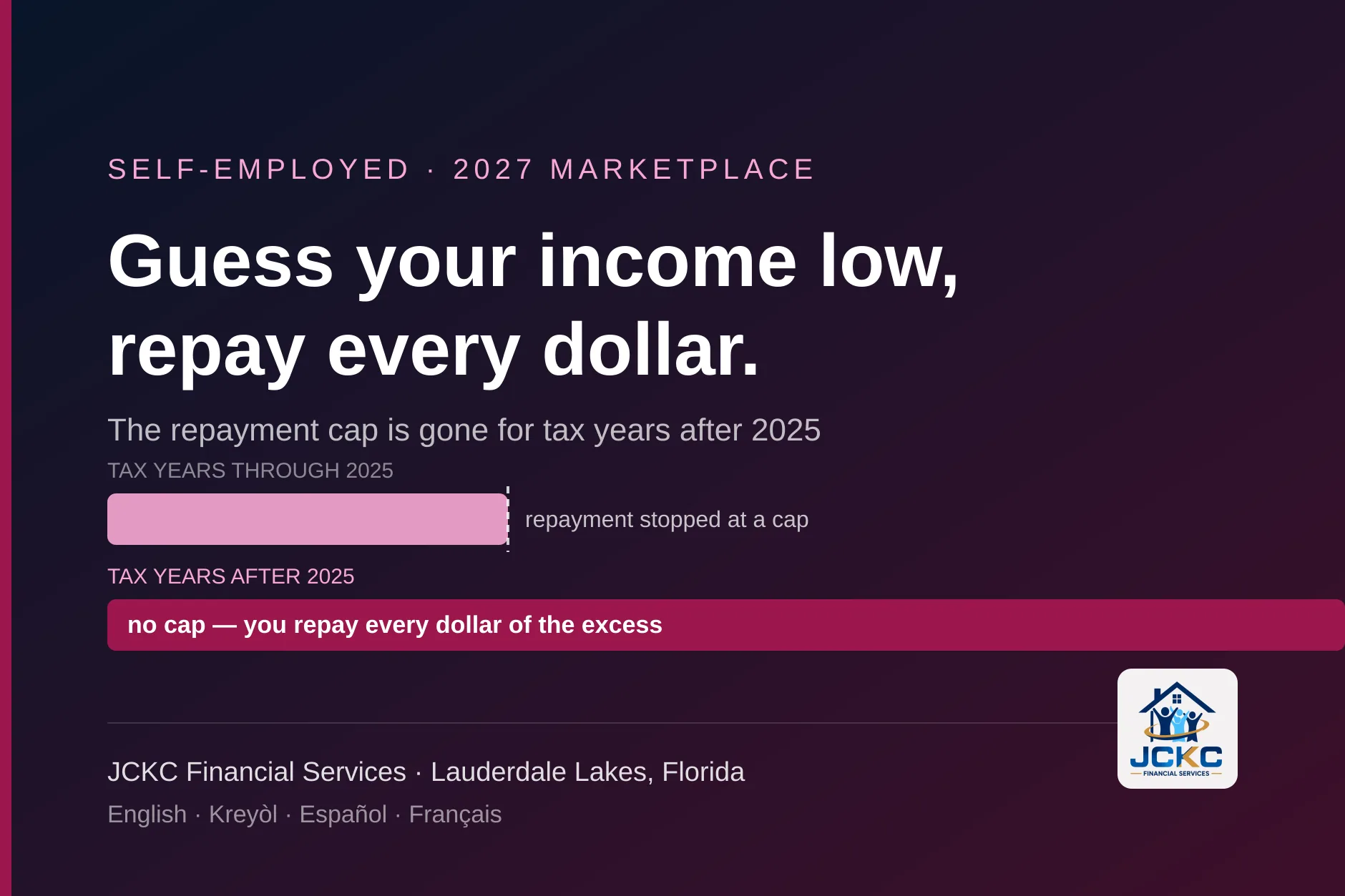
- Through tax year 2025, a repayment cap limited the amount a household under 400% of the federal poverty level had to pay back. Guessing low had a known, bounded downside.
- For tax years after 2025, the IRS states there is no repayment cap. You repay the full amount by which the advance payments exceeded the credit you actually qualified for.
The removal applies to tax years beginning after December 31, 2025. A Marketplace plan bought now for 2027 is reconciled on a 2027 return, so it is squarely inside the new rule. Nothing about this changes who qualifies or how the credit is calculated — it changes only what happens when the estimate turns out to be wrong in one particular direction. If buying your own coverage is new to you, start with how self-employed people get health insurance in Florida and come back to the estimate.2
2. Which income number they actually want
Before the estimate, get the definition right, because a good estimate of the wrong number is still wrong. HealthCare.gov asks a self-employed person for estimated net income for the year you are getting coverage — profit, not revenue:1
- It is income minus business expenses, the figure you would report on Schedule C.
- It is for the coverage year, not last year. Last year’s return is evidence, not the answer.
- It is not what you paid yourself. For a sole proprietor the draw is irrelevant; the net profit is the number whether it stayed in the business or not.
- If expenses exceed income you report a net loss, rather than nothing.
- Household income also includes everything else on the return — a spouse’s wages, interest, and so on — not only the business.
Revenue is the commonest wrong answer
People read "income" and enter what came in. On a business with real costs that can be double the right figure, and it quietly cancels a credit the household was entitled to. If you are about to type a number, check it is the profit line, not the top line.
3. How to estimate a figure you cannot know
HealthCare.gov’s own instruction is to do your best, using past experience, realistic expectations and industry standards. That is fair but thin, so here is the method we actually use across a desk:3
- Start from last year’s Schedule C net profit. It is the most defensible anchor you have, and it is already calculated.
- Adjust for what you already know. A contract that ended, a client you have signed, a van you are about to buy, a price rise you have already made. Known facts only, not hopes.
- Average the last two or three years if the work is seasonal or lumpy, rather than taking the best year or the worst.
- Write down the assumptions next to the number. Three lines is enough. It is what lets you revisit the estimate in March instead of starting again.
What this produces is not a prediction. It is a defensible figure with a documented basis, which is a different and more achievable thing. The goal is not to be right in advance — nobody is — it is to be close enough that the correction is manageable, and to know when it stops being close.4
4. Why to lean high, not low
Here is the part that changed. With no repayment cap, the two ways of being wrong are no longer symmetrical in their consequences:5
- Estimate low: a larger discount every month, then a bill at tax time for the entire excess. No ceiling on it any more.
- Estimate high: a smaller discount every month, and the rest of the credit arrives as part of your refund when you file.
Both land in the same place arithmetically. They do not land in the same place in a household’s cash flow. One produces an unexpected liability in April, the month a self-employed household is often already settling a tax bill; the other produces a refund. For a household with variable income, leaning slightly high is now the conservative choice — which is the reverse of the instinct most people bring to the form.5
This is a change of answer, not of emphasis
If you were advised in a previous year that a low estimate was a reasonable risk because the repayment was capped, that advice was right then and is wrong now. Anyone still giving it has not read the 2026 revision.
5. The habit that solves the whole problem
The estimate is not a one-off declaration, and treating it as one is what turns a small error into a large one. You can update the income on your Marketplace application whenever it changes, and HealthCare.gov tells you to do exactly that, as soon as possible, when your income turns out higher or lower than you estimated.6
Doing it matters more than getting the original number perfect. An update in March spreads the correction over nine remaining months of adjusted premiums; the same error found in April of the following year arrives as a single figure on a return. Put a recurring note in the calendar — quarterly, alongside the estimated tax payment you are already making — and the reconciliation problem mostly stops existing.6
Open Enrollment runs November 1 to January 15
Not sure what number to put on the form? Bring the Schedule C and we will work it out properly.
6. What guessing wrong now costs
What the change means in practice, as a shape rather than as dollars — the exact figures depend on your household size, age and plan:
| Situation | Through tax year 2025 | Tax years after 2025 |
|---|---|---|
| You estimated accurately | Nothing to settle | Nothing to settle |
| You earned a little more than you said | Repay the difference, up to the cap | Repay the difference in full |
| You earned a lot more than you said | Repayment stopped at the cap | No stop — the whole excess is due |
| You earned less than you said | The rest of the credit comes back at filing | The rest of the credit comes back at filing |
| You updated the application mid-year | Correction spread over remaining months | Correction spread over remaining months |
Only two rows changed, and they are both on the same side. That is the entire argument for leaning high and updating often: it moves you into the rows that did not change.35
7. The deduction that changes the subsidy
There is a second wrinkle that belongs to self-employed households specifically, and it is genuinely circular. The self-employed health insurance deduction lowers the income your premium tax credit is calculated on. But the credit changes the deduction. Each depends on the other, and you cannot settle one without the other.7
This is not something to attempt from an article. The IRS deals with it in Publication 974, in a section called "Self-Employed Health Insurance Deduction and PTC", and offers two routes: the Iterative Calculation Method and the Simplified Calculation Method. If you claim the deduction and take a premium tax credit in the same year, that calculation belongs with whoever prepares the return — and it is worth saying so when you hand over the paperwork, because it is easy to miss. The deduction itself — who can claim it, and against what — is covered separately: can I deduct health insurance premiums if I am self-employed.
8. The bottom of the range matters too
Most of this article is about not estimating too low for the reconciliation. There is a separate reason not to estimate too low, and in Florida it bites harder than almost anywhere. Premium tax credits generally begin at 100% of the federal poverty level, and Florida has not expanded Medicaid.1
So a household that estimates below that floor can end up with neither the credit nor Medicaid. If your realistic figure is near the bottom of the range, that is a reason to be accurate rather than cautious, and a reason to get a second pair of eyes on it. The current dollar figures by household size are on our answers page: what is the income limit for ACA subsidies in Florida.7
9. What to keep
Keep three things, and keep them where you will find them in April rather than where you filed them in November. The first is whatever you built the estimate from: the prior Schedule C, signed contracts, a dated note of your assumptions. That note is what makes an estimate defensible rather than a guess.8
The second is Form 1095-A, which arrives early in the new year and is what the reconciliation is calculated from — check it against your own records rather than assuming it is right. The third is a dated record of every mid-year update you made to the application, because that is the evidence that you did the thing the rules ask for.8
10. What goes wrong
Four, and they are all avoidable:1
- Entering revenue instead of net profit. The commonest error on the form and the one that silently costs the most.
- Using last year’s income because it is the number you have. The application asks about the coverage year. Last year is the starting point, not the answer.
- Estimating low on purpose, the way it was once reasonable to. The cap that made that a bounded risk is gone for tax years after 2025.
- Never updating after a good quarter. The update is free, takes ten minutes, and is the difference between a spread correction and a lump sum.
11. What to do before December 15
Open Enrollment runs to January 15, but December 15 is the date that decides whether coverage starts on January 1. Work backwards from it:9
- Pull last year’s Schedule C and find the net profit line. That is your anchor.
- Adjust it for what you already know about next year, and write the assumptions down beside it.
- Lean slightly high rather than slightly low, and understand you are choosing a refund over a liability, not paying more overall.
- Enroll by December 15 for coverage starting January 1, or by January 15 for February 1.
- Diarize a quarterly income check against the estimate, and update the application whenever the answer has moved. If you already diarize estimated tax payments, attach it to those.
12. Frequently asked questions
Is there still a cap on repaying the premium tax credit?
No. The IRS states it plainly: there is no repayment cap for tax years after 2025. Through tax year 2025 a cap limited how much excess advance credit a household under 400% of the federal poverty level had to repay. That limit was removed for tax years beginning after December 31, 2025. A 2027 Marketplace plan is reconciled on your 2027 return, so the change applies to it in full: if the advance payments exceed the credit you actually qualified for, you repay the whole difference.
What income figure does the Marketplace want from a self-employed person?
Your estimated net income for the year you are getting coverage, not last year’s. HealthCare.gov asks for net self-employment income — profit, the figure you would report on Schedule C, which is income minus business expenses. It is explicitly the coming year, not the last one, which is what makes it hard and what makes a careful estimate worth the time.
Should I estimate high or low?
Lean high, now that the cap is gone. Estimating low gets you a bigger monthly discount during the year and a bill at tax time for every dollar of the difference. Estimating high gets you a smaller monthly discount and the rest of the credit back as a refund when you file. Both end in the same place if your guess was wrong; only one of them can wreck a cash-flow month in April. This is a genuine change in the right answer, not a style preference.
What if my income changes during the year?
Report it. HealthCare.gov tells you to update your application as soon as possible when income turns out higher or lower than estimated, and that is the real protection against a reconciliation shock. The credit is recalculated from that point, which spreads the correction across the remaining months instead of landing it all on the return. A good quarter in March is worth a ten-minute update.
Does the self-employed health insurance deduction change my subsidy?
They affect each other, which is why this one goes to a preparer. The deduction lowers the income your premium tax credit is calculated on, and the credit changes the deduction — a genuine circle. The IRS addresses it in Publication 974 under "Self-Employed Health Insurance Deduction and PTC", and gives two ways through it: the Iterative Calculation Method and the Simplified Calculation Method. Neither is something to attempt from a blog post.
What counts as income if I take money out of the business?
For a sole proprietor the draw is not the number — the net profit is, whether or not you took it out. That surprises people who think of their income as what they transferred to the personal account. The Marketplace is asking what the business earned after expenses, which is the Schedule C figure, not what you paid yourself.
What if I overestimate and earn less than I said?
You get money back. The credit is reconciled on the return either way: if your advance payments were smaller than the credit you qualified for, the difference comes back as part of your refund. That is the direction you want to be wrong in now, and it is the whole argument for leaning high.
Can I still get a subsidy if my income is very low?
In Florida this is the awkward one. Premium tax credits generally start at 100% of the federal poverty level, and Florida has not expanded Medicaid, so a household below that line often gets neither. If your estimate is near the bottom of the range, it is worth being careful and realistic rather than conservative: estimating too low can put you under the floor and out of the credit entirely. The current dollar figures are on our answers page.
When do I have to do this by?
Open Enrollment for 2027 coverage runs November 1, 2026 to January 15, 2027, and December 15, 2026 is the last day to enroll for coverage starting January 1. If you enroll between December 16 and January 15, coverage starts February 1 instead. Self-employed households tend to leave it late because the income question is unpleasant; the question does not get easier in January.
What records should I keep?
Keep whatever you used to build the estimate — the prior Schedule C, invoices or contracts in hand, a note of the assumptions. Keep Form 1095-A when it arrives in the new year, because it is what the reconciliation is calculated from. And keep a dated note of any mid-year update you make to the application. If the number is ever questioned, the difference between a defensible estimate and a guess is the paper behind it.
13. Sources
- Internal Revenue Service, Questions and Answers on the Premium Tax Credit, Q31 and Q1 — "There is no repayment cap for tax years after 2025", and the removal of the limitations for tax years beginning after December 31, 2025. Read October 26, 2026.
- Internal Revenue Service, Publication 974, Premium Tax Credit, the section "Self-Employed Health Insurance Deduction and PTC" — the Iterative Calculation Method and the Simplified Calculation Method. Read October 26, 2026.
- HealthCare.gov, How to report self-employment income — estimated net income for the coverage year, profit rather than revenue, the Schedule C figure, and the instruction to update the application when income turns out different. Read October 26, 2026.
- HealthCare.gov, What to include as income — what counts in household income beyond the business. Read October 26, 2026.
- HealthCare.gov, Why report income and life changes. Read October 26, 2026.
- HealthCare.gov, How to report income and life changes. Read October 26, 2026.
- HealthCare.gov, Dates and deadlines for 2027 health insurance — November 1 to January 15, and December 15 for coverage starting January 1. Read October 26, 2026.
- Internal Revenue Service, About Form 7206, Self-Employed Health Insurance Deduction. Read October 26, 2026.
- Marketplace Call Center, 1-800-318-2596, TTY 1-855-889-4325, open 24 hours a day.
For general information only. This article explains federal rules as published by the IRS and HealthCare.gov; it is not tax, legal or accounting advice, and it is not a determination of your eligibility. Only the Marketplace can decide your eligibility for a premium tax credit, and the interaction between the self-employed health insurance deduction and the credit belongs with whoever prepares your return. Premium tax credits depend on your income, household size, location and plan year. Enroll and confirm eligibility at HealthCare.gov. JCKC Financial Services is an independent insurance brokerage and tax practice.