

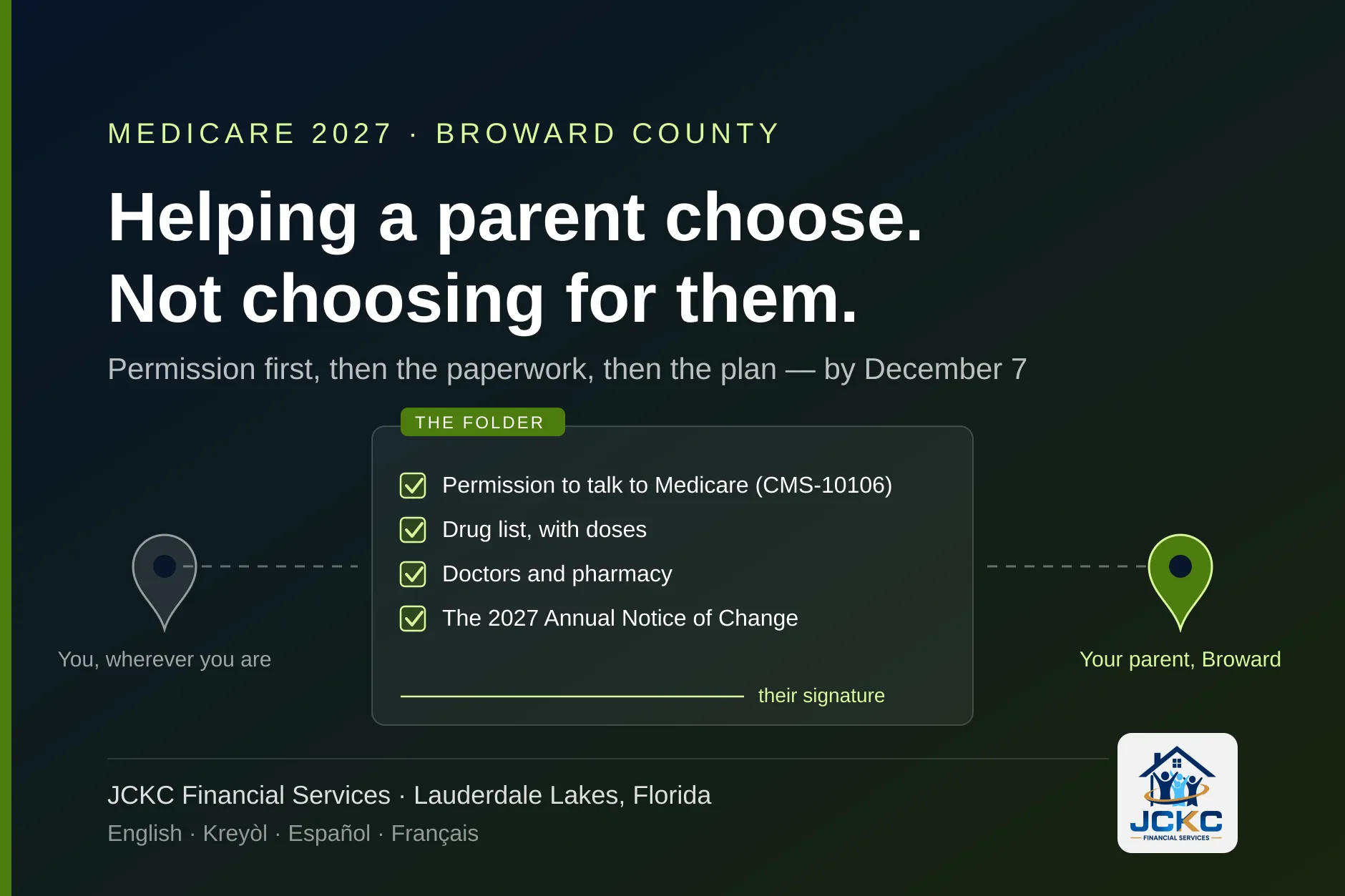
1. It is still your parent’s decision
Annual Enrollment for 2027 runs from October 15 to December 7, 2026. During it your parent can join, switch or drop a Medicare Advantage plan or a drug plan, or move between Original Medicare and Medicare Advantage, and the new coverage starts on January 1. Medicare.gov is precise about the last day: the plan must receive the request to join by December 7. A form posted on the 6th from Fort Lauderdale to a plan address in another state is a risk you do not need to take.1
The thing to settle before any of the paperwork is whose decision this is. It is your parent’s. You can gather the documents, sit in on the appointment, ask the hard questions and keep the copies, and all of that makes the decision better. What you cannot do, unless Florida law has given you the authority, is make the choice for them. Families who understand that from the start have an easier autumn: your parent stays in charge of their own coverage, and you stop being the person who “changed Mom’s plan” when something goes wrong in March.
2. Four permissions that people confuse
Four different documents get called “permission” in the same conversation, and they do four different things. Most of the frustration caregivers describe on the phone comes from having one of them and needing another:
| The document | What it lets you do | What it does not do |
|---|---|---|
| CMS-10106, Medicare’s authorization to disclose personal health information | Lets Medicare discuss your parent’s claims and health records with you | Does not let you make decisions, choose a plan or sign for your parent |
| CMS-1696, Appointment of Representative | Lets you act for your parent in a Medicare appeal or complaint | Is not a general permission for enrollment or for calls about the plan |
| Florida durable power of attorney (chapter 709) | Lets you act for your parent in the matters the document grants, and keeps working if your parent loses capacity, if it says so | Is not automatically on Medicare’s records; whether it covers health care or a health plan depends on its wording |
| Florida health care surrogate (chapter 765) | Lets you receive your parent’s health information and make health care decisions, as the document states | Is a health care document, not a financial one; it does not replace the Medicare form |
Each plan also has its own process for authorizing someone to discuss an account, which is worth asking for when you call the member services number on the back of your parent’s card. And the appeal form deserves a note of its own: Medicare.gov describes the Appointment of Representative as the way a trusted family member helps with an appeal or complaint, and CMS revised it on October 1, 2026. You will not need it to choose a plan. You may need it in April if a claim is denied.4
3. The Medicare form: CMS-10106
The form you want first is the Authorization to Disclose Personal Health Information, number CMS-10106. Medicare.gov lists it among its “other forms” and describes its purpose in one line: giving Medicare permission to talk to someone you choose about your claims and health records, if you cannot. That is the whole job. It is the reason a question to Medicare about your father’s drug claim gets an answer instead of a polite refusal.2
What CMS publishes about the current version, checked on October 30, 2026:3
- The current revision is dated March 1, 2026.
- It carries OMB control number 0938-0930, approved through March 31, 2029.
- It is published in English and Spanish, as a PDF and as an online version.
- CMS says it can be filled out and submitted online, through the Medicare Online Forms link on the form’s page.
- It is your parent who completes and signs it, naming you. It is their permission, not your application.
Do it before you need it
The best time to file this form is a quiet week, not the day a claim is denied. Your parent is well, you are both at the table, and there is no deadline running. If an older copy is in a drawer, check the date in its corner: CMS revised the form in March 2026, and the current version is the one to use.
4. Power of attorney is a different document
A Florida power of attorney is a different kind of document altogether. It is a legal instrument under chapter 709 of the Florida Statutes, and the statute is strict about how it is made: it must be signed by your parent and by two subscribing witnesses, and acknowledged by your parent before a notary public. It survives your parent losing capacity only if it is durable, which means it contains the statutory words, or similar words, saying the authority continues despite later incapacity. A power of attorney without that language stops working at exactly the moment families most need it.5
Health care decisions have their own document in Florida: the designation of a health care surrogate, under chapter 765. It is signed in front of two adult witnesses, the person named as surrogate cannot be one of them, and at least one witness must be neither a spouse nor a blood relative. One provision matters a great deal for caregivers: the document can say that the surrogate’s authority to receive health information starts immediately, without waiting for a doctor to find your parent incapacitated.6
So which one lets you choose a Medicare plan for a parent who can no longer choose? That depends on what the documents say, and that is a question for the attorney who drafted them, not for a Medicare broker. What we can tell you is the practical part: when your parent cannot make the decision, the authority to make it comes from these Florida documents or from a court-appointed guardianship, never from the Medicare form, and you should expect to be asked for a copy.
A notary is not a lawyer
A Florida power of attorney needs a notary’s acknowledgment, and a notary can witness your parent’s signature. A notary in Florida cannot draft the document or tell you what it should say. That is the work of an attorney. In Spanish especially, where a “notario” in much of Latin America is a lawyer, it is worth saying plainly.
5. What to gather before December 7
Your parent’s plan mailed its Annual Notice of Change in September. Medicare.gov says the plan sends it each fall and that it lists the changes in coverage and costs that take effect in January, and it adds one instruction: if the notice did not arrive, contact the plan. That letter is the starting point. We wrote a separate guide to reading the 2027 notice; here is everything else to put in the same folder:7
- The Medicare card and the current plan card. The Medicare number and the dates Part A and Part B started are on the first.
- The 2027 Annual Notice of Change, and the Evidence of Coverage if it came with it.
- Every prescription, with the exact name, the dose and how often it is taken. The bottles are better than memory. Include inhalers, injections and eye drops, which people leave off.
- Every doctor, including the specialists your parent sees twice a year and forgets to mention, and the hospital they would want to go to.
- The pharmacy your parent actually uses, and whether they would use mail order.
- Any letter about Medicaid, Extra Help or a Medicare Savings Program. These change which plans and which enrollment windows are open to your parent.
- What went wrong this year: a referral that took weeks, a drug that needed prior approval, a bill that surprised you. That list is what the next plan has to fix.
The drug list does more work than anything else on that list, and the doctors come second. Our guide to checking doctors and drugs explains why a plan that looks cheaper on premium can cost more over a year. Bring copies, keep the originals at home, and keep your own copy of everything your parent signs.
Free, no obligation
Bring the folder and your parent. We will go through it with both of you, in your language.
6. Where the plan data comes from
Every year CMS publishes the official plan data for each county: which Medicare Advantage and drug plans are offered, with their premiums, star ratings and benefits. It is the data we work from, and our Broward County page counts the 2027 plans in Broward from those CMS files. For information on all of your options, the notice at the bottom of this page names Medicare.gov.
For a caregiver, its most useful lesson is about the drug list. Medicare.gov’s own advice is to add all the prescription drugs taken regularly to get the most accurate monthly and yearly cost estimate, to ask the doctors and pharmacies whether they are in the plan’s network, and, if your parent lives in another state for part of the year, to check whether the plan covers them there. A comparison built on half a drug list is worse than none, because it looks finished. When you sit down with us, we run that comparison against the plans from the carriers we represent, using your parent’s full list, and show you the yearly figure rather than the monthly premium.1
7. Helping from another city
A great many of the caregivers we speak to do not live in Broward. They are in Atlanta or Brooklyn, in Orlando, or in Port-au-Prince, and the parent is in Lauderdale Lakes, Lauderhill or Pembroke Pines. That works, with a little structure:
- One call, three people. Your parent, you and us on the same line. Your parent hears every question and every answer, and you do not have to relay anything secondhand.
- Agree the topics first. Before a sales appointment, federal rules require the topics to be agreed with your parent and recorded, and in writing if the meeting is in person. We do that with your parent before the appointment, not during it.
- A shared folder. Photos of the cards, the notice and the pill bottles, sent before the call, save an hour on it.
- One person holds the copies. Decide who keeps the confirmation and the new plan’s welcome letter. In January that is the person who will need them.
- Dates in two calendars. December 7 for the decision, January 1 for the new card, and March 31 for the last change if your parent is in a Medicare Advantage plan.
The topic agreement is called a Scope of Appointment, and the regulation says it stays valid for 12 months from your parent’s signature or first request. It is also the rule that protects your parent from the agent who books a meeting about a drug plan and arrives selling something else: anything outside the agreed scope needs a new one.8
8. The red flags, and the rule behind them
Every autumn the calls start. They promise a bigger allowance card, more dental, a “new benefit for your area”, and they are aimed at older people who live alone. The rule that makes most of them illegitimate is short, and it is worth knowing because it names you. The federal regulation on beneficiary contact defines it as outreach “to a beneficiary or a beneficiary’s caregivers” by a Medicare Advantage plan or its agents and brokers. Unless your parent asked first, they may not:8
- Call your parent cold, or call because someone gave them a referral.
- Leave robocalls, text messages or voicemails.
- Send direct messages through social media.
- Knock on the door, or approach your parent in a parking lot, hallway or lobby.
Medicare.gov adds three plain lines that are worth taping next to the phone: Medicare will never call to sell you anything or visit you at home; do not give the Medicare number to anyone except your doctors and people you know should have it; and do not join a plan over the phone unless you called and asked for help. If something looks like fraud, Medicare says to report it to 1-800-MEDICARE. We wrote a longer piece on why the phone does not stop ringing and how to check who called. And because we are a Medicare broker ourselves, the same rules bind us: we do not call people who have not asked us to.9
9. Extra Help and Medicaid: check before you compare
Before anyone compares plans, check whether your parent qualifies for help with costs, because it changes the comparison. Extra Help is the Medicare program that lowers Part D premiums, deductibles and copays for people with limited income and resources. Your parent gets it automatically with full Medicaid, with a Medicare Savings Program paying the Part B premium, or with Supplemental Security Income. Otherwise they apply, and the 2026 limits Medicare.gov publishes are these:10
| Income limit, 2026 | Resource limit, 2026 | |
|---|---|---|
| Individual | $23,940 | $18,090 |
| Married couple | $32,460 | $36,100 |
Medicare.gov also lists what a person with Extra Help pays in 2027: a $0 plan premium and $0 deductible, up to $5.80 for each generic and $14.40 for each brand-name drug at a participating pharmacy, and $0 once total drug costs reach $2,400. And one detail matters for the calendar: with Medicaid or Extra Help, your parent may be able to change drug coverage once a month, not only in the autumn. Our guide to Extra Help and the savings programs covers who qualifies, and our piece on Medicare and Medicaid plans for 2027 covers parents who have both.10
The 2027 limits are not out yet
On October 30, 2026, Medicare.gov was still showing the 2026 income and resource limits, and it notes that the limits may go up each year. The new year’s figures normally appear early in that year. We will not print a 2027 limit until Medicare does. Even below the limits, “resources” has its own definition, so bring the bank statements rather than a guess.
10. The Broward fact that changes the answer
The Broward fact is simple, and it is the one families from out of state most often miss: Medicare Advantage plans are sold by service area, and to join one your parent must live in it. The plan you have where you live tells you nothing about the plans in your parent’s ZIP code in Broward, and a plan your cousin recommends in Orlando may not be offered here at all. If your parent moves in with you, the move itself opens a Special Enrollment Period to choose a plan where they now live. If your parent spends part of the year with you up north, check before you enroll whether the plan covers them there.1
The second Broward fact is language. A good share of the parents in this county read their letters more comfortably in Kreyòl, Spanish or French than in English, and the Annual Notice of Change arrives in English unless someone asks. Our office is in Lauderdale Lakes, and we go through the letters in the language your parent prefers. The Broward County page covers the rest of what we do here.
11. Done, still to do, and by when
Organised the way we would organise it for our own family, in three parts:
- Done: the Annual Notice of Change has arrived (it was due in September). If it has not, your parent calls the plan this week.
- Still to do, this week: your parent files the CMS-10106 naming you, online or on paper, so Medicare can talk to you if a claim goes wrong in January.
- Still to do, this week: build the folder: cards, the notice, the full drug list with doses, the doctors and specialists, the pharmacy, any Medicaid or Extra Help letter.
- Still to do, before you compare: check Extra Help and Medicaid. If your parent qualifies, the right plans and the right windows are different.
- Still to do, by mid-November: the appointment, with your parent present, in person or on one call from two cities.
- By December 7, 2026: if your parent decides to change, the plan must receive the request by then. Keep a copy of the confirmation.
- Separately, with an attorney: if your parent has no durable power of attorney or health care surrogate, or the ones in the drawer predate a move to Florida, that is a conversation to have while it is still your parent’s choice to make.
12. Frequently asked questions
Can Medicare discuss my mother’s plan with me?
Not until she gives Medicare permission to talk to you. That permission is the Authorization to Disclose Personal Health Information, form CMS-10106. Medicare describes it as giving Medicare permission to talk to someone you choose about your claims and health records. The current version is dated March 2026, and CMS says it can be filled out and submitted online. It lets Medicare share information with you; it does not let you make decisions for her. We can sit down with both of you to fill it in.
I already have power of attorney. Do I still need the Medicare form?
In practice, plan on it. A Florida power of attorney is a legal document about what you may do for your parent; the CMS-10106 is Medicare’s own record of who it may talk to. They do different jobs, and having the Medicare form on file avoids a call where the representative cannot discuss anything with you. Whether your particular power of attorney covers health care or the choice of a health plan depends on its wording, which is a question for the attorney who drafted it.
Can I enroll my father in a plan myself?
Only if he has made the decision, or if you have legal authority to make it for him. The choice is his. When he can make it, he makes it with you beside him, and he or you on his instructions completes the enrollment. When he can no longer make it, the authority comes from Florida law, through a durable power of attorney, a health care surrogate designation or a guardianship, and you should expect to be asked for a copy.
What is the deadline for changing plans for 2027?
December 7, 2026. Open Enrollment runs October 15 to December 7, and Medicare.gov says the plan must get the request to join by December 7 for coverage starting January 1. If your parent is already in a Medicare Advantage plan, there is a second window from January 1 to March 31 to switch to another Medicare Advantage plan or return to Original Medicare.
What should I bring to the appointment?
The red, white and blue Medicare card, the current plan card, the 2027 Annual Notice of Change the plan mailed in September, a list of every prescription with the dose and how often it is taken, the names of every doctor and specialist, the pharmacy your parent uses, and any letter about Medicaid or Extra Help. The drug list matters most, because it is what changes the yearly cost from one plan to the next.
My parent keeps getting calls about new benefits. Is that legitimate?
Almost certainly not. Federal marketing rules forbid Medicare Advantage plans and their agents from cold calling, robocalls, texts, voicemails and social media messages that your parent did not ask for, and the rule expressly covers outreach to caregivers too. Medicare.gov adds that Medicare will never call to sell anything or visit your home, and says not to join a plan over the phone unless you called and asked for help.
Does my parent qualify for help with drug costs?
Possibly, and it is worth checking every year. Extra Help lowers Part D costs for people with limited income and resources, and anyone with full Medicaid, a Medicare Savings Program or SSI gets it automatically. For 2026 the limits were $23,940 in income and $18,090 in resources for one person. The 2027 limits had not been posted on Medicare.gov when we wrote this.
I live in another state. Can you still help my parent?
Yes. We meet your parent in Lauderdale Lakes or by phone, and you can join the same call from wherever you live. The rules require the topics of a sales appointment to be agreed and recorded beforehand, and in writing when the meeting is in person, so we set that up with your parent first. Nothing is signed without your parent understanding it, in English, Kreyòl, French or Spanish.
13. Sources
- Medicare.gov, Joining a plan — Open Enrollment October 15 to December 7 with the plan receiving the request by December 7, coverage from January 1, the Medicare Advantage Open Enrollment Period January 1 to March 31, Special Enrollment Periods for moving, Medicaid and Extra Help, the service-area requirement, and the advice to check drugs, doctors, pharmacies and part-year residence. Read October 30, 2026.
- Medicare.gov, Other Forms — Authorization to Disclose Personal Health Information (CMS-10106), used for giving Medicare permission to talk to someone you choose about your claims and health records. Read October 30, 2026.
- Centers for Medicare & Medicaid Services, CMS forms list: CMS 10106 — title, revision date March 1, 2026, OMB number 0938-0930 and expiration March 31, 2029, English and Spanish versions, and online submission. Read October 30, 2026.
- Centers for Medicare & Medicaid Services, CMS forms list: CMS 1696, Appointment of Representative — revision date October 1, 2026, OMB number 0938-0950. Read October 30, 2026.
- The 2026 Florida Statutes, section 709.2105 (execution of a power of attorney: two subscribing witnesses and a notary’s acknowledgment) and section 709.2104 (when a power of attorney is durable). Read October 30, 2026.
- The 2026 Florida Statutes, section 765.202 — designation of a health care surrogate: two adult witnesses, the surrogate not a witness, one witness neither spouse nor blood relative, and authority to receive health information that may start immediately. Read October 30, 2026.
- Medicare.gov, Plan Annual Notice of Change (ANOC) — sent by the plan each fall, expected in September, lists changes effective in January; contact the plan if it does not arrive. Read October 30, 2026.
- Code of Federal Regulations, 42 CFR § 422.2264, Beneficiary contact — outreach to beneficiaries and their caregivers, the prohibited forms of unsolicited contact, and the Scope of Appointment, valid for 12 months. eCFR current as of October 28, 2026; read October 30, 2026.
- Medicare.gov, Reporting Medicare fraud & abuse — Medicare will never call to sell anything or visit you at home; do not join a plan over the phone unless you called; report suspected fraud to 1-800-MEDICARE. Read October 30, 2026.
- Medicare.gov, Help with drug costs — Extra Help income and resource limits for 2026, automatic eligibility, what a person with Extra Help pays in 2027, and changing drug coverage once per month. Read October 30, 2026.
For general information only. This article explains Medicare rules and forms as published by the Centers for Medicare & Medicaid Services and Medicare.gov, and Florida statutes as published by the Florida Legislature. It is not legal advice: whether a power of attorney or health care surrogate document gives you a particular authority depends on its wording, and only an attorney can advise on that. Plan availability, costs and networks depend on your parent’s ZIP code and the plan year. JCKC Financial Services is an independent insurance brokerage and tax practice.