

1. Two kinds of care, and only one is Medicare’s
The same building can provide two very different kinds of care, and Medicare treats them in opposite ways. Medicare.gov states it in one line: “Medicare doesn’t pay for long-term care.” Long-term care, which Medicare also calls custodial care, is help with the basic tasks of daily life for someone with a chronic illness or disability. It is a different thing from skilled nursing facility care, and the difference is the whole story:1
- Skilled care is nursing and therapy that can only be done safely by, or under the supervision of, licensed professionals: intravenous medication, wound care, physical, occupational or speech therapy after a stroke or a hip replacement. Part A covers it in a skilled nursing facility, for a limited time, when the conditions below are met.
- Custodial care is help with dressing, bathing, eating, using the bathroom and moving around. It is what most people mean by “going into a nursing home”, and Medicare pays for none of it, whether it happens in a nursing home, an assisted living facility or your own living room.
Medicare.gov adds that most health insurance does not pay for long-term care either, and names Medicare Supplement Insurance (Medigap) among the policies that do not. It points to two places the money can come from instead: Medicaid, if you meet your state’s eligibility rules, or private long-term care insurance. The rest of this article is about those routes, and about getting every day out of the Medicare benefit that you are owed first. If you want the full picture of what Medicare charges for everything else, our guide to Medicare costs has the 2026 table.1
2. The skilled nursing benefit: five conditions
Medicare covers care in a skilled nursing facility, often called a SNF and often part of a nursing home, only when every one of these conditions is met:2
- You have Part A and have days left in your benefit period.
- You have a qualifying inpatient hospital stay: a medically necessary inpatient stay of at least 3 days in a row, counting the day you were admitted as an inpatient and not counting the day you leave.
- You enter the skilled nursing facility within a short time of leaving the hospital, generally 30 days.
- Your doctor has decided that you need daily skilled care, given by or under the supervision of skilled nursing or therapy staff.
- The facility is Medicare-certified, and the care is for a condition treated during the hospital stay or one that started while you were in the facility for it.
A benefit period is not a calendar year. It starts the day you are admitted as an inpatient and ends once you have gone 60 days in a row without inpatient hospital or skilled nursing care. A new hospital stay after that starts a new benefit period, with a new deductible and a new 100 days. That is why a second fall in the same year can be covered again, and why a readmission a few weeks after discharge usually is not a fresh start.2
3. What a stay costs in 2026
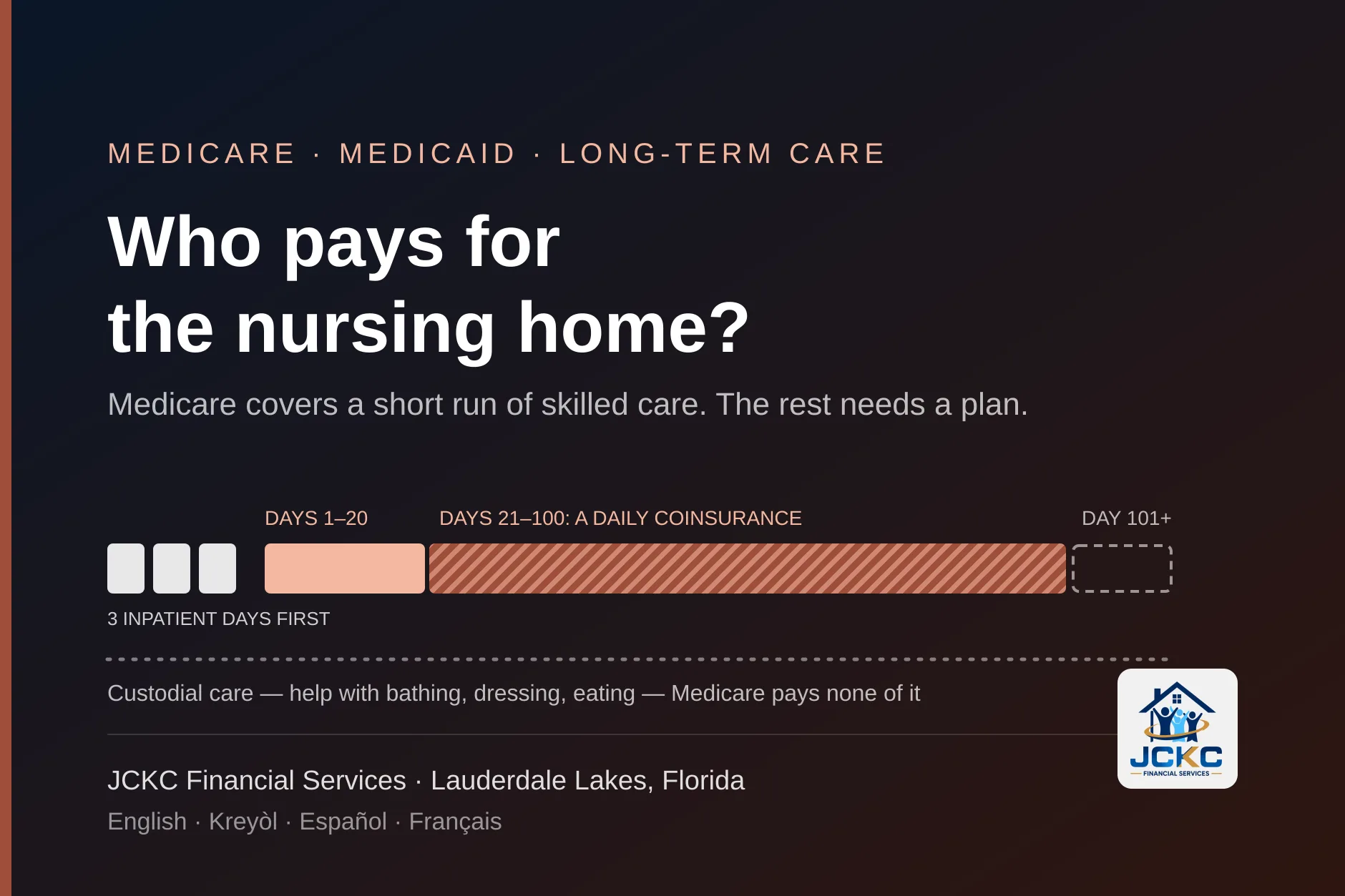
CMS published the 2026 Part A amounts on November 14, 2025. For skilled nursing, what you pay depends on which day of the benefit period you are on. The 2027 amounts had not been published when we wrote this on October 30, 2026; CMS normally announces them in mid-November, and we will update this table when it does.3
| Days in the facility | What you pay in 2026 | 2027 |
|---|---|---|
| Days 1–20 | $0 a day, after the $1,736 Part A deductible (not charged again if you already paid it for the hospital stay in the same benefit period) | Not yet published |
| Days 21–100 | $217 a day (it was $209.50 in 2025) | Not yet published |
| Day 101 and after | All costs | All costs |
Run the arithmetic on a full stay and the coinsurance alone is 80 days at $217, or $17,360 in 2026, before anything Medicare does not cover. Few stays run the full 100 days, for the reason in section 5, but the number is worth knowing when a facility asks how the family intends to pay from day 21.2
Where the day-21 money can come from
Help with Medicare’s cost-sharing exists for people with limited income and assets, and it is worth checking before day 21 rather than after. Read our piece on Extra Help and the Medicare Savings Programs and our answer to whether you can have Medicare and Medicaid at the same time.
4. The observation trap
This is the rule that catches the most families, and it is entirely about paperwork. You are an inpatient only from the moment a doctor writes an order formally admitting you. Before that, you are an outpatient — in the emergency room, in observation, even in a regular hospital bed overnight. Medicare.gov says an inpatient admission is generally appropriate when you are expected to need care over 2 or more midnights, but it is the order that counts, not the bed or the length of the stay.4
Observation days do not count toward the 3-day qualifying stay. So a parent who spends one night in the emergency room, two in observation and one as an inpatient has one qualifying day, not four, and the skilled nursing facility that follows is not covered. The hospital must give you a written Medicare Outpatient Observation Notice, called a MOON, once you have been in observation for more than 24 hours, explaining why you are an outpatient and how that may affect what you pay for care after you leave.4
Ask every day, and write the answer down
Medicare.gov’s own advice is that each day of the stay, you or your caregiver should ask the hospital, the doctor, a social worker or a patient advocate whether you are an inpatient or an outpatient. If the answer is observation and your parent will need rehabilitation afterwards, ask whether the doctor believes an inpatient admission is appropriate, and why not.
Two exceptions are worth knowing. Some doctors who belong to an Accountable Care Organization approved for the “Skilled Nursing Facility 3-Day Rule Waiver” can send a patient to a SNF without the 3 inpatient days, and Medicare Advantage plans may waive the rule too. And if your parent was admitted as an inpatient and the hospital later changed the status to observation, there is a specific appeal for that change, which can reach back to stays from January 2009. Our article on appealing a Medicare denial explains the fast appeals that apply when a hospital or facility is discharging someone too soon.2
5. 100 days is a ceiling, not a promise
Many families hear “Medicare covers 100 days” and plan around it. It covers up to 100 days per benefit period, and only while daily skilled care is still needed. When your parent no longer needs skilled nursing or therapy every day — because the wound has healed or therapy has done what it can — Medicare coverage of the facility ends, even on day 15. If you are told that covered care is ending and you disagree, you can ask for a fast appeal; our appeal article, linked above, explains how.2
The opposite mistake is just as common. A facility may tell a family that coverage is ending because the patient is “not improving”. That is not the test. Medicare.gov says skilled care is covered when you need it “to improve or maintain your current condition, or to prevent or delay it from getting worse”. Someone with a progressive illness who needs skilled therapy to hold on to what they can still do may still qualify. If you hear the word plateau, ask which skilled service has stopped being necessary, and ask for the answer in writing.2
6. If you have a Medicare Advantage plan
A Medicare Advantage plan must cover skilled nursing facility care, but it may do so on its own terms, so the 2026 table above is not necessarily what you will pay. Medicare.gov names two differences, and the plan’s Evidence of Coverage spells out the rest:2
- Copayments from day 1. A plan may charge copayments during the first 20 days, where Original Medicare charges $0 after the deductible. Look up the daily amounts and the days they apply to in your plan’s Evidence of Coverage.
- The 3-day rule may be waived. A plan may cover a SNF stay without a prior 3-day inpatient stay. Ask the plan before discharge, not after.
- Approval and the network. Plans commonly require the facility to be in network and the stay to be approved in advance. A family that chooses a facility from a list the hospital hands them should check it against the plan first.
- The out-of-pocket maximum. Covered in-network skilled nursing costs count toward the plan’s yearly limit on in-network spending, which Original Medicare does not have.
A parent in the hospital right now?
Bring the discharge papers and the plan card. We will check how the plan covers skilled nursing, in your language.
7. Florida Medicaid long-term care
For most Florida families, the program that pays for long-term custodial care is Medicaid, through the Statewide Medicaid Managed Care Long-Term Care program (SMMC LTC). The Agency for Health Care Administration runs Florida Medicaid, the Department of Children and Families decides who is eligible, and the Department of Elder Affairs handles the medical assessment. Each long-term care plan must cover, among other services:5
- Nursing facility care.
- Assisted living facility services, adult day care and respite care for family caregivers.
- Personal care, homemaker and attendant care, and home-delivered meals.
- Home accessibility changes, medical equipment and supplies, therapies and transportation.
- Hospice and case management.
To qualify you must be 65 or older and eligible for Medicaid, or 18 or older and eligible because of a disability, and the CARES unit of the Department of Elder Affairs must assess you as needing nursing home level of care. You apply for the Medicaid side through the ACCESS Florida application, and DCF’s instructions are specific: if long-term care in a nursing home or at home is needed, check the box for “HCBS/Waivers or Nursing Home” on the benefit screen. For services at home or in assisted living, Elder Affairs says to contact your local Aging and Disability Resource Center about the waitlist. Applying early, and keeping copies of everything you send, matters.6
8. The money rules: limits, the look-back, the estate
Medicaid is for people with limited income and assets, and the limits are lower than most families expect. DCF prints the 2026 limits for the home and community-based (HCBS) waiver, which is how SMMC LTC delivers care outside a nursing home:6
| 2026 (DCF) | Monthly income limit | Asset limit |
|---|---|---|
| Individual | $2,982 | $2,000 |
| Couple | $5,964 | $3,000 |
DCF says these standards change each year with the Supplemental Security Income benefit rate, which was $994 for an individual in 2026; it had not posted 2027 figures when we checked on October 30, 2026. Two details on the same page change the answer for many families. Retirement accounts recognized by the IRS are an excluded asset. And someone whose income is above the limit is not automatically shut out: a Qualified Income Trust lets them qualify by depositing the income over the limit into the trust each month. Separate rules protect the income and assets of a spouse who stays at home. Nursing home Medicaid is assessed under DCF’s SSI-related financial standards, which we do not reproduce here.6
Two federal rules apply on top of the state limits. First, the look-back: when someone applies for nursing facility or home and community-based care, Medicaid looks back 60 months at assets given away or sold for less than they were worth, and a transfer inside that window can cause a period of ineligibility. Second, estate recovery: for someone who was 55 or older when they received nursing facility or home and community-based services, the state must seek repayment from their estate, though only after a surviving spouse has died and never while a child under 21, or a blind or disabled child, survives.7
This is where an elder law attorney earns the fee
Do not give away the house, retitle accounts or set up a trust because a relative or a video said to. The look-back and estate rules turn on dates and documents, and a mistake can cost months of coverage. A Florida elder law attorney can tell you what applies to your family. We can help with the parts that are ours: the Medicare plan, the life insurance and the tax return that DCF may ask to see.
9. Long-term care insurance and life insurance riders
Long-term care insurance is designed for exactly the care Medicare leaves out: personal and custodial care at home, in the community or in a facility. A policy pays a daily amount up to a limit you choose, for a period you choose, and the premium depends on your age when you buy, those limits, and options such as inflation protection. The federal long-term care site is candid about the drawbacks: most individual policies require medical underwriting, so someone already in poor health may not qualify; most limit how long or how much they pay; and the insurer may raise the premium later. JCKC does not sell long-term care insurance, so we mention it here as an option to know about, not one we offer.8
Some life insurance policies can help pay for long-term care too. The federal site describes the main forms:9
- Combination life and long-term-care products, where the long-term care benefit is usually expressed as a percentage of the death benefit.
- Accelerated death benefits, sometimes called chronic-illness or long-term-care riders, which pay part of the death benefit early if you are terminally ill, need long-term care for an extended time or are permanently in a nursing home. Sometimes they cost an extra premium; sometimes they are included.
- Life and viatical settlements, where you sell the policy for cash. These are a different transaction with their own tax and family consequences.
Three cautions apply to every one of them. Whatever is paid while you are alive is subtracted from what your beneficiaries receive. Payments may not keep up with inflation. And taking an accelerated benefit may affect Medicaid eligibility. If the death benefit was meant to pay for the funeral, a policy that is drawn down for care may leave nothing for it — our comparison of a preneed funeral contract and final expense insurance covers that side. Life insurance is one of our lines: we can show you which policies from the carriers we represent include an accelerated or chronic-illness benefit, what triggers it and what it costs, so you can judge it before you buy. Whether a rider is available, and on what terms, depends on the policy, your age and your health.
10. Hospice: what it pays and what it does not
Hospice is the one part of end-of-life care Medicare covers almost in full. To qualify, your hospice doctor and your regular doctor certify that you are terminally ill with a life expectancy of 6 months or less, and you choose comfort care instead of treatment to cure the illness. You pay nothing for covered hospice care from a Medicare-approved provider, apart from a copayment of up to $5 for each outpatient prescription for pain and symptoms and 5% of the approved amount for inpatient respite care. Hospice runs in two 90-day periods and then an unlimited number of 60-day periods, as long as the doctor recertifies.10
What hospice does not pay is the room. Medicare does not cover room and board when you receive hospice care at home, in a nursing home or in a hospice residence, except for short inpatient or respite stays the hospice team arranges. A parent who lives in a nursing home and elects hospice still owes the nursing home’s daily rate, from savings, from long-term care insurance, or from Medicaid if they qualify.10
11. What to do this week in South Florida
Many of the families we see in Lauderdale Lakes, Lauderhill and North Miami are caring for a parent who reads their hospital papers in Kreyòl, French or Spanish, or not at all. The rules above are the same for everyone, but they are only useful if someone in the family understands them before the discharge meeting. Here is the order we suggest:
- While your parent is in the hospital: ask every day whether they are an inpatient or an outpatient, and keep any Medicare Outpatient Observation Notice. Count the inpatient days, not the nights.
- Before discharge: if rehabilitation is planned, ask whether the stay qualifies and, with a Medicare Advantage plan, whether the facility is in network and the stay is approved.
- In the facility: know which day of the benefit period it is, and when day 21 arrives. If you are told coverage is ending, ask for the notice in writing and ask which skilled service is no longer needed.
- If custodial care is coming: start the ACCESS Florida application early, check the HCBS/Waivers or Nursing Home box, and gather income, bank and insurance records. See an elder law attorney before moving any asset.
- Look at the policies you already have: a life policy may have an accelerated benefit nobody has read. Check it before you need it.
- Review the Medicare plan in Annual Enrollment: if a parent is likely to need skilled nursing in 2027, the plan’s SNF copays, network and approval rules belong in the comparison before December 7.
Bring the papers to our office on West Oakland Park Boulevard, and we will go through them with you in English, Kreyòl, French or Spanish. Asking questions does not commit you to anything, and nothing is signed until you understand it.
12. Frequently asked questions
Does Medicare pay for a nursing home?
Only in one situation, and only for a while. Part A pays for care in a Medicare-certified skilled nursing facility after a qualifying inpatient hospital stay of at least 3 days, when a doctor orders daily skilled nursing or therapy. In 2026 that means $0 for days 1 to 20 and $217 a day for days 21 to 100 of a benefit period, and nothing after day 100. Medicare does not pay for long-term custodial care, which is help with bathing, dressing, eating and using the bathroom, and which is what most long nursing home stays are.
What is the 3-day rule?
Before Medicare covers a skilled nursing facility, you need a medically necessary inpatient hospital stay of at least 3 days in a row. The count starts on the day you are formally admitted as an inpatient and does not include the day you leave. Time in the emergency room or under observation before the admission does not count, even if you spent the night. Some Medicare Advantage plans waive the rule, and so do some doctors who belong to an approved Accountable Care Organization.
My mother stayed in the hospital three nights. Why was her rehab denied?
Most often because some or all of those nights were observation, not inpatient. Observation is an outpatient service, even in a regular hospital bed. If fewer than 3 of the days were inpatient days, she did not have a qualifying stay. Ask the hospital for her status in writing, look for a Medicare Outpatient Observation Notice in the paperwork, and if she was admitted and then changed to observation, ask about the appeal for that change, which can reach back to stays from January 2009.
Does Medicare stop paying when my father stops improving?
Not for that reason alone. Medicare.gov says skilled care is covered when you need it to improve or maintain your current condition, or to prevent or delay it from getting worse. Coverage ends when you no longer need daily skilled care, or at day 100 of the benefit period, whichever comes first. If the facility says coverage is ending because he has reached a plateau, ask what skilled service has stopped being necessary and why.
What will the 2027 coinsurance be?
It had not been published when this was written. CMS announces the next year’s Part A deductible and skilled nursing coinsurance in the autumn: the 2026 figures came out on November 14, 2025, so the 2027 figures are expected around mid-November 2026. The $217 a day in this article is the 2026 amount, labelled as such. We will not print a 2027 figure until CMS does.
Who pays for long-term care in Florida if Medicare does not?
Most families pay from their own savings and income first. For people with limited income and assets, Florida Medicaid’s Statewide Medicaid Managed Care Long-Term Care program can cover nursing facility care, assisted living services and care at home, if you are 65 or older (or an adult with a disability), eligible for Medicaid, and assessed at nursing home level of care. Private long-term care insurance, and some life insurance policies with long-term-care or chronic-illness features, are the other routes.
Can we give the house to the children so Mom qualifies for Medicaid?
Do not do anything before you talk to an elder law attorney. Federal law makes Medicaid look back 60 months before the application at assets given away or sold for less than they were worth, and a transfer inside that window can make the person ineligible for a period. Federal law also requires the state to seek repayment from the estate of someone 55 or older for nursing facility and home and community-based services, with protections for a surviving spouse and certain children. The rules on the home are specific and the stakes are high; this is legal advice territory, and we are not lawyers.
Does JCKC sell long-term care insurance?
No. We place Medicare Advantage and Part D plans and life insurance from the carriers we represent, and we prepare taxes. Long-term care insurance is not a line we sell, and Medicaid planning is not a service we offer. What we can do is explain how your Medicare plan handles skilled nursing, review whether a life policy you are considering has an accelerated or chronic-illness benefit and what it would cost you, and tell you plainly when the question belongs with an elder law attorney.
Does hospice pay for the nursing home?
Hospice covers the care for the terminal illness — the team, the drugs for pain and symptoms, equipment and supplies — and you pay nothing for covered hospice care apart from up to $5 per prescription and 5% for inpatient respite. It does not pay room and board if you live in a nursing home. That cost stays with you, or with Medicaid if you qualify for it.
13. Sources
- Medicare.gov, Long-term care: Medicare does not pay for long-term (custodial) care; it differs from skilled nursing facility care; Medicaid or private long-term care insurance as alternatives. Read October 30, 2026.
- Medicare.gov, Skilled nursing facility care: the qualifying 3-day inpatient stay, the eligibility conditions, the 2026 costs per benefit period, the 100-day limit, Medicare Advantage copayments and waivers, the ACO 3-day rule waiver, and the improve-or-maintain standard. Read October 30, 2026.
- Centers for Medicare & Medicaid Services, 2026 Medicare Parts A & B Premiums and Deductibles, fact sheet, November 14, 2025: skilled nursing daily coinsurance for days 21–100 of $217.00 in 2026 ($209.50 in 2025) and the $1,736 Part A deductible. The 2027 amounts were not published as of October 30, 2026.
- Medicare.gov, Inpatient or outpatient hospital status affects your costs: the doctor’s order, observation as an outpatient service, the 2-midnight expectation, and the Medicare Outpatient Observation Notice. Read October 30, 2026.
- Florida Department of Elder Affairs, Statewide Medicaid Managed Care Long-Term Care Program: covered services, eligibility, the CARES level-of-care assessment, and the waitlist through Aging and Disability Resource Centers. Read October 30, 2026.
- Florida Department of Children and Families, Medicaid: roles of AHCA and DCF, the ACCESS Florida application and the HCBS/Waivers or Nursing Home box, the 2026 HCBS waiver income and asset limits, the excluded retirement accounts and the Qualified Income Trust. Read October 30, 2026.
- United States Code, 42 U.S.C. § 1396p (govinfo, 2023 edition): the 60-month look-back on asset transfers in subsection (c) and estate recovery in subsection (b). Read October 30, 2026.
- U.S. Administration for Community Living, LongTermCare.gov, What is Long-term Care Insurance?: what it covers, underwriting, benefit limits and premium increases. Read October 30, 2026.
- U.S. Administration for Community Living, LongTermCare.gov, Using Life Insurance to Pay for Long-term Care: combination products, accelerated death benefits, settlements, and their effect on the death benefit and Medicaid eligibility. Read October 30, 2026.
- Medicare.gov, Hospice care: eligibility, what you pay, benefit periods, and room and board. Read October 30, 2026.
For general information only. This article explains Medicare coverage rules and figures published by the Centers for Medicare & Medicaid Services, Florida Medicaid rules published by the Department of Children and Families and the Department of Elder Affairs, and federal law. It is not legal, tax or financial advice, and it is not a determination of coverage or eligibility: only Medicare, your plan and Florida Medicaid can decide those. Figures are labelled with their year; 2027 amounts not yet published are marked as such. For Medicaid planning, asset transfers and estate questions, consult a Florida elder law attorney. JCKC Financial Services is an independent insurance agency and tax practice; it does not sell long-term care insurance.