

1. What doing nothing actually does
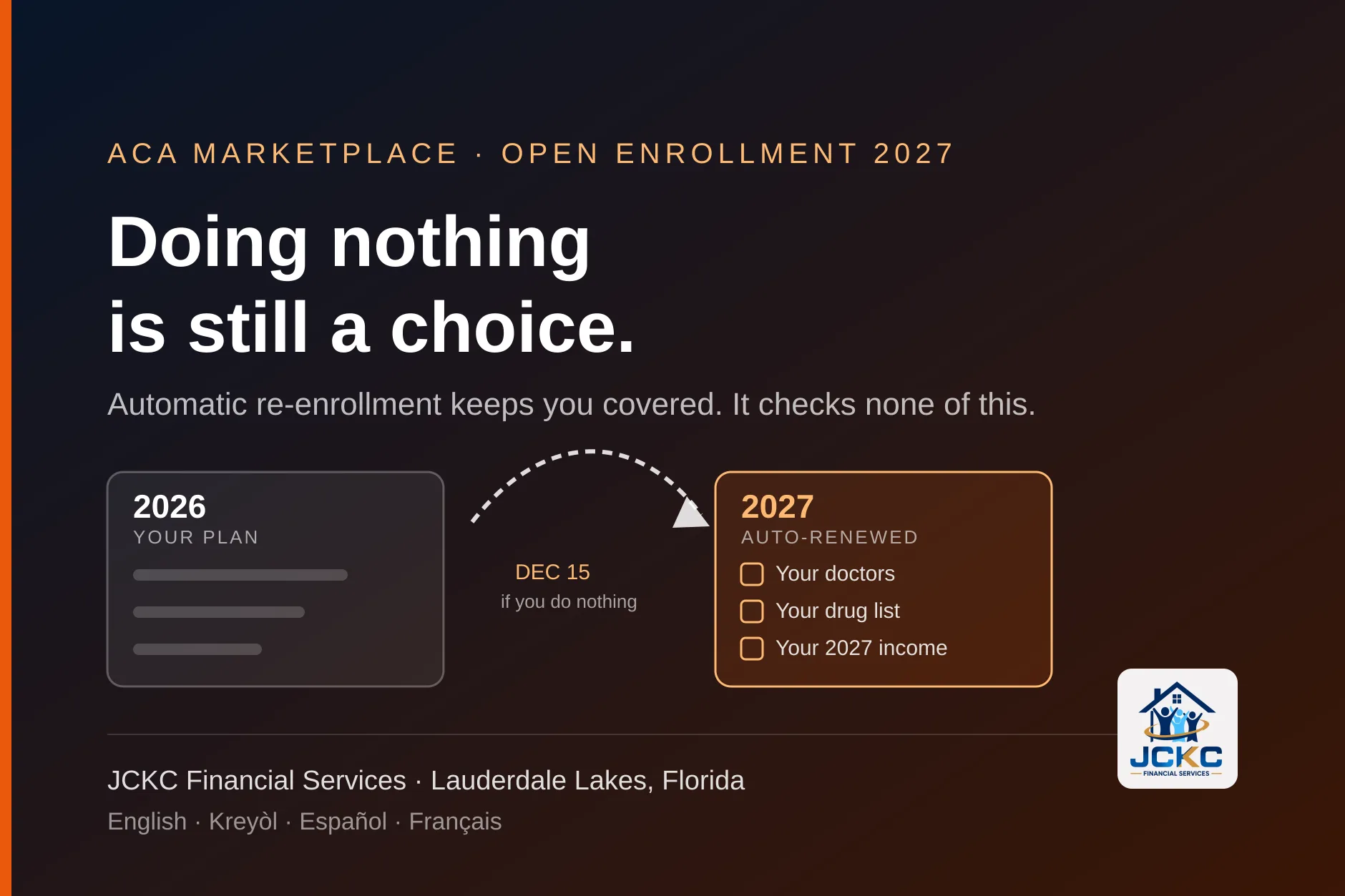
HealthCare.gov describes the default plainly. If you have Marketplace coverage in December and do not take any action to choose a plan or stop your coverage by December 15, it will automatically re-enroll you. Four details in that same page are worth knowing before you rely on it:1
- It may not be the same plan. You may be re-enrolled in the plan you have now, in a different plan from the same insurance company, or, if your company is not offering plans next year, in a plan from a different company.
- It is not universal. HealthCare.gov says that in some cases you will not be automatically re-enrolled, and that you should enroll during Open Enrollment to keep Marketplace coverage.
- It does not start by itself. Your plan does not start until you pay your first monthly premium, and this year’s coverage ends on December 31 no matter when you enrolled.
- It does not stop by itself either. If you will not want Marketplace coverage next year, you have to stop it, or you may be re-enrolled anyway.
Behind that page sits a federal regulation, 45 CFR 155.335, the annual eligibility redetermination. It requires the Marketplace to check your eligibility once a year and, if you remain eligible and choose nothing, to renew you in a fixed order. That order decides what you will actually have in January.12
2. The order the Marketplace follows if your plan is gone
The regulation does not say "the Marketplace picks something similar". It sets a ladder, and the Marketplace climbs down it only as far as it has to. In plain words, for 2027:2
| If this is true for 2027 | The Marketplace re-enrolls you in |
|---|---|
| Your current plan is still offered | The same plan |
| Your plan is gone, but its product still has a plan at your metal level | A plan in the same product, same metal level, with the most similar network |
| You are in silver and your product has no silver plan left | A silver plan in another product from the same company, most similar product and network |
| You are not in silver and your product has nothing at your level | A plan one metal level higher or lower in the same product, most similar network |
| Nothing at, above or below your level remains in the product | Any other plan in that product you are eligible for, most similar network |
| The whole product is gone | The most similar product from the same company: same level first, then one level up or down, then any plan |
| Your company offers no Marketplace plans at all | A plan from a different company, as the state regulator directs, or as the Marketplace decides if the state declines |
| You are in a catastrophic plan and no longer qualify for one | A bronze plan in the same product, or the lowest level it offers |
Two things follow from the ladder. First, silver is protected: a silver enrollee stays in silver with the same company before the rule will change the metal level, which matters because cost-sharing reductions, the extra savings on deductibles and copays, are attached to silver plans. Second, a protection has gone. The version of this regulation in force until August 2025 let the Marketplace move someone who qualified for cost-sharing reductions out of a bronze plan into a silver plan in the same product, with the same network and an equal or lower premium after the credit. The current text no longer contains that paragraph. If you are in bronze and your income would earn extra savings on silver, the regulation no longer provides for that move; the decision is yours to make.2310
A product is not a plan
Federal rules define a "product" as a package of benefits an insurance company offers with one network type, such as an HMO or a PPO, within a service area, and a "plan" as that product paired with one cost-sharing structure, one provider network and one service area. So "your plan is ending" in a letter can mean that you are moved to a sibling plan of the same product, from the same company, that you have never looked at.
3. A "similar network" is not the same as your doctor
Every rung of that ladder uses the same test: the plan "that has the most similar network compared to the enrollee’s current QHP". That is a comparison between two networks as wholes. It is not a check of your primary care doctor, the specialist you see every quarter, the hospital you would choose, or the pharmacy on your corner. A plan can have the most similar network of everything available and still leave out the one practice your family uses. Even keeping "the same plan" is less fixed than it sounds: under the federal definition, a renewed plan still counts as the same plan if it continues to cover a majority of the same provider network and a majority of the same service area. A majority is not all.29
The same is true of the drug list. Nothing in the re-enrollment order looks at your prescriptions. HealthCare.gov publishes, for every Marketplace plan, the documents that let you check:6
- a summary of benefits, which shows the deductible, copays and out-of-pocket maximum;
- a provider directory, which lists the doctors, hospitals and facilities in network;
- a list of covered drugs, the formulary, which shows whether your medicines are covered;
- and, when plans are reviewed on HealthCare.gov, a search that marks whether each plan covers your chosen doctors, facilities and drugs in network.
That last tool is what we use when we sit down with you: we enter your doctors and your medicines first, then look at the plans, not the other way round. If you want to know what to gather before that conversation, our guide on checking your doctors and drugs before you choose a plan lists it. The point here is narrower: automatic re-enrollment has never done this step for you, in any year, and it will not for 2027.
4. Your subsidy rides on the income already on file
Re-enrollment renews the plan. The subsidy is a separate calculation, and it runs on whatever the Marketplace already knows about you. HealthCare.gov says it in so many words: savings are based on your expected income for the year you are applying for, not past years, and if you do not update your income, it will estimate your premium tax credit from the most recent income sources it has, including your most recent Marketplace application and other sources such as the IRS.1
The regulation adds a detail that is easy to miss. When you first applied, you were asked whether the Marketplace could use your updated tax information in future years. That permission lasts at most five years. Where there is no active permission, the regulation says the Marketplace may redetermine your eligibility for a plan only, not for the premium tax credit, until you give it or update your application. HealthCare.gov lists the same situation among the reasons a renewal letter can say you will get no premium tax credit next year. The full list it gives:2
- the additional savings created during the COVID pandemic ended on December 31, 2025;
- updated income information from the IRS may show that you do not qualify;
- the Marketplace may need documents from you before it can confirm the credit;
- and you may not have allowed it to use your updated tax information automatically.
A letter that says "no credit" is a reason to look, not a verdict
HealthCare.gov’s own advice is to update your most recent application even if you are told you do not qualify, because you may find out that you do. The end of the pandemic-era savings and the return of the income limit are explained in our article on the 2026 ACA subsidy cliff; we will not repeat them here.
5. Why a stale income number costs more now
Until this year, a stale income figure had a ceiling on what it could cost. When the credit paid in advance turned out larger than the credit you qualified for, a repayment cap limited what most households below 400% of the poverty level had to give back. The IRS now states it without qualification: "There is no repayment cap for tax years after 2025." For tax years after 2025 you repay the full amount by which your advance payments exceed your premium tax credit.5
Coverage that renews automatically for 2027 is reconciled on your 2027 tax return, using the Form 1095-A that arrives by early February 2028. So the old habit, letting the renewal ride on last year’s numbers and sorting it out at tax time, now has no limit on how wrong it can go. The fix is the same one the IRS recommends: report changes to the Marketplace as soon as they happen, so the advance credit is adjusted forward instead of corrected in one figure on the return. You report them by updating your application online, by phone or in person; HealthCare.gov does not take changes by mail. How to arrive at a defensible number when your income moves around is a separate subject, covered in our article for self-employed households.57
6. The $0-premium question for 2027
The 2025 federal rule that reshaped the Marketplace added a charge aimed at exactly the households this article is about: people whose plan cost them nothing after the credit and who were re-enrolled without updating anything. As written in the regulation today, that provision applies "for benefit year 2026 annual redeterminations": a $0-premium enrollee who did not update by the January 1 deadline would see the credit reduced so that $5 a month remained to be paid. The current text, which the eCFR shows as up to date on October 29, 2026, contains no equivalent charge for 2027. The court history of that rule, and of the enrollment dates, is in our September article on the 2027 rule changes.2
One more document is worth knowing about, so that a headline does not surprise you. On October 27, 2026, the Department of Health and Human Services published a proposed rule on Exchange eligibility and verification, implementing requirements of the 2025 tax law. Among other things it would update annual eligibility redeterminations and create an annual verification period before Open Enrollment. It is a proposal: comments close November 27, 2026, and nothing in it is in force for this Open Enrollment. If it becomes final, we will write about what it actually says.8
So the regulation, as it stands today, does not charge a $0-premium re-enrollee $5 for 2027. The real risk was never the $5. It is the income behind the $0: if that credit is built on last year’s pay and you earn more in 2027, the difference is repaid in full on the return.
Open Enrollment runs November 1 to January 15
Not sure what your renewal letter means? Bring both letters and we will go through them with you.
7. The two letters to read before December 15
By November 1 you should have received two letters about 2027, one from your insurance company and one from the Marketplace. Together they tell you whether your plan is still available, which plan you are matched with if you do nothing, what is changing in your coverage and your savings, and whether the Marketplace needs documents from you. What to look for in each:1
| Letter | What it tells you | What to check |
|---|---|---|
| From your insurance company | Whether your plan continues for 2027, or the plan you are being moved to, and its new premium and benefits | The deductible and out-of-pocket maximum against this year’s; whether the plan name changed; whether your doctors and medicines are still in it |
| From the Marketplace | The plan you are matched with if you do nothing, and the savings it expects you to get | The income it used; whether it says you will get no premium tax credit and why; any document request and its deadline |
If one is missing, HealthCare.gov says to ask your plan for the insurance company letter and the Marketplace for the other. If your company is not offering your plan for the new year, update the application during Open Enrollment and, when asked whether you are losing coverage, say that it ends on December 31.1
8. The calendar, with and without you
The dates are the same as last year and are set out on HealthCare.gov. What changes is what each one means if you have not acted:4
| Date | If you act | If you do nothing |
|---|---|---|
| November 1, 2026 | Open Enrollment opens. You can update your application, renew, or choose another plan. | Nothing happens yet. Your letters should already be in hand. |
| December 15, 2026 | Last day to update and choose a plan for coverage starting January 1. | The automatic re-enrollment is set for January 1, on the plan and income the Marketplace has. |
| January 1, 2027 | Your chosen plan starts once the first premium is paid. | The matched plan starts once the first premium is paid. |
| January 15, 2027 | Last day to change plans; a change made December 16 to January 15 starts February 1. | Open Enrollment closes. After this you generally need a qualifying life event to change. |
An automatic re-enrollment does not lock you in: even after the matched plan has started, you can change until January 15, with the new plan starting February 1. The detailed answer on the closing date is on our page when does ACA Open Enrollment end for 2027.1
9. What this looks like in Broward
Florida does not run its own exchange. Households in Lauderdale Lakes, Lauderhill, Sunrise, Fort Lauderdale and the rest of Broward use the federal Marketplace at HealthCare.gov, where we enroll you, so the federal re-enrollment rule described above is the one that applies here, word for word. There is no separate state version with different protections.
What we see across our desk in November is less about the rule than about the paper. The two letters use words like "product" and "redetermination" that are hard to follow in any language. Many families we work with enrolled years ago and have not opened the application since; some have moved within the county, changed jobs or added a grandchild to the household. None of those changes reach the Marketplace by themselves. If it would help to go through the letters in Kreyòl, Spanish or French, that is what the review is for.
10. A twenty-minute review before December 15
None of this requires starting again. It is a short review of the renewal you have already been offered, and it is easier in early November than on December 14:7
- Find both letters and the name of the plan you are matched with for 2027. If the plan name differs from this year’s, treat it as a new plan.
- Write down your 2027 household income estimate, including a spouse’s pay, overtime and side work, and compare it with the income the Marketplace used. If they differ, the application needs updating.
- List your doctors and medicines by name and check them against the matched plan’s provider directory and drug list, not this year’s.
- Check the deductible and out-of-pocket maximum on the matched plan against what you have now.
- Check whether the Marketplace can still use your tax information for future years, and answer any document request before its deadline.
- Decide by December 15: keep the matched plan, choose another, or end the coverage if you will have other insurance.
- Diarize a check-in during 2027 and update the application whenever your income or household changes.
11. Frequently asked questions
If I do nothing, will I lose my Marketplace coverage on January 1?
In most cases, no. If you have Marketplace coverage in December and take no action to choose a plan or stop your coverage by December 15, HealthCare.gov says it will automatically re-enroll you for January 1. HealthCare.gov also says that in some cases you will not be re-enrolled, and the coverage does not start until the first monthly premium is paid. So doing nothing usually keeps you covered, but it is not certain, and it is not a review of whether the plan still suits you.
Will I stay in exactly the same plan?
Only if your plan is still offered for 2027. If it is, the federal rule re-enrolls you in the same plan. If it is not, the rule moves you to a plan in the same product, at the same metal level, with the most similar network. If the whole product is gone, it looks for the most similar plan from the same insurance company, and only if that company offers nothing does it place you with a different insurer. Your Marketplace letter names the plan you were matched with.
My insurance company letter says my plan is ending. What happens now?
You will be matched with an alternate plan, and that match is what you get if you do nothing. HealthCare.gov’s advice is to update your Marketplace application during Open Enrollment, review the plans available to you, and when the application asks whether you are losing coverage, say that your coverage ends on December 31. That is the case where a twenty-minute review matters most, because the matched plan was chosen by a rule, not by your doctors or your prescriptions.
Will my subsidy stay the same if I am re-enrolled automatically?
Not necessarily. The credit is recalculated every year from your expected income, your household size and the plans available, and prices change too. If you do not update your income, HealthCare.gov estimates the credit from the most recent sources it has, including your last application and the IRS. Without your permission to use updated tax information, the regulation lets it redetermine you for the plan only, not for the credit, until you act.
My plan costs me $0 now. Will I be charged $5 a month in 2027?
The $5 provision in the federal regulation is written for benefit year 2026 annual redeterminations, and the current text, up to date as of October 29, 2026, contains no equivalent charge for 2027. A proposed rule published October 27, 2026 would change annual redeterminations, but it is a proposal and is not in force for this Open Enrollment. Either way, a $0 bill does not prove the income on file is right.
I was re-enrolled automatically and then saw the new plan. Can I still change?
Yes, within Open Enrollment. If you choose a different plan by December 15, it starts January 1. HealthCare.gov says that even if the automatic coverage has already started, you can still change plans until January 15, and the new plan starts February 1. After January 15 you generally need a qualifying life event to change.
Does automatic re-enrollment check that my doctor and my medicines are still covered?
No. The rule compares networks between plans, looking for the "most similar network" when your plan is replaced. It does not look at your doctor, your clinic or your prescriptions. Every Marketplace plan publishes a provider directory and a list of covered drugs, and when we review plans with you we enter your doctors and medicines so we can see which plans cover them in network.
I will have job coverage next year and do not want my Marketplace plan. What should I do?
End it. HealthCare.gov is explicit that if you do not want Marketplace coverage for next year, you need to stop it, or you may be automatically re-enrolled. If someone in the household keeps Marketplace coverage and someone else leaves, that is a change to report on the application rather than a cancellation of everything.
Do I have to pay JCKC to review my renewal?
No. A renewal review with us is free, and asking questions does not commit you to anything. We look at both letters, the plan you were matched with, your income estimate, your doctors and your medicines, and if a change makes sense we make it with you on HealthCare.gov, where we enroll our clients, in English, Kreyòl, French or Spanish.
12. Sources
- HealthCare.gov, Renew, change, update, or cancel your plan: automatic re-enrollment if you take no action by December 15; same plan, a different plan from the same company, or another company; the two letters by November 1; savings based on expected income and estimated from the most recent sources if not updated; reasons a letter may show no premium tax credit; coverage ends December 31; the first premium must be paid. Read October 30, 2026.
- Electronic Code of Federal Regulations, 45 CFR 155.335, Annual eligibility redetermination, up to date as of October 29, 2026: paragraph (j), the re-enrollment order and the "most similar network" test; paragraphs (b), (k) and (l), tax data authorization for up to five years and redetermination for the plan only without it; paragraph (n), the $5 provision written for benefit year 2026. Read October 30, 2026.
- Electronic Code of Federal Regulations, 45 CFR 155.335, comparison of the text in effect on August 24 and August 25, 2025: the earlier text’s paragraph (j)(4) allowing an Exchange to move a cost-sharing-eligible bronze enrollee to silver, absent from the current text. Read October 30, 2026.
- HealthCare.gov, When can you get health insurance? Dates and deadlines: November 1, December 15 for January 1, January 15, and February 1 for changes made December 16 to January 15. Read October 30, 2026.
- Internal Revenue Service, Questions and Answers on the Premium Tax Credit, Q31 ("There is no repayment cap for tax years after 2025"), Q29 (Form 1095-A by early February) and Q4 (report changes as soon as they occur). Read October 30, 2026.
- HealthCare.gov, 3 things to know before you pick a health insurance plan: the summary of benefits, provider directory and list of covered drugs published for each plan, and the doctor, facility and drug search. Read October 30, 2026.
- HealthCare.gov, How to report changes to the Marketplace: updates online, by phone or in person, not by mail. Read October 30, 2026.
- Federal Register, Patient Protection and Affordable Care Act, Exchange Pre-Eligibility Verification, proposed rule, 91 FR 67656, October 27, 2026 (CMS-9873-P); comments close November 27, 2026. Read October 30, 2026.
- Electronic Code of Federal Regulations, 45 CFR 144.103, Definitions: "product" and "plan", and the rule that a renewed plan is the same plan if it keeps a majority of the same provider network and service area. Read October 30, 2026.
- HealthCare.gov, Cost-sharing reductions: the extra savings on deductibles, copayments and coinsurance apply only if you pick a Silver plan. Read October 30, 2026.
For general information only. This article explains federal rules as published in the Code of Federal Regulations, by HealthCare.gov and by the IRS; it is not tax or legal advice and it is not a determination of your eligibility. Only the Marketplace can decide your eligibility for a plan or a premium tax credit, and the plan it matches you with depends on what insurance companies offer in your area for 2027. Rules can change, and a proposed rule is not in force until it is finalized. JCKC Financial Services is an independent insurance brokerage and tax practice; we enroll you on HealthCare.gov and review plans from the carriers we represent.