

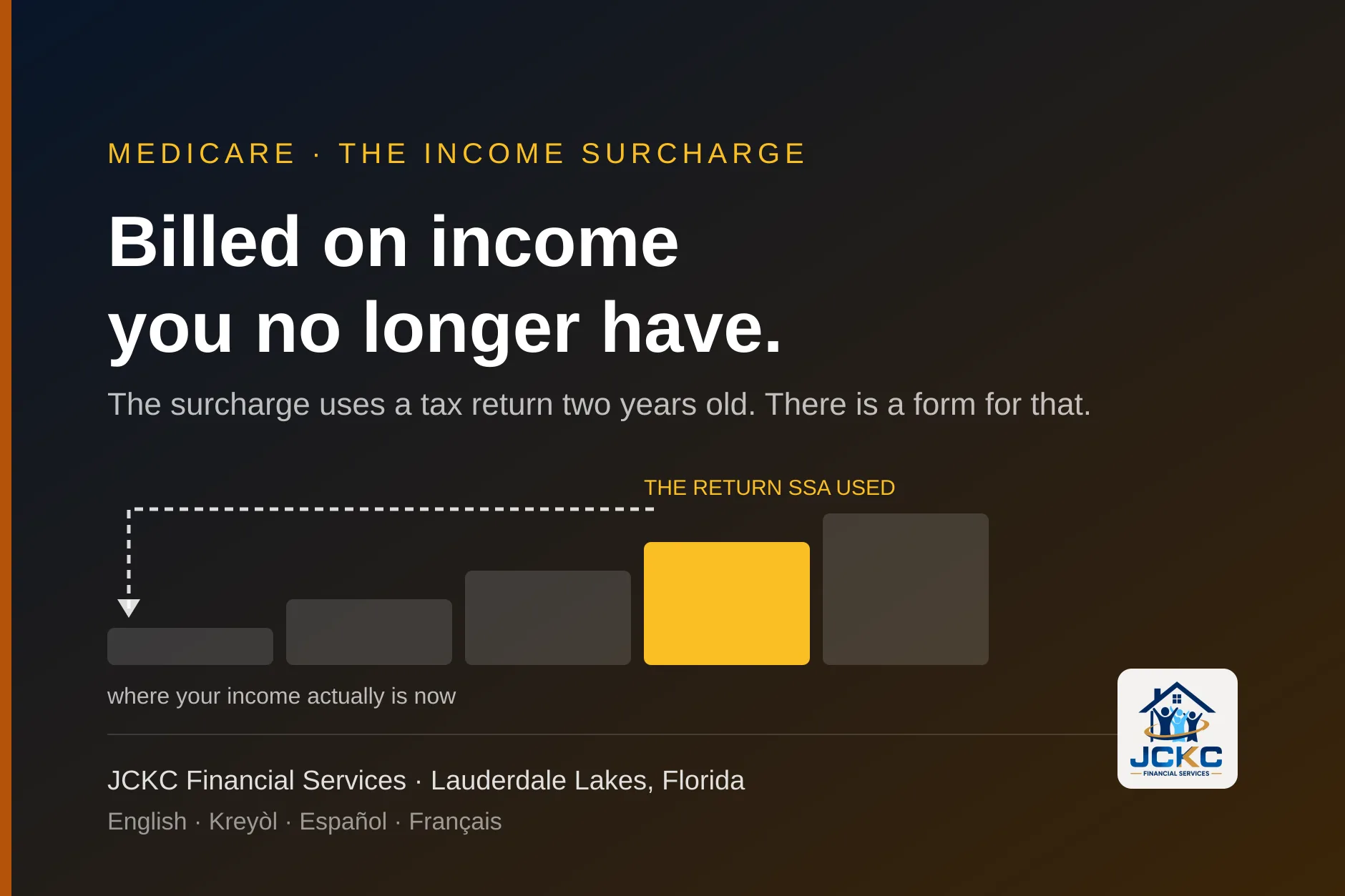
1. Why the bill is built on a two-year-old return
Most people meet the income-related monthly adjustment amount — IRMAA, in the acronym everyone uses and nobody enjoys — as a line on a letter they did not expect. It is an amount added to the Part B premium and to the Part D premium when income is above a threshold, and the income it looks at is not the income you have:1
- The regulation directs Social Security to use the modified adjusted gross income the IRS holds for the tax year two years prior to the year the surcharge applies to. A 2027 premium is normally set from a 2025 return.
- There is a fallback almost nobody has heard of. When the IRS has not supplied that year, Social Security uses the year three years prior, and adjusts later once the newer figure arrives. So a 2027 premium is occasionally set from a 2024 return.
- If that happens to you, you can hand Social Security your own retained copy of the two-year-prior return rather than waiting. The regulation says so explicitly, and it also says what to do if you did not keep one: request a transcript or a copy from the IRS.
None of this is an error. It is the design, and the design works perfectly well for a household whose income is steady. It breaks for the household whose income has just changed — and the single commonest version of that is retirement, where the two-year-old return records the last full year of a working life and the premium lands in the first year without one. We cover what IRMAA is and the full bracket table separately, in our guide to the income surcharge. This article is about the procedure for fixing it.1
2. What the surcharge actually costs
The amounts are worth knowing before you decide whether the paperwork is worth your afternoon. These are the 2026 figures, published by CMS on November 14, 2025. The Part B column is a total monthly premium and already includes the standard $202.90; the Part D column is an amount added to whatever your own plan charges.2
| Individual return | Joint return | Part B total monthly premium | Part D monthly add-on |
|---|---|---|---|
| $109,000 or less | $218,000 or less | $202.90 | $0.00 |
| Over $109,000 to $137,000 | Over $218,000 to $274,000 | $284.10 | $14.50 |
| Over $137,000 to $171,000 | Over $274,000 to $342,000 | $405.80 | $37.50 |
| Over $171,000 to $205,000 | Over $342,000 to $410,000 | $527.50 | $60.40 |
| Over $205,000 and under $500,000 | Over $410,000 and under $750,000 | $649.20 | $83.30 |
| $500,000 or more | $750,000 or more | $689.90 | $91.00 |
Read the gap between the first row and the second. One dollar of income over $109,000 on an individual return moves a household from $202.90 a month to $284.10, and adds $14.50 to the drug plan on top. Over a year, for a couple who both have Part B, that single dollar is worth close to two thousand. The brackets are cliffs, not slopes, which is exactly why a return that no longer describes you is worth correcting rather than shrugging at.2
The 2027 figures are not out yet
CMS had not published the 2027 Part B premium, deductible or income brackets when this was written on October 27, 2026. The 2026 figures were published on November 14, 2025, so the 2027 announcement is expected around the same point this autumn. Everything in the table above is labelled 2026 because that is what it is. We will update this page when CMS publishes, and not before.
3. The seven events that count
The list is closed. Social Security will consider exactly seven categories to be major life-changing events, and the regulation sets them out in lettered paragraphs:3
- Your spouse dies.
- You marry.
- Your marriage ends through divorce or annulment.
- You or your spouse stop working or reduce the hours you work. This is the one that applies to most people reading this.
- You or your spouse lose income-producing property, where the loss was not at your direction and did not come from the ordinary risk of investment. The regulation gives examples: real property in a declared disaster area, livestock or crops destroyed by natural disaster or disease, property lost to arson, or investment property lost to fraud or theft by a third party.
- You or your spouse experience a scheduled cessation, termination or reorganization of an employer’s pension plan.
- You or your spouse receive a settlement from an employer or former employer because of the employer’s closure, bankruptcy or reorganization.
In South Florida the fifth of those is less exotic than it reads. Real property lost in a declared disaster area is a hurricane clause, and a household that lost a rental property in a storm two seasons ago and is still being billed on the rent it used to collect is squarely inside it. So is a retiree whose former employer’s pension plan was terminated and reorganized. The categories are narrow, but they are not rare.3
4. What does not count, including the one everyone asks about
The regulation is equally explicit about the other direction. Events other than those seven are not major life-changing events, and it names two kinds specifically:4
- Events that affect your expenses but not your income. A medical catastrophe, a new mortgage, a child moving back home: all real, none of them a reason to recalculate the surcharge.
- The loss of dividend income through the ordinary risk of investment. A portfolio that fell is not an event. A portfolio that was stolen by a third party is, and the regulation will want a conviction to prove it.
Selling something is not a life-changing event
This is the question we are asked more than any other, and the answer disappoints people every time. The loss-of-property event expressly excludes a loss that happens at your own direction, and gives the sale or transfer of the property as its example. So the capital gain from selling a house, cashing out a business or converting a retirement account will raise your Medicare premium two years later, and there is no life-changing-event route out of it. That is a reason to run the arithmetic before you sign, not after. A one-off gain in 2026 is a Medicare bill in 2028.
5. “Significant” is a definition, not a judgement
Having an event is necessary and not sufficient. The regulation requires four things at once: a major life-changing event; a significant reduction in your modified adjusted gross income for the year you want used; a request; and evidence. Miss any one and there is nothing to decide.5
And “significant” is not left to anybody’s judgement. It has a definition: the reduction must either move you down the table of applicable percentages — that is, into a lower bracket — or take your income below the threshold so that no surcharge applies at all. The practical consequence is worth stating plainly, because it saves wasted paperwork: a fall in income that leaves you inside the same bracket does not qualify, no matter how painful it was, because the premium would not change either way.5
Retired this year?
The letter is built on the year you stopped, not the year you are in. That is fixable.
6. The form, and what it asks you to prove
The request is made on Form SSA-44, whose full title is Medicare Income-Related Monthly Adjustment Amount — Life-Changing Event, carrying OMB control number 0960-0784. Social Security uses it to decide whether you qualify for a reduction in the surcharge. What it collects is the four things the regulation requires:6
- Which of the seven events happened, and the date it happened.
- The more recent tax year you want used, and the modified adjusted gross income for it.
- Your tax filing status for that year, since the thresholds differ for a joint return and for someone married, living with a spouse and filing separately.
- A second year, where the reduction is expected to continue into the following year as well.
On the income evidence, the regulation is specific and worth reading before you start. Social Security will always ask for your retained copy of the filed federal return for the more recent year you want used. If you have not filed that return yet — which is the normal case, since you are usually asking about the year you are still living in — you supply equivalent evidence instead, together with a signed statement under penalty of perjury that what you have given is true, and a statement of the filing status you intend to use.7
7. The evidence, event by event
Alongside the income, Social Security wants proof that the event itself happened. The regulation sets this out event by event, and unless something in its own records casts doubt on what you have given, it will not ask for more.7
| The event | What the regulation asks for |
|---|---|
| Your spouse died | Proof of death, unless Social Security already has it on record |
| You married | Proof of marriage, unless already on record |
| Your marriage ended | Proof that the marriage has ended, unless already on record |
| Work stopped or hours were cut | Documentation of the change in work activity — a signed statement from the employer, proof of the transfer of a business, or your own signed statement under penalty of perjury describing the separation or the reduction in hours |
| Loss of income-producing property | Documentation of the loss, such as insurance claims or an adjuster’s statement. Where the loss was criminal fraud or theft, proof of conviction as well |
| A pension plan ended or was reorganized | Documentation of the change in or loss of the pension, such as a statement from the pension fund administrator |
| A settlement from a closed or bankrupt employer | Documentation of the settlement and the reasons for it |
Two details in that table matter more than their length suggests. For a work stoppage, your own signed statement under penalty of perjury is listed as acceptable documentation — you are not blocked because a former employer will not write a letter. And for property loss and pension failure, the regulation will not accept anything but original documents or copies from the original source, so a scan of a scan is a round trip you can avoid.7
8. When you can ask — and the March 31 trap
You may ask at any time during the calendar year in which the life-changing event significantly reduces your income. That is a generous window, and for an event in January it means the whole year is available to you.8
The exception is the one that catches people, and it is the single most useful thing in this article. When the event happens in the last three months of a calendar year and your income for that year is significantly reduced as a result, you may ask from the date of the event until March 31 of the following year. Someone who retires in November is in exactly that situation, which is why this paragraph is worth a note in the calendar rather than a good intention.8
A late request is reviewed, not refused
If you miss the window, the request is not thrown out automatically. The regulation sends it to the good-cause rules that govern late filings generally, and Social Security decides whether there was good cause for the delay. That is a real route and it is not a comfortable one to rely on: the decision is somebody else’s, and a request that is simply dismissed cannot be appealed further. Ask inside the window.
9. What date the lower premium starts
When the request succeeds, the correction is generally effective on January 1 of the year in which you made the request — not the month you got round to it. If your Part B enrollment or re-enrollment began later than January of that year, it runs from the first day of that enrollment instead. Asking in June about a drop that happened in February normally still reaches back to the start of the year.9
Two edges are worth knowing. If the reduction will not actually arrive until the following year, the determination takes effect on January 1 of that following year rather than the current one. And a determination made for your drug coverage surcharge is applied to your Part B surcharge for the same year, so you are not making the same case twice.9
10. A new determination is not an appeal
This is where people lose months, so it is worth being blunt about the difference. There are two separate roads and they answer two different complaints:9
- A new initial determination is what you want when the figure Social Security used is accurate but out of date. You are not saying the decision was wrong on the facts it had; you are saying there is a newer year and here is why it should be used. The life-changing-event request is one of four circumstances that open this road — the others are supplying the two-year-prior return when Social Security has used the three-year-prior one, supplying an amended return, and proving that the information the IRS gave was incorrect.
- A reconsideration is the appeal proper, for when you are dissatisfied with the determination itself. It follows the ordinary appeal rules and leads on to the further levels of review.
- A dismissal is a dead end. If a request for a new initial determination does not fit one of the four circumstances, Social Security dismisses it — and the regulation states that the dismissal is not itself subject to further administrative or judicial review. Which is to say: choose the right road the first time.
11. What to do this week
None of this is urgent in the way an enrollment deadline is urgent, and all of it is easier before the letter about next year arrives. If you have stopped working, cut your hours, lost a spouse, married, divorced, or had a pension end in the last twelve months, work through this:
- Find the determination letter. It names the tax year used and the bracket it put you in. Without it you are guessing at what to correct.
- Check the bracket arithmetic before you file anything. Compare the income you now expect against the thresholds in the table above. If the drop does not move you to a lower row, the request does not meet the definition of a significant reduction and the paperwork will not help you.
- Fix the date of the event. If it fell in October, November or December, your deadline is March 31, and that is now the date that matters.
- Gather the two pieces of evidence separately — proof the event happened, and proof of the income for the newer year. People routinely bring one and not the other, and the request waits.
- Check what else in the year moves the number. A Roth conversion, a property sale or a lump sum in the same year can undo a work stoppage entirely, and it is better to know that before filing than after. This is where a tax preparer and a Medicare broker are usefully the same conversation.
- If the letter looks wrong rather than out of date, ask for a reconsideration instead, and do not spend three months on the other form. What Medicare actually costs is worth a read either way.
12. Frequently asked questions
Which tax year does my Medicare surcharge use?
The return from two years earlier. The regulation says Social Security will use the modified adjusted gross income the IRS has for the tax year two years prior to the year the surcharge applies to. There is a fallback that surprises people: if the IRS has not supplied that year, Social Security uses the year three years prior instead, and corrects it once the newer figure arrives. So a premium for 2027 is normally built on a 2025 return, and occasionally on a 2024 one.
I retired this year. Can I get the surcharge reduced?
Probably, if the drop is big enough to move you down a bracket. Stopping work or reducing your hours is one of the seven major life-changing events in the regulation, and it is by far the commonest reason a bracket is wrong. You ask Social Security to use a more recent tax year instead of the two-year-old one, using Form SSA-44, and you supply evidence both of the event and of the newer income.
Is selling a house a life-changing event?
No, and this is the question we get most. The regulation lists a loss of income-producing property as an event, but it expressly excludes a loss that happens at your own direction, giving the sale or transfer of the property as the example. A capital gain from selling is not a life-changing event either. It will raise your Medicare premium two years later and there is no appeal on those grounds, which is an argument for knowing the thresholds before the sale rather than after it.
What counts as a significant reduction?
It is defined, not judged. The reduction must either move you down the table of applicable percentages, or take your income below the threshold so that no surcharge applies at all. A fall in income that leaves you inside the same bracket does not meet the test, however large it feels, because the premium would not change.
How long do I have to ask?
You may ask at any time during the calendar year in which the reduction happens. The exception is the one that catches people: if the event happens in the last three months of a year, you have from the date of the event until March 31 of the following year. A request after the applicable window is reviewed for good cause rather than refused outright, but it is far better not to need that.
When does the lower premium start?
Generally January 1 of the year you make the request, not the month you make it. If your Part B enrollment began later than January of that year, it starts on the first day of that enrollment instead. So asking in June about a reduction that happened in February normally still reaches back to January.
Is this the same as appealing?
No, and asking for the wrong one wastes months. A request based on a life-changing event is a request for a new initial determination: you are not saying the decision was wrong, you are saying the year it used is out of date. A reconsideration is the appeal, for when the determination itself is wrong — the income figure is incorrect, or the filing status is. Both exist, and they are separate roads.
What are the 2027 brackets?
They had not been published when this was written. CMS announces the following year’s Part B premium, deductible and income brackets in the autumn — the 2026 figures came out on November 14, 2025 — so the 2027 numbers are expected around the same point this year. The thresholds in this article are the 2026 ones, labelled as such. We will not print a 2027 figure until CMS does.
Does the surcharge affect my drug plan too?
Yes, and the two behave differently. The Part B amount is a total monthly premium that already includes the standard figure. The Part D amount is added to whatever your plan charges, and it is collected by Social Security or billed directly rather than by the plan, which is why it can show up as a separate and unexplained charge. A determination made for one is applied to the other for the same year.
13. Sources
- Code of Federal Regulations, 20 CFR § 418.1135 — the modified adjusted gross income used is that of the tax year two years prior, and the three-year-prior fallback when the IRS has not supplied it. Read October 27, 2026.
- Centers for Medicare & Medicaid Services, 2026 Medicare Parts A & B Premiums and Deductibles, published November 14, 2025 — the standard Part B premium of $202.90, the $283 annual deductible, and the Part B and Part D income-related adjustment tables reproduced above. Read October 27, 2026.
- Code of Federal Regulations, 20 CFR § 418.1205, What is a major life-changing event? — the seven lettered categories. Read October 27, 2026.
- Code of Federal Regulations, 20 CFR § 418.1210, What is not a major life-changing event? — events affecting expenses but not income, and dividend losses from ordinary investment risk. Read October 27, 2026.
- Code of Federal Regulations, 20 CFR § 418.1215, What is a significant reduction in your income? — and § 418.1201 for the four conditions that must all hold. Read October 27, 2026.
- Social Security Administration, Form SSA-44, Medicare Income-Related Monthly Adjustment Amount — Life-Changing Event, OMB control number 0960-0784. The form’s title, number and purpose are as described in the agency’s information-collection notice at 79 FR, January 30, 2014: “SSA uses the Form SSA-44 to determine if a recipient qualifies for a reduction in the IRMAA.” Read October 27, 2026.
- Code of Federal Regulations, 20 CFR § 418.1255, the evidence required for each event — and § 418.1265 for the income evidence and the equivalent-evidence route. Read October 27, 2026.
- Code of Federal Regulations, 20 CFR § 418.1310, When may you request that we make a new initial determination? — the four circumstances, the March 31 rule for an event in the last three months of a year, the good-cause review of a late request, and the unreviewable dismissal. Read October 27, 2026.
- Code of Federal Regulations, 20 CFR § 418.1230, the effective date of a determination based on a more recent tax year — and § 418.1325 on requesting a reconsideration. Read October 27, 2026.
For general information only. This article explains federal regulations as published in the Code of Federal Regulations and figures published by the Centers for Medicare & Medicaid Services. It is not tax, legal or accounting advice, and it is not a determination of what you will pay. Only the Social Security Administration can decide your income-related monthly adjustment amount or grant a request to use a more recent tax year. Amounts depend on your income, your tax filing status and the plan year. Confirm your own situation with Social Security at ssa.gov and your coverage at Medicare.gov. JCKC Financial Services is an independent insurance brokerage and tax practice.