

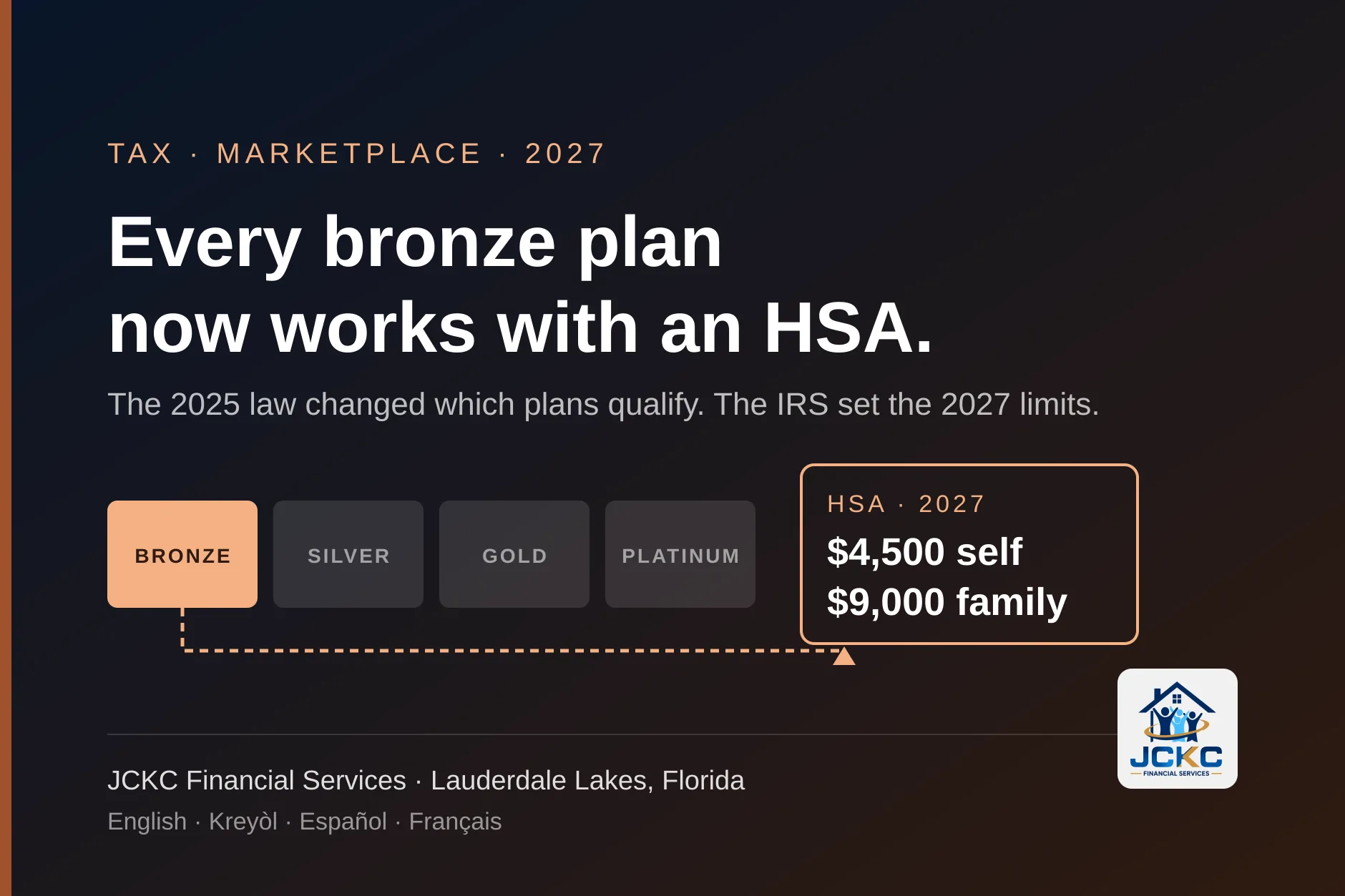
1. The 2027 numbers, from the IRS
Every spring the IRS adjusts the Health Savings Account figures for inflation. The 2027 amounts are in Revenue Procedure 2026-24, printed in the Internal Revenue Bulletin of June 15, 2026. Here they are beside the 2026 amounts, so you can see what moved.1
| Item | 2026 | 2027 |
|---|---|---|
| Contribution limit, self-only coverage | $4,400 | $4,500 |
| Contribution limit, family coverage | $8,750 | $9,000 |
| Extra contribution if 55 or older | $1,000 | $1,000 |
| Minimum deductible for an ordinary high-deductible plan, self-only | $1,700 | $1,750 |
| Minimum deductible, family | $3,400 | $3,500 |
| Maximum out-of-pocket for an ordinary high-deductible plan, self-only | $8,500 | $8,700 |
| Maximum out-of-pocket, family | $17,000 | $17,400 |
| Direct primary care fees allowed per month | $150 ($300 if more than one person) | $150 ($300 if more than one person) |
The 2026 column comes from IRS Publication 969, which also states the extra $1,000 for people 55 and older. That amount is not on the list of inflation-adjusted items in the 2027 revenue procedure, so it stays at $1,000. Self-only with the extra comes to $5,500 for 2027; family with the extra comes to $10,000.2
The limit is a ceiling, not a target. You can put in any amount up to it, including nothing in a tight month. Money you do not spend stays in the account and rolls over from year to year; there is no use-it-or-lose-it rule as there is with many flexible spending accounts.
2. What changed: bronze and catastrophic plans now count
Until 2026, a Marketplace plan could pair with an HSA only if it met the IRS definition of a high-deductible health plan: a deductible at least as high as the minimum in the table, and an out-of-pocket maximum no higher than the cap. Many bronze plans failed that test, usually because their out-of-pocket maximum sat above the HSA cap, or because they paid for some services before the deductible. The 2025 federal tax law, which the IRS calls the One, Big, Beautiful Bill, changed that. In the IRS’s words, as of January 1, 2026, bronze and catastrophic plans available through an Exchange “are considered HSA-compatible, regardless of whether the plans satisfy the general definition of an HDHP”. The IRS guidance on the change, Notice 2026-05, adds that the plans do not have to be bought through an Exchange to qualify.3
HealthCare.gov now says it in one line: all bronze and catastrophic plans work with Health Savings Accounts. Some plans at other metal levels are designated HSA-eligible too, because they meet the ordinary definition. If you want a refresher on what bronze, silver, gold and catastrophic mean in practice, our guide to the metal levels covers it.4
The thing most coverage still gets wrong
A bronze plan does not have to meet the $1,750 deductible or the $8,700 out-of-pocket figures to work with an HSA. Those numbers decide whether an ordinary plan qualifies — a silver plan, a gold plan, an employer plan. For bronze and catastrophic plans the law settles the question by metal level. If a website or a plan summary from before 2026 told you your bronze plan was “not HSA-eligible”, that answer is out of date.
3. Who can actually put money in
The plan qualifying is half the test. The IRS calls the other half being an “eligible individual”, and it is checked month by month. For each month you want to count, all of these have to be true on the first day of the month:2
- You are covered by a qualifying plan — for a Marketplace household, any bronze or catastrophic plan, or another plan designated HSA-eligible.
- You have no other health coverage that disqualifies you. The usual culprit is a spouse’s ordinary employer plan that also covers you; your spouse having that plan is fine as long as you are not on it. Dental, vision, accident, disability and long-term care coverage are allowed.
- You are not enrolled in Medicare.
- Nobody can claim you as a dependent on their tax return.
If you start mid-year, the limit is normally prorated by the months you were eligible. There is one shortcut, the last-month rule: if you are eligible on December 1, you can contribute the full year’s amount, but you then have to stay eligible through the following December, a period the IRS calls the testing period. Drop out early for a reason other than death or disability and part of what you put in becomes taxable, with an additional 10% tax. Anyone who changes jobs or coverage often should take the prorated amount instead.2
4. Bronze or catastrophic: the subsidy decides it
Both bronze and catastrophic plans now pair with an HSA, so the choice between them turns on something else. Catastrophic plans are open only to people under 30 or to people who qualify for a hardship or affordability exemption, and HealthCare.gov is explicit that you cannot use the premium tax credit on one: you pay the full premium. Bronze plans are available everywhere and do qualify for the credit. HealthCare.gov’s own comparison concludes that bronze plans with an HSA are usually a better deal than catastrophic plans, though in some areas a catastrophic plan may be the better option.4
The IRS rule says the same thing from the tax side: to be eligible for the premium tax credit you must be enrolled in Marketplace coverage “excluding ‘catastrophic’ coverage”. For most households in Broward who qualify for help, that settles it. A bronze plan gives you the credit and the HSA together; a catastrophic plan makes you choose. If you would get no credit anyway, compare the two premiums and the deductibles side by side before deciding.5
5. How an HSA deposit can raise your premium tax credit
This is the part of the change that matters most for a Marketplace household, and almost nobody explains it. HSA money you put in yourself is deducted on your federal return whether or not you itemize. It comes off before your adjusted gross income is figured. The premium tax credit is computed on household income, which the IRS defines as modified adjusted gross income: your adjusted gross income plus a few items, such as tax-exempt interest and non-taxable Social Security. So a dollar into your HSA is, in most cases, a dollar off the income your credit is figured on.25
The IRS describes the credit as the premium of the second-lowest-cost silver plan for your household, minus a percentage of your household income. Lower the income, and the share you are expected to pay goes down, so the credit tends to go up. There is also a line that matters more in 2027 than it did a few years ago. The IRS states that the credit is generally available between 100% and 400% of the federal poverty line, and that the expansion above 400% applied to tax years 2021 through 2025 only. For a household just above the 400% line, an HSA deposit can be what brings income back under it. Our answer on the income limits for ACA subsidies in Florida has the dollar figures.5
You do not have to wait for tax time to get the effect. HealthCare.gov’s list of expenses you may subtract from income on your Marketplace application includes Health Savings Account deposits, in limited situations, along with IRA contributions and student loan interest. Plan your deposits for the year, and we put that number into your income estimate when we enroll you. Then make the deposits. An estimate built on contributions you never make is an estimate that is too low.6
Two cautions before you count on it
First, there is no longer a cap on repaying excess advance credit: for tax years after 2025 the IRS says you repay the full difference. If you plan $4,500 of deposits and make $1,000, the gap comes back on your return. Our post on choosing your income number for 2027 when you are self-employed explains why to estimate carefully. Second, an HSA is not the same thing as the self-employed health insurance deduction for premiums, which has its own rules; our answer on deducting premiums when you are self-employed covers that one. Both can lower the same income, and the order they are figured in matters.
Is an HSA worth it for your household?
It depends on your income, your plan and how much care you expect to use. We run the numbers with you before you enroll.
6. Direct primary care and telehealth
The same law made two smaller changes that matter to people who use care in newer ways. Telehealth and other remote care can now be covered before the deductible without costing you HSA eligibility, permanently, for plan years beginning on or after January 1, 2025. And from January 1, 2026, an otherwise eligible person enrolled in certain direct primary care arrangements — the monthly-membership model where you pay a doctor’s office a flat fee for primary care — can keep contributing to an HSA and can pay those periodic fees from it tax-free.3
There is a limit. The arrangement only stays compatible if your total direct primary care fees do not exceed $150 a month, or $300 if the arrangement covers more than one person. The law indexes those amounts for inflation from 2027, and the IRS’s 2027 figures leave them at $150 and $300. A membership priced above that line can cost you the right to contribute for the months it applies. Ask the practice for the exact monthly fee in writing before you sign.1
7. At 55, an extra $1,000. At Medicare, a full stop
If you are 55 or older at the end of the tax year, your limit goes up by $1,000. For 2027 that means $5,500 on self-only coverage or $10,000 on family coverage. This is the most useful decade for an HSA, because the years when medical spending tends to rise are close, and money left in the account keeps growing tax-free until you need it. After 65, withdrawals for non-medical purposes are taxed as income but no longer carry the additional 20% tax that applies before then.2
The stop is just as firm. The IRS says your contribution limit is zero beginning with the first month you are enrolled in Medicare, including months of retroactive coverage. Because premium-free Part A can start retroactively when you sign up after 65, Medicare.gov tells people with an HSA that they and their employer should stop contributing six months before they retire or apply for Social Security benefits. Otherwise contributions made in the backdated months can become excess contributions, which the IRS generally taxes at 6% for every year they stay in the account. If you are within a year or two of 65, plan the last contribution date before you file.27
8. The Florida angle: the federal deduction is the whole benefit
In most of the country an HSA saves two layers of income tax. In Florida it saves one, because there is no second layer. The Florida Department of Revenue says it plainly: “Florida does not impose a personal income tax, so there are no filing requirements.” There is no state return on which an HSA deduction could be taken, added back or lost. That makes the federal deduction the whole tax benefit for a Florida household — and, for Marketplace households, the effect on the premium tax credit described in section 5, which can be larger than the tax saved.8
That combination is common among the households we see in Lauderdale Lakes and across Broward: self-employed people, gig drivers, home health aides, small shop owners, families where one spouse works for themselves. Many are on bronze plans already because the premium is lowest after the credit, and until this year that plan could not open an HSA. Now it can. Because we prepare the return and do the enrollment under one roof, the deposit, the income estimate and the reconciliation on Form 8962 are in the same hands, in English, Kreyòl, French or Spanish.
9. Where people get it wrong
The rules are not hard. The mistakes come from assuming something that used to be true, or from mixing up two accounts that sound alike.
- Paying the premium from the HSA. Generally not allowed. The exceptions are narrow — continuation coverage such as COBRA, coverage while you receive unemployment compensation, long-term care insurance — and a monthly Marketplace premium is not one of them.
- Putting in more than the limit. Excess contributions are not deductible and are generally taxed at 6% for each year they stay in the account. You can avoid the tax by withdrawing the excess and its earnings by your filing deadline, extensions included.
- Choosing catastrophic for the HSA and losing the credit. Catastrophic coverage does not qualify for the premium tax credit. If you are eligible for one, compare against bronze first.
- Counting deposits on the application and not making them. With no repayment cap after 2025, every dollar of deposit you planned and skipped can come back as credit you have to repay.
- Forgetting the other coverage. If a spouse’s ordinary employer plan also covers you, you may not be an eligible individual even though your own plan is bronze.
- Spending on things that are not medical. Before 65 that money is taxed as income and generally carries an additional 20% tax. Keep receipts showing each withdrawal paid a qualified medical expense.
- Missing the last-month rule’s fine print. Contributing the full year after joining late in the year commits you to staying eligible through the next December.
10. What to do before December 15
Open Enrollment for 2027 coverage starts November 1. December 15 is the last day to choose a plan that starts January 1, and January 15 is the last day of Open Enrollment. If an HSA is part of your 2027 plan, the decision belongs before December 15, because it changes which plan you pick and what income you report.9
- Decide whether a bronze plan fits how much care your household actually uses. An HSA does not make a high deductible small; it gives you a tax-favored way to save for it.
- Check the first-of-month tests for each person: no disqualifying other coverage, nobody on Medicare or about to be, nobody who is someone else’s dependent.
- Pick a realistic deposit for 2027 — up to $4,500 self-only or $9,000 family, plus $1,000 at 55 or older — and set it up as a monthly transfer you can keep.
- Bring that number to your enrollment appointment so it goes into the income estimate, and update the application if your plan changes during the year.
- If you are near 65, write down the date six months before you plan to retire or apply for Social Security benefits, and stop contributions there.
- If you are considering a direct primary care membership, get the monthly fee in writing and check it against $150, or $300 for more than one person.
- Keep every receipt. At tax time we report contributions and withdrawals on Form 8889 and reconcile the credit on Form 8962.
11. Frequently asked questions
What are the HSA contribution limits for 2027?
For calendar year 2027 the IRS set the limit at $4,500 if your qualifying plan covers only you and $9,000 if it covers your family, in Revenue Procedure 2026-24. If you are 55 or older at the end of the year you can add $1,000 more. For comparison, the 2026 limits were $4,400 and $8,750.
Can I open an HSA with a bronze Marketplace plan?
Yes, from January 1, 2026. A 2025 federal law treats every bronze and catastrophic plan as HSA-compatible, whether or not it meets the usual high-deductible test. You still have to be an eligible individual: no other disqualifying coverage, not enrolled in Medicare, and not someone else’s tax dependent. HealthCare.gov now says plainly that all bronze and catastrophic plans work with HSAs.
Does my bronze plan have to meet the $1,750 deductible and $8,700 out-of-pocket limits?
No. Those 2027 figures define an ordinary high-deductible health plan, which is how silver, gold or employer plans qualify. Under the 2025 law, bronze and catastrophic plans count as HSA-compatible regardless of whether they meet that definition, according to the IRS.
Will putting money in an HSA lower my Marketplace premium?
It can. Your deposit is deducted on your federal return whether or not you itemize, which lowers your adjusted gross income, and the premium tax credit is figured on modified adjusted gross income built from that number. A lower income means you are expected to pay a smaller share toward the benchmark plan, so the credit tends to rise. HealthCare.gov lets you subtract HSA deposits when you estimate income on the application. How much it helps depends on your income and household, so we run it with you.
Can I use my HSA to pay my health insurance premium?
Generally no. The IRS lists narrow exceptions, including continuation coverage such as COBRA, coverage while you receive unemployment compensation, and long-term care insurance. Your monthly Marketplace premium is not one of them. HSA money pays deductibles, copayments, coinsurance and other qualified medical expenses.
I am on a catastrophic plan. Can I get a subsidy and an HSA?
You can have the HSA. You cannot have the premium tax credit on a catastrophic plan: both HealthCare.gov and the IRS say catastrophic coverage does not qualify for it. If you are eligible for a credit, a bronze plan usually gives you the HSA and the subsidy together.
When do I have to stop contributing because of Medicare?
Your HSA limit is zero from the first month you are enrolled in Medicare, and that includes months Medicare covers retroactively. Medicare.gov says you and your employer should stop contributing six months before you retire or apply for Social Security benefits, so backdated coverage does not create a tax penalty.
Does Florida tax my HSA?
Florida does not impose a personal income tax, according to the Florida Department of Revenue. There is no state return on which an HSA deduction could be added back or taken. What you save is the federal income tax on the money you put in, plus the effect on your premium tax credit if you have Marketplace coverage.
Is a direct primary care membership allowed with an HSA now?
Yes, from 2026, within limits. An otherwise eligible person in a direct primary care arrangement can still contribute, and can pay the periodic fees from the HSA tax-free, as long as total fees do not exceed $150 a month, or $300 if the arrangement covers more than one person. The IRS kept the same amounts for 2027.
12. Sources
- IRS, Internal Revenue Bulletin 2026-25 (June 15, 2026), Rev. Proc. 2026-24 — 2027 HSA contribution limits of $4,500 self-only and $9,000 family; 2027 high-deductible health plan minimum deductible of $1,750 / $3,500 and out-of-pocket maximum of $8,700 / $17,400; direct primary care fee limits of $150 / $300 a month, effective for months after December 31, 2025, and unchanged for 2027. Read October 30, 2026.
- IRS, Publication 969 (2025), Health Savings Accounts and Other Tax-Favored Health Plans — 2026 limits of $4,400 / $8,750 and 2026 HDHP figures of $1,700 / $3,400 and $8,500 / $17,000; the $1,000 additional contribution at 55; eligible individual rules; the last-month rule and testing period; deduction whether or not you itemize; zero limit from the first month of Medicare including retroactive coverage; the 6% excise tax on excess contributions; the additional 20% tax and its exceptions; the limits on paying premiums. Read October 30, 2026.
- IRS, IR-2025-119, Treasury, IRS provide guidance on new tax benefits for health savings account participants under the One, Big, Beautiful Bill (December 9, 2025), announcing Notice 2026-05 — bronze and catastrophic plans HSA-compatible from January 1, 2026, regardless of the general HDHP definition, and not only when bought through an Exchange; direct primary care arrangements from January 1, 2026; telehealth before the deductible made permanent for plan years beginning on or after January 1, 2025. Read October 30, 2026.
- HealthCare.gov, Health Savings Accounts work with many Marketplace plans — all bronze and catastrophic plans work with HSAs; who can buy a catastrophic plan; the premium tax credit applies to bronze plans and not to catastrophic plans. Read October 30, 2026.
- IRS, Questions and answers on the Premium Tax Credit (FS-2025-10) — Q5 eligibility excluding catastrophic coverage; Q7 the 100% to 400% range and the 2021 to 2025 expansion; Q8 household income as modified adjusted gross income; Q24 how the credit is computed; Q31 no repayment cap for tax years after 2025. Read October 30, 2026.
- HealthCare.gov, Reporting income expenses — Health Savings Account deposits are among the expenses you may subtract from income on the Marketplace application, in limited situations. Read October 30, 2026.
- Medicare.gov, Working past 65 — stop HSA contributions six months before you retire or apply for Social Security benefits. Read October 30, 2026.
- Florida Department of Revenue, Do I have to file a personal income tax return in Florida? — Florida does not impose a personal income tax (reference: Section 5, Florida Constitution). Read October 30, 2026.
- HealthCare.gov, When can you get health insurance? — Open Enrollment starts November 1; December 15 for coverage starting January 1; Open Enrollment ends January 15. Read October 30, 2026.
For general information only, and not tax advice for your situation. This article describes federal tax rules and Marketplace rules as the IRS, HealthCare.gov and Medicare.gov publish them, with a link to each. Figures are for the years stated. Whether an HSA helps you depends on your income, household, coverage and health care use, and the premium tax credit you receive is determined on your federal return. JCKC Financial Services prepares tax returns and is a licensed insurance agency; we are not a bank and do not hold or invest HSA funds. Plan documents, not this article, govern what a particular plan covers.