

1. Two clocks, and which one is yours
There are two separate deadlines running, and confusing them is how people end up uninsured. The first is the Marketplace one and it is the generous one: a Special Enrollment Period that opens 60 days before you lose coverage and stays open 60 days after. Knowing it runs in both directions is worth real money, because it means you can have the new plan starting the day the old one ends instead of discovering the gap afterwards.1
- Marketplace Special Enrollment Period — 60 days either side of the loss. Same for everyone, whatever size your employer was.
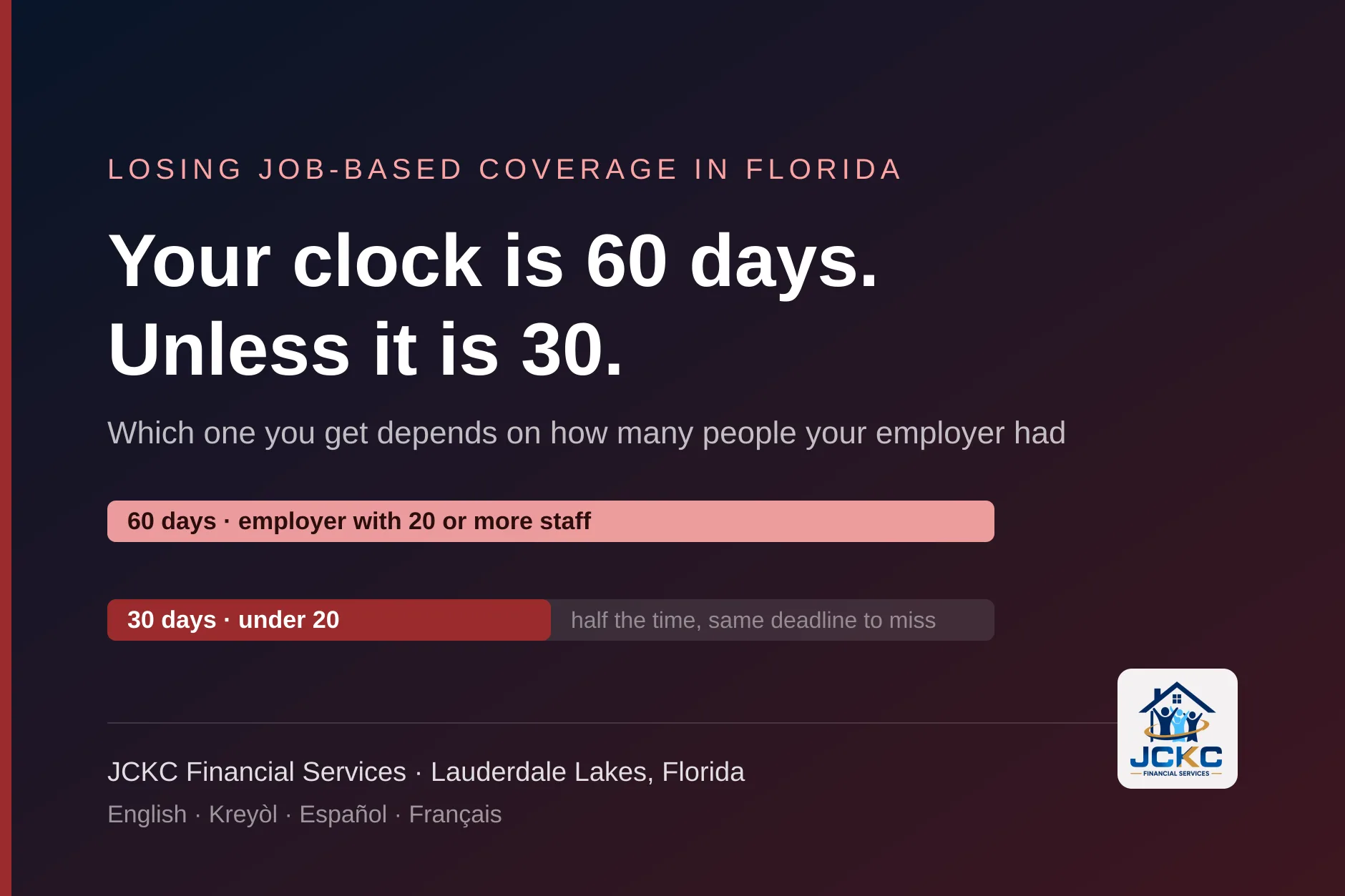
- COBRA election — at least 60 days, if your employer had 20 or more employees last year.
- Florida continuation election — 30 days from the carrier’s notice, if your employer had fewer than 20.
The second and third never both apply: which one you get is decided entirely by how many people your employer had. Nobody at the old job is likely to explain which side of the line you are on, and the letter that arrives will not say "this is the Florida version, you have half the usual time". So the first thing to establish is the headcount.2
2. What counts as losing coverage
The Special Enrollment Period is for coverage that ended on you, not coverage you ended. That distinction decides whether you can buy a plan in March or have to wait until the following January, so it is worth being exact about. These qualify:1
- Losing coverage through your employer, or through a family member’s employer plan.
- COBRA or continuation coverage running out at the end of its term.
- An individual or Marketplace plan being discontinued.
- Losing coverage as a dependent — most commonly turning 26 and aging off a parent’s plan.
- Losing Medicaid or CHIP, which gets a longer look-back of 90 days rather than 60.
Three things that do not qualify
Dropping your coverage voluntarily. Losing it because the premiums went unpaid. And voluntarily dropping COBRA — HealthCare.gov says that one in as many words. You will also be asked for documents proving the loss, so keep the termination letter and the end-of-coverage notice.
3. COBRA: who gets it, how long, what it costs
COBRA is the federal right to stay on the employer plan you just left, at your own cost. It applies to group health plans of employers with 20 or more employees in the prior year, which is the detail that decides everything else:3
- 18 months when the qualifying event is losing the job for a reason other than gross misconduct, or a cut in hours. 36 months for most other events, such as divorce or a child aging off the plan.
- Up to 102% of what the coverage costs the plan. Not 102% of your payroll deduction — 102% of the whole premium, employer share included, plus 2% for administration.
- At least 60 days to elect, counted from the election notice.
- At least 45 days after electing to make the first payment, then a minimum 30-day grace period on each payment after that.
That 102% is the number that surprises people, and it is the reason COBRA is so often the wrong answer. Your old deduction might have been $180 a month because the employer was quietly paying $700 of an $880 premium. COBRA is the $880, plus the 2%. Nothing about the coverage changed; the whole bill simply moved onto you.4
4. The Florida rule for small employers
If the business had fewer than 20 employees, everything above is irrelevant to you, and this is where most of the confusion in this market comes from. Florida wrote its own continuation law for exactly this gap — section 627.6692 of the Florida Statutes, the Florida Health Insurance Coverage Continuation Act. It does a similar job with different numbers:5
- At least 18 months of continuation, with an 11-month extension to 29 months if Social Security determines you are disabled.
- Up to 115% of the applicable premium — higher than COBRA’s 102% — and up to 150% of the group rate during the disability extension.
- 30 days from the carrier’s notice to elect in writing and pay the first premium. This is the clock nobody warns you about.
- 63 days to give the carrier written notice of the qualifying event in the first place.
Read those last two again, because the order matters and the second one is easy to miss: you notify the carrier of the event, the carrier sends a notice, and from that notice you have 30 days to elect and pay. Not 60. If you are waiting for a COBRA packet that is never coming because your employer had 11 people, the 30 days can be most of the way gone before you realise which system you are in.5
Ask one question before anything else
How many people did the employer have last year? Twenty or more means COBRA and at least 60 days. Fewer than 20 means Florida continuation and 30 days from the notice. Every other decision follows from that answer, and your old HR contact or the plan carrier can confirm it in a phone call.
5. The decision that costs the most
Here is the part that costs the most and gets the least attention. Many people take COBRA because it is familiar and the paperwork arrives first, without pricing the alternative. But being offered COBRA does not disqualify you from a premium tax credit on a Marketplace plan. The IRS states it directly: where the coverage comes from a former employer, including COBRA and retiree coverage, you may decline it even if it is affordable and provides minimum value, and still be eligible for the credit.6
Enrolling is what changes the answer. For the months you are actually enrolled in COBRA you have coverage, so there is no credit for those months. So the choice is not "COBRA or nothing" — it is a full-price continuation of the old plan against a subsidised Marketplace plan whose price depends on your new, lower income. A household that just lost a salary is often the household the subsidy is largest for, which is exactly when people stop looking.6
Open Enrollment runs November 1 to January 15
Not sure which clock you are on? That is the quickest question we answer all year.
6. The three routes, side by side
The three routes, with the numbers that actually differ between them:
| COBRA | Florida continuation | Marketplace plan | |
|---|---|---|---|
| Who it is for | Employer had 20+ employees | Employer had under 20 | Anyone who qualifies |
| Time to act | At least 60 days to elect | 30 days from the carrier notice | 60 days before or after the loss |
| What it costs | Up to 102% of the plan cost | Up to 115% of the premium | Depends on income; a credit may apply |
| How long it lasts | 18 months, or 36 for some events | 18 months, 29 with disability | The plan year, renewable |
| Keeps your doctors | Yes — it is the same plan | Yes — it is the same plan | Only if they are in the new network |
| Premium tax credit | No, for months you are enrolled | No, for months you are enrolled | Yes, if you qualify |
Two rows decide most cases. "Keeps your doctors" is why continuation is sometimes worth the money — mid-treatment, mid-pregnancy, or with a specialist you are not willing to change, paying 102% to keep the exact plan can be the right call. "Premium tax credit" is why it usually is not.35
7. Losing coverage during Open Enrollment
Lose your job in November or December and you are probably inside two windows at once. Open Enrollment for 2027 coverage runs from November 1, 2026 to January 15, 2027, and December 15 is the last day to enroll for coverage that starts January 1; enroll between December 16 and January 15 and coverage starts February 1 instead.7
Having both open is an advantage, but only if you use the earlier date. People see "January 15" and relax, then discover their coverage does not start until February and the gap they were trying to avoid arrived anyway. If your Special Enrollment Period lets you start sooner, start sooner. The later deadline is a backstop, not a plan.
8. When the new coverage actually starts
A gap of even a few weeks is not a technicality: it is the window in which an ambulance ride is entirely yours to pay. The Special Enrollment Period running 60 days before the loss exists precisely so you do not have one, and it is the most under-used part of the rule.1
So if you know the last day of your coverage — a layoff with notice, a contract ending, a planned retirement before 65 — apply before it arrives rather than after. Outside the window after a loss, coverage typically starts the first of the month after you pick a plan, which can leave weeks uncovered if you enroll late in a month. Confirm your actual start date on HealthCare.gov before you cancel anything else.7
9. If you are not a citizen
The enrollment windows above work the same whatever your status. What changed for 2027 is who can get help paying. From plan year 2027, Marketplace premium tax credits and cost-sharing reductions are allowed for US citizens, US nationals, and three noncitizen categories only: Lawful Permanent Residents, Cuban or Haitian Entrants, and people lawfully residing under a Compact of Free Association.8
Lawfully present people outside those three can still enroll in a Marketplace plan; they pay full price for it. If that might be you, read the separate article on who keeps the premium tax credit in 2027 before you decide anything, because the version of this circulating locally is wrong for the largest group it frightens — Cuban and Haitian Entrants keep the credit.8
10. Four mistakes we see every year
The same four, every year:1
- Assuming the 60-day number applies to you. It applies to the Marketplace window for everyone, but not to the continuation election if your employer had fewer than 20 people. That one is 30 days from the notice.
- Taking COBRA without pricing a Marketplace plan. The offer costs you nothing; enrolling costs you the credit. Price both before the election deadline, not after.
- Cancelling COBRA mid-year because it got expensive. Voluntarily dropping it does not open a Special Enrollment Period, so that move can leave you waiting until the next Open Enrollment.
- Estimating income from the job you just lost. The subsidy is calculated on what you expect to earn this year, not what you earned last year. Using the old salary can wipe out a credit you were entitled to.
11. What to do in the first week
Five things, in order. The first one is the only one that is urgent:9
- Find out how many employees the business had. Twenty or more, you are in COBRA and have at least 60 days. Under 20, you are in Florida continuation and the clock is 30 days from the carrier’s notice.
- Write down the last day of coverage from the termination letter, and count 60 days forward. That is your Marketplace deadline, and the window was already open 60 days before that date.
- Open everything that arrives. The election notice starts the clock whether or not it is read, and it is easy to mistake for ordinary leaving paperwork.
- Estimate this year’s income honestly — what you now expect to earn, not last year’s salary. That single number decides the size of the credit.
- Price all three routes before you elect anything. Continuation keeps your exact plan and doctors; a Marketplace plan may cost a fraction of it. Fifteen minutes with the figures in front of you settles it.
12. Frequently asked questions
How long do I have to get health insurance after losing my job?
Sixty days, and the window is wider than people think: it runs 60 days before the loss and 60 days after it, so you can line a plan up in advance and avoid a gap entirely. The important exception is continuation coverage. If your employer had 20 or more people, COBRA applies and the plan must give you at least 60 days to elect. If your employer had fewer than 20, COBRA does not apply at all; Florida’s own continuation law covers you instead, and it gives you 30 days from the carrier’s notice to elect in writing and pay.
Does COBRA apply to small employers in Florida?
No. Federal COBRA covers group health plans of employers with 20 or more employees in the prior year. Below that line Florida has its own law, section 627.6692 of the Florida Statutes, which does much the same job for small-employer plans: at least 18 months of continuation, extendable to 29 months with a Social Security disability determination. The differences that matter are the price cap and the clock, covered below.
What does COBRA cost?
Up to 102% of what the coverage costs the plan — your old payroll deduction plus whatever your employer was contributing, plus a 2% administration charge. That is the shock for most people: the employer share was usually the larger half. Florida continuation for a small-employer plan is capped higher, at 115% of the applicable premium, and at up to 150% of the group rate during the 11-month disability extension.
If I am offered COBRA, can I still get a Marketplace subsidy?
Yes, as long as you do not enroll in it. The IRS is explicit on this: where the coverage comes from a former employer, including COBRA and retiree coverage, you can decline it even if it is affordable and provides minimum value, and still be eligible for the premium tax credit on a Marketplace plan. Enrolling is what changes the answer — for the months you are enrolled in COBRA you have coverage, so no credit. The offer alone costs you nothing.
Can I drop COBRA later and move to a Marketplace plan with a subsidy?
Only at certain moments. During Open Enrollment, November 1 to January 15, you can switch for any reason. Outside it you can switch when COBRA runs out, or when you must start paying the full cost because your employer stops contributing. What does not work is simply cancelling COBRA mid-year because it is expensive: HealthCare.gov says plainly that voluntarily dropping COBRA does not open a Special Enrollment Period, so you would generally wait for the next Open Enrollment.
What does not count as losing coverage?
Three things catch people. Dropping your coverage voluntarily does not qualify. Losing coverage because you did not pay the premiums does not qualify. And voluntarily dropping COBRA does not qualify. The Special Enrollment Period is for coverage that ended on you, not coverage you ended — and you will be asked for documents proving the loss.
I lost my job in November. Do I use the Special Enrollment Period or Open Enrollment?
In November and December you are usually inside both, which is a good problem. Open Enrollment for 2027 runs November 1, 2026 to January 15, 2027, and December 15 is the last day to enroll for coverage that starts January 1. If your 60-day Special Enrollment window is also open, use whichever gets coverage started soonest and do not rely on the later date just because it exists.
How long does COBRA last?
Eighteen months when the qualifying event is losing your job for a reason other than gross misconduct, or having your hours cut. Thirty-six months for most other qualifying events, such as a divorce or a child aging off the plan. Florida continuation for small-employer plans also runs at least 18 months, with the 11-month disability extension taking it to 29.
What if I miss the deadline?
If you miss both the continuation election and the 60-day Special Enrollment Period, the next ordinary route is Open Enrollment, and coverage would start January 1 or February 1 depending on when you enroll. Before you accept that, check whether anything else in the household opened a separate window: a move, a marriage, a birth, a change in income that makes someone newly eligible. Call the Marketplace on 1-800-318-2596 or ask us — a missed deadline is worth ten minutes of checking before you accept months without cover.
I am not a US citizen. Does any of this work differently for me?
The enrollment windows work the same way, but from plan year 2027 a separate rule narrows who can get financial help. Marketplace premium tax credits are allowed for citizens, US nationals and three noncitizen categories: Lawful Permanent Residents, Cuban or Haitian Entrants, and people lawfully residing under a Compact of Free Association. Other lawfully present people can still enroll, at full price. We wrote that one up separately because the version going round locally is wrong for the biggest group it frightens.
13. Sources
- HealthCare.gov, Special Enrollment Periods — the 60 days before and after, the 90-day Medicaid look-back, and what does not qualify, including voluntarily dropping COBRA. Read October 26, 2026.
- HealthCare.gov, COBRA coverage and the Marketplace — when you may switch from COBRA, and the 60 days when it runs out. Read October 26, 2026.
- U.S. Department of Labor, Continuation of Health Coverage (COBRA) — the 20-or-more-employee threshold and the 102% ceiling. Read October 26, 2026.
- U.S. Department of Labor, Employee Benefits Security Administration, An Employee’s Guide to Health Benefits Under COBRA — at least 60 days to elect, 18 and 36 months, 45 days for the first payment and a 30-day grace period after. Read October 26, 2026.
- Florida Statutes, s. 627.6692, Florida Health Insurance Coverage Continuation Act — small employer defined as fewer than 20 at (4)(h), 18 months at (5)(b)1, the 11-month disability extension at (5)(c), 115% and 150% at (5)(f) and (5)(c), the 30-day election at (5)(e)1 and the 63-day notice at (5)(d)1. Read October 26, 2026.
- Internal Revenue Service, Questions and Answers on the Premium Tax Credit, Q20 — coverage from a former employer may be declined even where affordable and of minimum value, without losing eligibility for the credit. Page last reviewed September 21, 2026; read October 26, 2026.
- HealthCare.gov, Dates and deadlines for 2027 health insurance. Read October 26, 2026.
- CMS, Center for Consumer Information & Insurance Oversight, Guidance on Noncitizen Eligibility for Advance Payments of the Premium Tax Credit (APTC) and Cost-Sharing Reductions (CSRs) for Plan Year 2027, released October 5, 2026. Read October 26, 2026.
- Marketplace Call Center, 1-800-318-2596, TTY 1-855-889-4325, open 24 hours a day.
For general information only. This article explains federal and Florida rules as published by the agencies that administer them; it is not legal, tax or benefits advice, and it is not a determination of your eligibility. Only the Marketplace can decide your eligibility for a premium tax credit, and only your former employer or its plan carrier can confirm which continuation rules apply to your plan. Premium tax credits depend on your income, household size, location and plan year. Enroll and confirm eligibility at HealthCare.gov. JCKC Financial Services is an independent insurance brokerage.