

1. Two doors, and they are not the same door
Medicare has two separate entrances for someone who was not born here, and almost every confused conversation starts with mixing them up. One is earned through work. The other is bought, and only the bought one has a residence test attached. Before anything else, work out which of these describes you:1
- You or your spouse worked in the United States and paid Medicare taxes for 40 quarters — ten years, not necessarily consecutive. Part A costs you nothing, and the five-year rule is not part of your story.
- You do not have that work history. You may buy Part A, and to do that you must be 65 or older, a US resident, lawfully admitted for permanent residence, and have lived in the United States for five continuous years before the month you apply.
That is the whole fork. People in the first group are routinely told they must wait five years, which is simply not what the rule says, and some of them delay enrolling because of it — which starts a penalty clock for no reason at all. People in the second group sometimes assume they are shut out entirely, when in fact there is a priced door they can walk through.2
2. Door one: ten years of work
Forty quarters of Medicare-covered employment is ten years of work on which Medicare taxes were paid. The quarters do not have to be consecutive, they do not have to be with one employer, and they do not have to be recent. What they do have to be is on the record, which is why the Social Security earnings statement is the first document to pull:1
- Work counts if Medicare tax came out of the pay. Look at the old W-2s or the earnings record rather than trying to remember.
- Self-employment counts where self-employment tax was paid on it.
- Quarters earned under a previous immigration status still count; the credit belongs to the work, not to the status you held at the time.
- Work abroad for a foreign employer generally does not count, which is the usual reason a long career produces fewer quarters than expected.
Check the record before you believe anyone, including us
Your Social Security earnings record is the only thing that decides how many quarters you have. Get it from Social Security on 1-800-772-1213 or your my Social Security account. Families regularly discover they are at 38 quarters, not 40, and two more quarters of covered work is a very different problem from a $565 monthly premium.
3. Door two: the five-year rule
If you are buying Part A rather than earning it, CMS sets out what you must be. All of these at once, not any one of them:3
- Age 65 or older.
- A United States resident.
- Lawfully admitted for permanent residence — a green card holder.
- Residing in the United States for five continuous years before the month you file the Medicare application.
Two details are worth being precise about, because they change what people do. The five years is counted back from the month you apply, so it is not a clock that starts at 65 and it is not a clock that starts at your green card. And the test is continuous residence, so long absences are the thing to ask Social Security about before you file rather than after. If you are short, the practical move is to work out the date you will qualify and file then, instead of filing early and being refused.4
4. What buying in actually costs
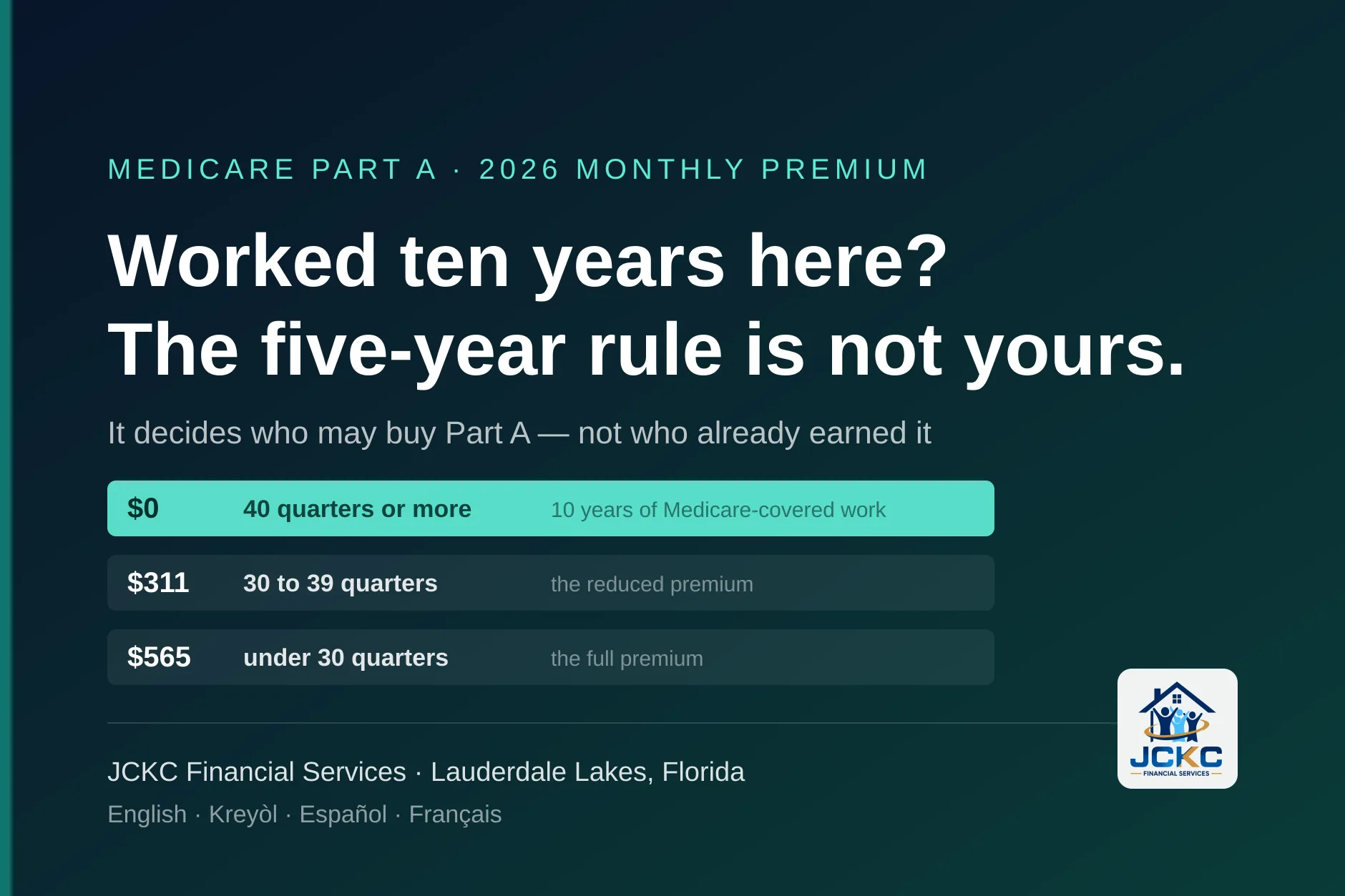
Buying Part A is priced on exactly one thing: how many quarters of Medicare-covered work are on your record, or your spouse’s. These are the 2026 monthly premiums:5
- 40 quarters or more: nothing. Part A is premium-free. This is the group the five-year rule does not touch.
- 30 to 39 quarters: $311 a month in 2026 — the reduced premium.
- Fewer than 30 quarters: $565 a month in 2026 — the full premium.
Notice the size of the step between 30 and 39 quarters and fewer than 30: it is $254 a month, which is $3,048 a year. If somebody in the household is a few quarters short of 30 and still able to work, that gap is worth doing the arithmetic on before deciding anything.5
These are 2026 figures, and 2027 is not out yet
CMS normally publishes the following year’s Part A and Part B premiums around the middle of November. We will not print a 2027 number before it exists. If you are reading this after that announcement, check the current figure on Medicare.gov or ask us — and treat any 2027 premium you see quoted before mid-November with suspicion.
5. Part B is not optional here
This catches people out and it is expensive to discover late. If you have to pay a premium for Part A, CMS requires you to enroll in Part B as well, or already have it — and to stay enrolled in Part B to keep the Part A you are paying for. You cannot buy the hospital half on its own.6
So the monthly figure to plan around is both premiums together. In 2026 the standard Part B premium is $202.90. Someone buying Part A with fewer than 30 quarters is looking at $565 plus $202.90, not $565. Every budgeting conversation that goes wrong on this subject goes wrong because only one of the two numbers was on the table.6
Medicare help in four languages, Lauderdale Lakes
Not sure whether you earned Part A or have to buy it? That is one phone call and we will make it with you.
6. The two penalties, compared
Waiting is the most expensive decision available here, and the two penalties are worth understanding separately because only one of them ever ends:
| Part A late penalty | Part B late penalty | |
|---|---|---|
| How much | 10% higher monthly premium | 10% of the standard premium for each full 12 months you could have enrolled and did not |
| How long you pay it | Twice the number of years you did not sign up | For most people, as long as you have Part B |
| Does it end? | Yes | No |
| Who it applies to | Only people who buy Part A | Anyone who enrolls in Part B late without other qualifying coverage |
| Worked example | 2 years late means 4 years of the higher premium | 2 years late means 20% added, for life |
Read the bottom right cell again. The Part B penalty is permanent for most people, and it is calculated on the standard premium, which goes up most years — so the penalty goes up with it. That is why the advice for anyone close to 65 is to find out their enrollment window now rather than when it is convenient.35
7. Who may join an Advantage or drug plan
Having Medicare and being able to join a Medicare Advantage or Part D plan are two different questions. Medicare.gov states that to join a Medicare health or drug plan you generally must have Part A and/or Part B, live in the plan’s service area, and be a US citizen or US national, a lawful permanent resident, a Cuban-Haitian entrant, or lawfully living in the United States as a Compact of Free Association migrant.7
We are reporting that as what Medicare.gov says today, and no further: the page gives no effective date and cites no statute, so anyone telling you precisely when it changed or what it was before is going beyond the source. What is worth knowing is that those four categories are the same shape as the 2027 Marketplace rule, so a household may meet two versions of the same list in the same month, for two different programs. If your status is in any doubt, that is a question for Social Security and an immigration lawyer, not for a brokerage.
8. Quarters you did not work yourself
This is the route most often missed, and it is worth real money. Entitlement to premium-free Part A can come from a spouse’s work record as well as your own, and the reduced buy-in premium can be based on a spouse’s quarters too. Someone who never worked in the United States can be entitled through a husband or wife who did.1
The rules also reach some divorced and widowed spouses, under conditions about the length of the marriage. We are not going to lay those conditions out here, because getting them slightly wrong in an article is worse than not stating them: the right move is to take both earnings records to Social Security and let them apply the test. What matters is knowing to ask, because nobody will volunteer it.7
9. If the premium is out of reach
If the premiums above look impossible, do not stop there, and do not assume Medicare is simply out of reach. The Medicare Savings Programs can pay the Part B premium for people under the income and asset limits, and in some cases the Part A premium as well. Extra Help cuts prescription costs sharply for the same kind of household.8
Both have their own article on this site, with the current limits and how to apply: Extra Help and the Medicare Savings Programs. We are not repeating the figures here, because two copies of a limit is how one of them goes stale. If the monthly number in section 4 made your decision for you, read that one before you decide.8
10. What goes wrong
Four things, and we see all of them every enrollment season:1
- Being told to wait five years when you already have 40 quarters. The residence test is for buying in. If you earned Part A, it is not your rule, and waiting only starts a penalty clock.
- Counting the five years from the green card, or from your 65th birthday. It is counted back from the month you file.
- Budgeting for Part A and forgetting Part B. You cannot buy one without the other, and in 2026 Part B is another $202.90 a month.
- Never checking a spouse’s earnings record. It is the difference between $565 a month and nothing, and it costs one phone call to rule in or out.
11. What to do, and when
In order, and the first two can be done this week:9
- Get your Social Security earnings record, and your spouse’s. Call 1-800-772-1213 or use a my Social Security account. The number of quarters decides everything that follows.
- Work out which door you are at. Forty quarters or more and Part A is free. Fewer, and the five-year residence test applies to buying it.
- If you are buying in, find your five-year date — count back from the month you would file, not from your birthday or your green card, and ask Social Security about any long absences before you apply.
- Find your enrollment window before your 65th birthday, not after. The Part B penalty is permanent for most people and it is the one real emergency on this list.
- If the premium is the obstacle, check the Savings Programs and Extra Help before you conclude you cannot afford Medicare.
12. Frequently asked questions
Can a green card holder get Medicare at 65?
Yes, by one of two routes. If you or your spouse worked in the United States and paid Medicare taxes for 40 quarters — ten years — you qualify for premium-free Part A on that record, and the five-year residence rule does not apply to you at all. If you do not have the work history, you may still buy Part A, and that is where the five-year rule comes in: CMS requires that you be 65 or older, a US resident, lawfully admitted for permanent residence, and have been residing in the United States for five continuous years before the month you file.
What exactly is the five-year rule?
It is the residence test for buying into Medicare. The requirement is five continuous years of residence in the United States immediately before the month you apply, together with lawful permanent resident status. It is not a waiting period that starts when you turn 65, and it is not a test anyone has to pass if they are already entitled to Part A through work credits.
How much does it cost to buy Part A?
In 2026, $311 a month if you or your spouse have 30 to 39 quarters of Medicare-covered employment, and $565 a month with fewer than 30. At 40 quarters Part A costs nothing. Those are the 2026 figures; CMS normally publishes the following year’s premiums around the middle of November, and we will not print a 2027 number before it exists.
Do I have to take Part B as well?
If you are buying Part A, yes. CMS is explicit: people who must pay a premium for Part A have to enroll in, or already have, Part B, and have to stay in Part B to keep the Part A they are buying. The standard Part B premium is $202.90 a month in 2026. So budget for both together — the real monthly figure for someone buying in with under 30 quarters is the $565 and the $202.90, not one of them.
What happens if I wait?
Two penalties, and they behave differently. The Part A penalty raises the premium by 10%, and you pay it for twice the number of years you went without signing up — so it ends. The Part B penalty adds 10% of the standard premium for each full 12-month period you could have had Part B and did not, and for most people it lasts as long as they have Part B. That one does not end. Waiting is the most expensive thing in this article.
My spouse worked here but I did not. Does that help?
It can, a great deal. Eligibility for premium-free Part A can come from a spouse’s work record as well as your own, and the reduced buy-in premium can also be based on a spouse’s quarters. The rules reach some divorced and widowed spouses too. This is the single most commonly missed route we see, and it is worth checking your spouse’s earnings record with Social Security before you accept a premium of any size.
Can I join a Medicare Advantage or drug plan?
Medicare.gov states that to join a Medicare health or drug plan you generally must be a US citizen or US national, a lawful permanent resident, a Cuban-Haitian entrant, or lawfully living in the United States as a Compact of Free Association migrant — and you must have Part A and/or Part B and live in the plan’s service area. The page does not give an effective date or cite a statute, so treat it as what Medicare.gov says today and check your own situation before you rely on it.
Is this the same rule as the 2027 ACA subsidy change?
They are different programs with a similar shape, and meeting both in the same month is why people get confused. The ACA change narrows who can get Marketplace financial help from plan year 2027 to citizens, US nationals and three noncitizen categories. The Medicare plan-eligibility wording lists those same categories. But Medicare eligibility itself still turns on age, work credits and the five-year residence test described here — they are not one rule.
How do I prove five years of continuous residence?
Social Security administers Medicare enrollment and will tell you what it needs; your permanent resident card, entry and travel records and the dates on your immigration documents are the usual evidence. Call Social Security on 1-800-772-1213, or TTY 1-800-325-0778. Start before your 65th birthday rather than after, because gathering immigration documents is slower than people expect and the Part B penalty counts from when you could first have enrolled.
What if I cannot afford the premiums?
Ask about the Medicare Savings Programs and Extra Help before you decide you cannot afford Medicare. The Savings Programs can pay the Part B premium, and in some cases the Part A premium, for people under the income and asset limits; Extra Help cuts drug costs sharply. They are a separate subject with their own article on this site, and they are the first thing to check when the monthly figure looks impossible.
13. Sources
- CMS, Original Medicare (Part A and B) Eligibility and Enrollment — age 65, US resident, lawfully admitted for permanent residence and five continuous years of residence before the month of filing; and the requirement to enroll in Part B to buy and keep Part A. Read October 26, 2026.
- Medicare.gov, Medicare costs — the 2026 Part A premiums of $311 and $565, and the $202.90 standard Part B premium. Read October 26, 2026.
- Medicare.gov, Avoid late enrollment penalties — Part A 10% for twice the number of years not signed up; Part B 10% for each full 12-month period, generally for as long as you have Part B. Read October 26, 2026.
- Medicare.gov, Joining a plan — the citizenship and lawful-presence categories for joining a Medicare health or drug plan. The page carries no effective-date language and cites no statute. Read October 26, 2026.
- CMS, 2026 Medicare Parts A & B Premiums and Deductibles — the reduced premium applies at 30 to 39 quarters of coverage; the full premium to those with fewer than 30. Read October 26, 2026.
- CMS, CMS Newsroom — where the following year’s Part A and Part B premiums are published, normally around the middle of November. The 2027 figures were not available when this article was written.
- Social Security Administration, 1-800-772-1213, TTY 1-800-325-0778 — Social Security takes Medicare applications and holds the earnings record that decides your quarters of coverage.
- CMS, Center for Consumer Information & Insurance Oversight, Guidance on Noncitizen Eligibility for Advance Payments of the Premium Tax Credit (APTC) and Cost-Sharing Reductions (CSRs) for Plan Year 2027, released October 5, 2026 — the separate Marketplace rule referred to in section 7. Read October 26, 2026.
- Social Security, my Social Security — where you can read your own earnings record online and count your quarters of coverage without waiting for the post. Read October 26, 2026.
For general information only. This article explains federal rules as published by CMS, Medicare and the Social Security Administration; it is not legal, immigration or tax advice, and it is not a determination of your eligibility. Only Social Security can decide your entitlement to Medicare and count your quarters of coverage, and only an immigration lawyer can advise you on your status. Premiums and penalties change each year; the figures here are the 2026 ones and are labelled as such. Confirm current amounts at Medicare.gov. JCKC Financial Services is an independent insurance brokerage.