

1. The 24-month wait, counted from the right month
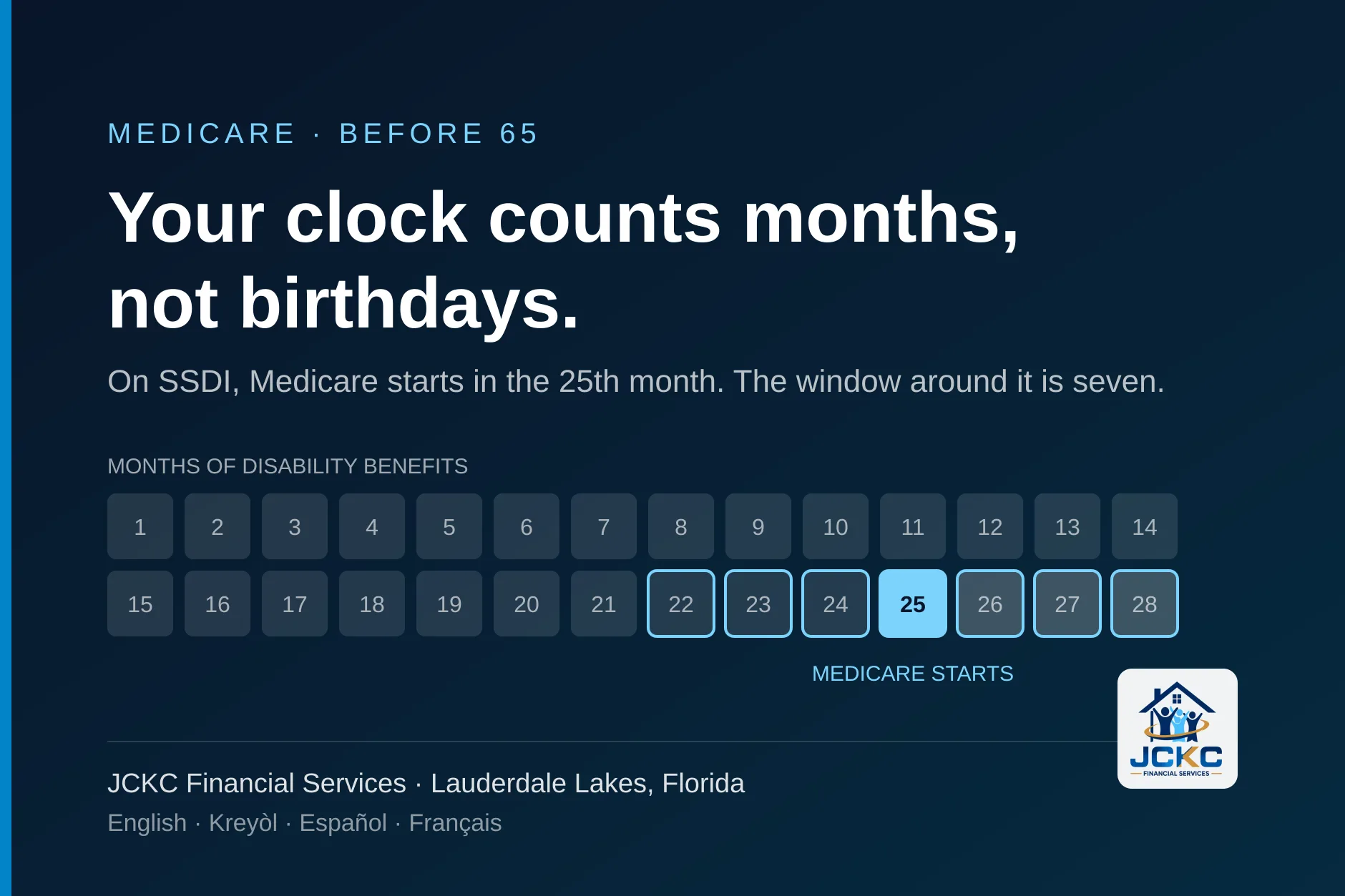
The rule fits in one sentence of the Code of Federal Regulations: entitlement to Part A for a person under 65 begins with the 25th month of entitlement to Social Security disability benefits. People hear "two years" and start counting from the wrong date. Three details decide your real date:1
- The count is months of entitlement to the benefit. Not the day you became ill, not the day you stopped working, not the day you applied. Your Social Security award letter gives the month your entitlement began; count 24 months from there and Medicare starts in the next one.
- An earlier period of benefits can count. If you were on disability benefits before, those months count toward the 25 when the earlier period ended within 60 months of the current disability, or within 84 months for a disabled child, widow or widower, or at any time if the impairment is the same or directly related. A person whose benefits restart after an attempt to work does not always wait two years again.
- It has to be Social Security disability. The regulation names disability benefits as an insured worker, a disabled child, or a disabled widow or widower, plus Railroad Retirement disability. Supplemental Security Income is a different program and does not start this clock. Many people in South Florida receive one, the other, or both, and the award letters look alike; it is worth knowing which you have.
One cost you will not have: Medicare.gov is explicit that if you get Medicare before 65 you do not pay a Part A premium. Part B is a different matter. Its standard premium in 2026 is $202.90 a month with a $283 annual deductible; CMS had not published the 2027 figures when we wrote this on October 30, 2026, and normally announces them in November (the 2026 figures came out on November 14, 2025). Who qualifies for Medicare in general, by every route, is in our eligibility guide; this article is only about the disability route.11
2. ALS and kidney failure: the two other clocks
The 24-month wait is the rule for most people, and there are two conditions that run on different clocks. ALS shortens the wait to nothing. Kidney failure is not really a disability-benefit route at all: it has its own eligibility, its own start date, and it is the one route where nothing happens unless you apply.2
| Route | When Medicare starts | Automatic? | Ends if |
|---|---|---|---|
| Social Security disability benefits | The 25th month of entitlement to benefits | Yes, Part A and Part B | Disability benefits end (with the work exception in section 9), or at 65 when age takes over |
| ALS (Lou Gehrig’s disease) | The month disability benefits start | Yes, Part A and Part B | As above |
| End-Stage Renal Disease | Usually the first day of the fourth month of dialysis; earlier with home-dialysis training or around a transplant | No: you sign up | 12 months after dialysis stops, or 36 months after a transplant, if ESRD is your only basis |
Two ESRD details catch families out. Coverage can be made retroactive for up to 12 months before the month you apply, so applying late does not always lose the months. And if you already have Medicare through age or disability and are paying a Part B late enrollment penalty, Medicare.gov says you have to sign up again on the basis of ESRD to stop paying it. If you are on dialysis and have not applied, that is worth checking this week, not next year.3
3. Automatic enrollment, and the one choice in the envelope
For most people on SSDI, Medicare simply arrives. Medicare.gov says you get Part A and Part B automatically after 24 months of disability benefits, and that the welcome package with your Medicare card is mailed three months before coverage starts. That envelope is easy to set aside with the rest of the Social Security mail. Do not: it starts the clock on every decision in the next section.2
The one real choice in it is Part B. You are enrolled in it automatically, and it carries a monthly premium. If you have no other coverage that pays alongside Medicare, Part B is what pays your doctors, and keeping it is almost always right. If you are covered through a family member’s job, Medicare.gov sets a condition that surprises people: for a disabled person, that coverage only lets you delay Part B without penalty when the employer is large enough, which it puts at 100 or more employees.4
The under-65 penalty has an end date
A Part B late enrollment penalty is 10% of the standard premium for each full 12 months you could have had Part B and did not.12 For most people it lasts as long as they have Part B. For someone on Medicare through disability, Medicare.gov says the penalty is paid until you turn 65. It is still money, and it is still worth avoiding, but it is not the lifetime charge the general guidance describes.
4. The seven months around your 25th month
The window is the same shape as the one at 65, centered on a different month. The regulation defines the Part B initial enrollment period as seven months: the three months before the month you first become eligible, that month, and the three months after. For a disability beneficiary, the month you first become eligible is the 25th month. The Part D initial enrollment period is, by a separate regulation, the same seven months.5
| Months of benefits | What it is | What you can do |
|---|---|---|
| 22nd, 23rd, 24th | The three months before Medicare starts; the card usually arrives here | Join a Part D drug plan or a Medicare Advantage plan so it starts the same day Medicare does |
| 25th | Medicare Part A and Part B begin | Join a plan; coverage starts the first of the next month |
| 26th, 27th, 28th | The three months after | Still inside the window; coverage starts the month after the plan gets your request |
Medicare.gov sets out the timing: a plan you join before your Part A or Part B starts begins the same day Medicare does, and a plan you join afterwards begins the first of the month after the plan gets your request. A Medicare Advantage plan needs both Part A and Part B; a drug plan needs either. If you join an Advantage plan during this window you can still change to another one, or go back to Original Medicare, within your first three months of having Part A and Part B. The point of the window is that you choose, instead of drifting into Original Medicare with no drug coverage and a Part D penalty building every month.6
5. Medigap under 65: what Florida law actually requires
Here is where the turning-65 advice is most wrong for you. A Medicare Supplement policy, or Medigap, pays the share of the bill Original Medicare leaves you, and the federal protections everyone quotes belong to the six months after you are 65 and enrolled in Part B. Medicare.gov is direct about what that means under 65: federal law does not require companies to sell Medigap policies to people under 65, and with a disability you may not be able to buy the policy you want, or any policy, until you turn 65. It also says the answer depends on your state.8
In Florida the state answers it. Section 627.6741 of the Florida Statutes is the governing text, and we read the 2026 version on the Legislature’s site. It says an insurer issuing Medicare supplement policies in Florida shall offer them, without conditioning the issue or effectiveness of the policy on your medical or health status and without discriminating in price on that basis, to a Florida resident under 65 who is eligible for Medicare by reason of disability or end-stage renal disease:7
- During six months beginning with the first month you are eligible for Medicare by reason of disability or ESRD and enrolled in Part B.
- During the two months following the end of coverage under a group health insurance policy, if you are enrolled in Part B.
- With no preexisting-condition exclusion for a policy issued in either of those windows, if you have at least six months of continuous creditable coverage on the date you apply.
What the statute does not say matters as much. It does not set the price. It forbids pricing on your health inside those windows, and in the same section it refers to insurers keeping separate premium classes and age bands for policyholders under 65 who qualify through disability or ESRD. So the right to buy is real; a premium equal to a 65-year-old’s is not promised. Outside those six-month and two-month windows, the statute gives you no right to be accepted, and an application can be underwritten.7
We do not sell Medigap
JCKC Financial Services does not sell Medicare Supplement policies; ask the insurers that do for their under-65 rates. We explain the Florida rule because it decides what is open to you later: whether Original Medicare plus a supplement is possible now, or only at 65. If you are weighing that against Medicare Advantage, our comparison of the two sets out how the choice works in Florida.
Card on its way?
The seven months around your 25th month are when the choices are open. Let us work out yours.
6. If you also have Medicaid: Advantage and D-SNPs
If you have Medicaid as well as Medicare, the menu changes. Medicare.gov describes three kinds of Special Needs Plan, and one of them, the Dual Eligible Special Needs Plan or D-SNP, is for people who have both Medicare and Medicaid. To join you need Part A and Part B and must live in the plan’s service area; every Special Needs Plan must include Part D drug coverage; and D-SNPs, including integrated ones, are meant to coordinate your Medicare and Medicaid benefits. How Florida lines up a D-SNP with your Medicaid plan for 2027 is its own subject, covered in our D-SNP aligned enrollment article; if you are not sure you can have both programs at once, the short answer is here.9
The other change is that Medigap mostly drops out. Medicare.gov says insurance companies generally cannot sell you a Medigap policy if you have Medicaid, even when you have both programs. Medicaid already pays much of what a supplement would, so the Florida under-65 right in section 5 matters most to people on SSDI who do not qualify for Medicaid. If your Medicaid ends, check the dates: the window that matters for Medigap is tied to Part B, not to Medicaid.8
7. Help with the costs
SSDI income is often modest, and the Medicare cost-help programs were built with that in mind. Medicare.gov lists four Medicare Savings Programs run by the states. Three pay Part B premiums and, for the lowest-income group, deductibles and coinsurance too. The fourth is the one written for this audience: the Qualified Disabled and Working Individual program, for people who have a disability, are working, and lost their Social Security disability benefits and premium-free Part A because they returned to work. It pays the Part A premium only. Its 2026 limits are a monthly income of $5,405 for an individual or $7,299 for a couple, and resources of $4,000 or $6,000.10
Those are 2026 limits; Medicare.gov had not posted 2027 figures when we read it on October 30, 2026, and it notes the limits go up each year and that states may count income more generously than the federal floor. It also says to apply even if you do not think you qualify. How the programs work together with Extra Help for drug costs is in our Extra Help and Medicare Savings Programs article, and we will not repeat the full table here.10
8. What changes when you turn 65
Turning 65 does not end Medicare that came through disability. The regulation ends disability-based entitlement on the last day of the month before you turn 65, and says a person entitled to Social Security benefits in the month they turn 65 is entitled on the basis of age automatically. Your coverage carries on; the legal basis changes underneath it. Three things move with it:1
- The Part B penalty stops. Medicare.gov says a person under 65 pays a Part B late enrollment penalty until they turn 65, not for life.
- A new Medigap window opens. The federal Medigap Open Enrollment Period is the six months that start the first day of the month you are 65 or older and signed up for Part B. If you already have Part B, that is the month you turn 65. The Florida statute grants the same six months to a person who has attained 65 and is enrolled in Part B.
- You can apply again, even if you already have a policy. If you bought a supplement under the Florida under-65 rule, the age-65 window lets you apply for a new one without your health being held against you. Whether the price differs from your under-65 policy depends on the insurer’s rates for each age band, so ask.
So a person who could not afford Medigap at 50, or chose Medicare Advantage, gets a second look at 65, with the protections people turning 65 for the first time get. Mark the month. The rest of the age-65 sequence, from Part D to the Annual Enrollment Period, is in our turning-65 checklist; most of it applies to you, except the part about signing up, which you have already done.8
9. Working while on SSDI
Going back to work does not switch Medicare off the next month. Social Security gives you a trial work period of nine months, which do not have to be consecutive, during which work does not show that your disability has ended. After that comes a 36-month reentitlement period in which benefits can stop and restart without a new application. Separately, the Ticket to Work program exists, in the words of its own regulation, to widen the providers available to people on Social Security disability or SSI who want to find, enter and keep a job.13
For Medicare, the CMS regulation is the one to read. If your disability benefits end because you are doing substantial work after the 36-month reentitlement period, Medicare continues until the last day of the 78th month following the first month of substantial work after the 15th month of the reentitlement period, or until the end of the month after benefits end, if that is later. In plain terms: years, not months, of continued Medicare while you work, as long as the impairment itself has not improved.1
If a job brings employer coverage, check how it works with Medicare before dropping anything. Medicare.gov says that if you have a disability and your coverage comes from a family member’s current job, the employer must have a large group health plan for the Part B special enrollment rules to protect you. For coverage through your own job, ask the employer’s benefits office which pays first.14
When premium-free Part A finally ends
If you keep working past the extended period and premium-free Part A ends, the Qualified Disabled and Working Individual program in section 7 exists for exactly that case: it pays the Part A premium for people who lost premium-free Part A because they went back to work, and who are under its 2026 limits.
10. The South Florida part of the answer
The South Florida fact that changes the answer is the state statute. Federal law gives a person under 65 no right to buy a supplement, and Medicare.gov says the answer depends on the state. In Florida the answer is six months, and two more after losing group coverage. That makes the order of decisions different here. A Broward resident on SSDI who wants Original Medicare with a supplement should decide inside the six months that begin when Part B starts, not wait for 65 and hope.
The second local fact is paperwork in a second language. A Social Security award letter, a Medicare welcome package and a Medicaid notice can arrive within weeks of each other, all in English, all with dates that matter. We sit down with households in Lauderdale Lakes and across Broward, Miami-Dade and Palm Beach in English, Haitian Creole, French and Spanish, and go through every letter, with you, until the dates are clear. Nothing is signed until you understand it. Medicare Advantage and Part D options come from the carriers we represent.
11. What to do, month by month
Work from your award letter, not from your birthday. In order:
- Find the month your entitlement to benefits began on the Social Security award letter, and count forward to the 25th month. If you had an earlier period of disability benefits, ask whether those months count.
- Check which program you are on. SSDI starts the Medicare clock; SSI alone does not. With ALS, Medicare starts with benefits. On dialysis, apply: ESRD Medicare is not automatic.
- Watch for the card about three months before the 25th month. That is when the seven-month window opens. Decide about Part B, Part D and Medicare Advantage inside it.
- If you want a supplement, act in the first six months of Part B. That is your Florida window under 65. Ask insurers for their under-65 rate. If you have Medicaid, look at a D-SNP instead.
- Apply for a Medicare Savings Program through the state if your income is near the limits, and ask about Extra Help for drugs.
- Mark the month you turn 65 as the start of a new six-month Medigap window, and the end of any Part B penalty.
- Before you take a job, read section 9 and keep every Social Security letter about the trial work period.
12. Frequently asked questions
When does Medicare start if I am on SSDI?
In the 25th month you are entitled to Social Security disability benefits. The regulation counts months of entitlement to the benefit, not months since you became ill or since you applied, so the date on your award letter is the one that matters. Medicare.gov describes the same rule as getting Medicare automatically after 24 months of disability benefits.
Do I have to sign up, or does it happen on its own?
If you are getting Social Security disability benefits, it happens on its own. Part A and Part B start automatically after 24 months of benefits, and Medicare.gov says the welcome package with your card is mailed three months before coverage starts. ESRD is the exception: Medicare based on kidney failure is something you apply for.
Is there any way around the 24-month wait?
Two. With ALS, Medicare starts the month your disability benefits start. And if you had an earlier period of disability benefits, those months can count toward the 25 — for most workers, when the earlier period ended within 60 months of the current disability. ESRD is a separate route with its own timing, not a shortcut through SSDI.
I get SSI, not SSDI. Will I get Medicare after two years?
Not from SSI. The Medicare regulation lists Social Security disability benefits as an insured worker, a disabled child, or a disabled widow or widower, and Railroad Retirement disability. Supplemental Security Income is a different program and is not on that list. Some people receive both, and in that case the SSDI side is what starts the clock.
Can I buy a Medigap policy in Florida before 65?
Yes. Federal law does not require insurers to sell Medigap to anyone under 65, but Florida law does. Under section 627.6741 of the Florida Statutes, an insurer selling Medigap in Florida must offer it to a resident under 65 who has Medicare because of disability or ESRD, during the six months that begin when you are eligible on that basis and enrolled in Part B, without conditioning the policy or its price on your health. JCKC does not sell Medigap; we explain the rule because it decides what you can do later.
Will a Medigap policy cost the same for me as for a 65-year-old?
The Florida statute does not say so. It forbids pricing on your medical history during the protected window. It also refers to insurers keeping separate premium classes and age bands for policyholders under 65 who qualify through disability or ESRD, so the price can differ by age band. Ask each insurer for its rate for your age before assuming.
What happens to my Medicare when I turn 65?
It continues. Disability-based entitlement ends the month before 65, and if you are getting Social Security benefits in the month you turn 65 you become entitled on the basis of age automatically. What changes is around it: a Part B late enrollment penalty for someone under 65 stops at 65, and you reach a Medigap Open Enrollment Period of six months from the month you are 65 and enrolled in Part B.
If I go back to work, do I lose Medicare?
Not straight away, and often not for years. You get a nine-month trial work period during which work does not end your disability status. After that, if benefits end because of substantial work, the regulation keeps Medicare going until the last day of the 78th month after a specified point in your reentitlement period. If premium-free Part A then ends, the Qualified Disabled and Working Individual program can pay the Part A premium for people under its limits.
I have Medicare and Medicaid. What changes for me?
Two things. Insurers generally cannot sell you a Medigap policy while you have Medicaid, so Medigap is mostly off the table. And you may be able to join a Dual Eligible Special Needs Plan, a Medicare Advantage plan built for people with both programs, which must include Part D drug coverage. Whether it suits you depends on your doctors and your Medicaid plan.
13. Sources
- 42 CFR § 406.12 — Part A entitlement for a person under 65 begins with the 25th month of entitlement to Social Security or Railroad Retirement disability benefits; earlier periods count within 60 or 84 months or for a related impairment; entitlement ends the month before 65; and the continuation of Medicare after benefits end because of substantial gainful activity, to the 78th month. Read October 30, 2026.
- Medicare.gov — How do I sign up for Medicare? — Automatic Part A and Part B after 24 months of disability benefits; the welcome package mailed 3 months before coverage starts; with ALS, Medicare from the month disability benefits start. Read October 30, 2026.
- Medicare.gov — End-Stage Renal Disease (ESRD) — ESRD eligibility at any age; signing up is a choice; coverage usually from the fourth month of dialysis; retroactive coverage up to 12 months; when ESRD-only coverage ends; re-enrolling on the basis of ESRD to stop a Part B penalty. Read October 30, 2026.
- Medicare.gov — When can I sign up for Medicare? — First eligible after 24 months of disability benefits, or as soon as benefits start with ALS; the Part B penalty paid until 65 for a person under 65; the 100-employee condition for coverage through a family member’s job. Read October 30, 2026.
- 42 CFR § 407.14 · 42 CFR § 423.38 — The seven-month Part B initial enrollment period, three months before the first month of eligibility to three months after; and the Part D initial enrollment period, the same as Part B’s. Read October 30, 2026.
- Medicare.gov — Joining a plan — Part A and Part B needed for Medicare Advantage, either for a drug plan; when plan coverage starts; changing plans within the first three months. Read October 30, 2026.
- Florida Statutes § 627.6741 — Issuance, cancellation, nonrenewal and replacement of Medicare supplement policies: the six-month and two-month windows for residents under 65 eligible through disability or ESRD; no conditioning on health status or price discrimination on that basis; the preexisting-condition rule; separate under-65 premium classes. The Florida Legislature, 2026 Florida Statutes. Read October 30, 2026.
- Medicare.gov — When can I buy a Medigap policy? — Federal law does not require Medigap sales to people under 65; the six-month Medigap Open Enrollment Period from the month you are 65 and in Part B; insurers generally cannot sell Medigap to people with Medicaid. Read October 30, 2026.
- Medicare.gov — Special Needs Plans (SNP) — The three types of Special Needs Plan; who can join; Part D in every SNP; D-SNPs coordinating Medicare and Medicaid. Read October 30, 2026.
- Medicare.gov — Medicare Savings Programs — The four Medicare Savings Programs, including the Qualified Disabled and Working Individual program, and their 2026 income and resource limits. Read October 30, 2026.
- Medicare.gov — Costs — No Part A premium for people who get Medicare before 65; the 2026 Part B standard premium of $202.90 and deductible of $283. Read October 30, 2026.
- Medicare.gov — Avoid late enrollment penalties — The Part B late enrollment penalty of 10% for each full 12-month period without Part B. Read October 30, 2026.
- 20 CFR § 404.1592 · 20 CFR § 411.105 — The nine-month trial work period (20 CFR 404.1592); the purpose of the Ticket to Work program (20 CFR 411.105). Social Security’s own pages on work incentives could not be read from our research tool on the date below, so we cite the regulations. Read October 30, 2026.
- Medicare.gov — When does Medicare coverage start? — Special Enrollment Period rules for Part B, including that a disabled person covered through a family member’s current job needs that employer to have a large group health plan. Read October 30, 2026.
For general information only. This article explains federal regulations published in the Code of Federal Regulations, the Florida Statutes, and guidance published on Medicare.gov. It is not legal advice and it is not a determination of your eligibility or your dates. Only the Social Security Administration can decide your entitlement to disability benefits and Medicare, and only an insurer can decide an application for a policy. Confirm your own dates with Social Security at ssa.gov and your coverage at Medicare.gov. JCKC Financial Services is an independent insurance brokerage and tax practice and does not sell Medicare Supplement insurance.