

Who this is for, and what it is not
This is written for the owner of a business with roughly 2 to 20 employees in Broward, Miami-Dade or Palm Beach that does not offer a group health plan today. It explains federal rules as published, with a link to each source. It is not tax or legal advice for your situation, and an HRA needs a written plan document, which usually comes from an HRA administrator or a benefits attorney. Our part is the tax side and each employee’s individual coverage.
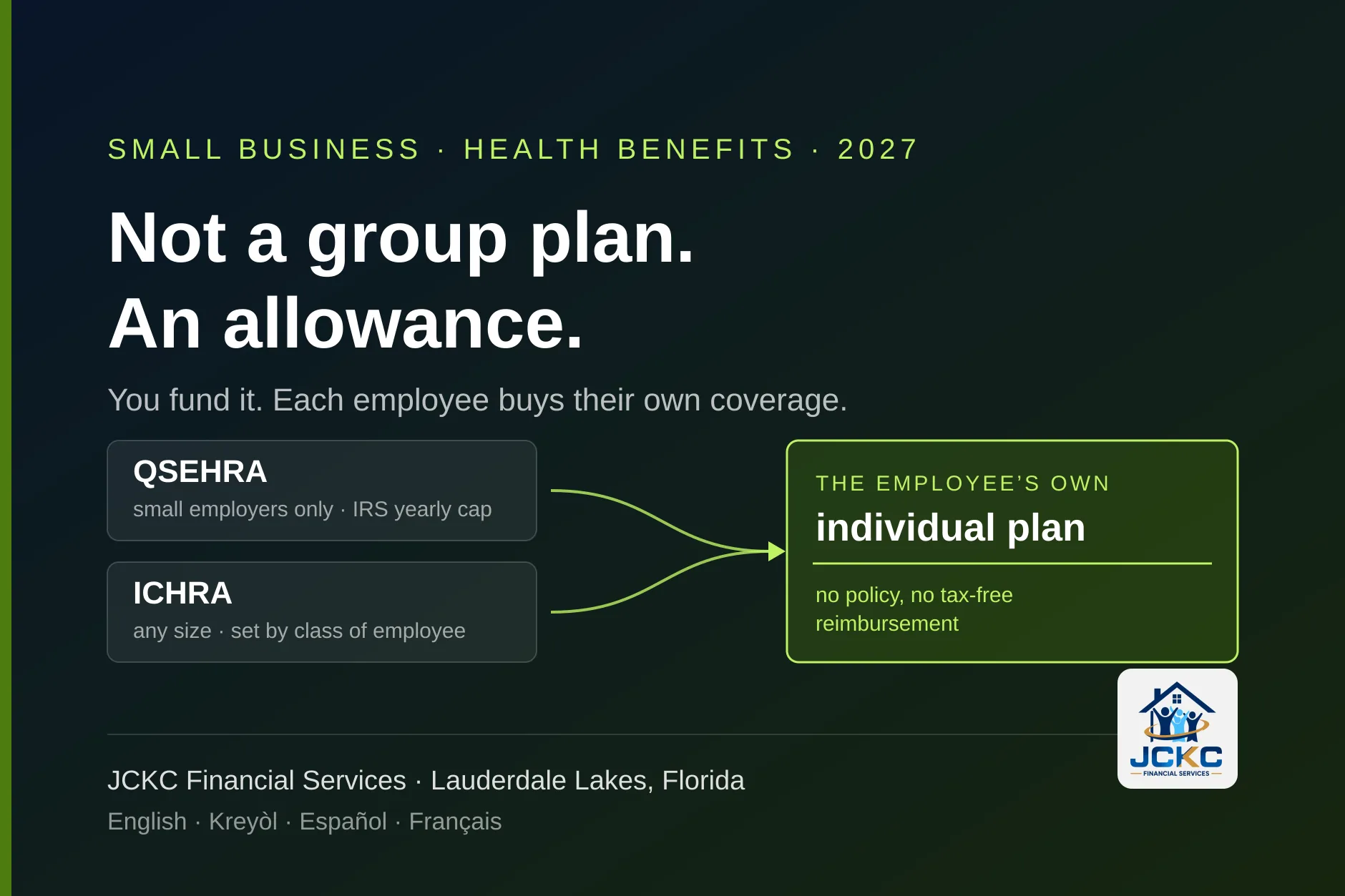
1. An allowance, not a group plan
A small business that wants to help with health insurance has traditionally had one option: buy a group plan, pay a share of every premium, and manage the renewal each year. Since 2017 for the QSEHRA, and since 2020 for the ICHRA under a 2019 federal rule, there has been a second route. Both are health reimbursement arrangements, and both work the same basic way:5
- You decide an amount and put it in writing. You are not buying insurance and you do not pick a carrier.
- Each employee buys their own health insurance — usually an individual plan on HealthCare.gov or directly from a carrier.
- The employee shows proof of coverage and submits premiums (and, if your plan allows, other medical expenses). You reimburse them up to the amount you set.
- Done properly, the reimbursement is not taxable income to the employee.
The two arrangements differ in who may offer them, how much you can give, and whether you can treat groups of employees differently. They differ most of all in what they do to the premium tax credit an employee may already be getting. Your own coverage as the owner is a separate question; if that is what brought you here, start with health insurance for the self-employed in Florida.
2. The QSEHRA: for employers under 50
The qualified small employer health reimbursement arrangement is the simpler of the two, and the narrower. IRS Publication 15-B sets out who may use it and how:2
- You must not be an applicable large employer — that is, you did not employ at least 50 full-time employees, counting full-time equivalents, in the prior calendar year.
- You must not offer any group health plan to any employee, including another HRA or a health FSA.
- You fund it entirely. No salary reductions, no employee contributions into it.
- Same terms for every eligible employee. The amount may vary only with age and family size, in line with how an individual policy’s price varies.
- Some employees may be left out: those with under 90 days of service, those under 25 before the plan year begins, part-time or seasonal staff, union employees whose health benefits were bargained, and nonresident aliens with no US earned income.
- The yearly amount you give appears on the employee’s Form W-2, in box 12 with code FF — the full amount available, not what was actually reimbursed.
IRS Notice 2017-67 adds three details that catch small employers. An eligible employee cannot decline the QSEHRA; you provide it, rather than offer it. Reimbursements are tax-free only for months the employee has minimum essential coverage, which can include a spouse’s employer plan. And if your business grows to 50 or more, you stop being an eligible employer on January 1 of the following year.1
A dental plan alone rules out a QSEHRA
Notice 2017-67 says a group health plan includes a plan that provides only excepted benefits, such as dental or vision, if the employer offers it. So a business that pays for a small group dental plan cannot also offer a QSEHRA. The same notice warns that endorsing a particular policy, form or insurer can itself create a group plan. Telling employees about the Marketplace and the premium tax credit does not.
3. The 2026 limits, and what is pending for 2027
The QSEHRA has a statutory cap, adjusted for inflation each year. For 2026 the IRS limits are $6,450 for self-only coverage and $13,100 for family coverage. You can give less; you cannot give more. A new hire who joins mid-year gets a prorated amount.2
The 2027 limits are not yet published. As of October 30, 2026, the IRS had not released its tax year 2027 inflation adjustments; its list of October 2026 news releases contains none. For comparison, the 2026 figures came in Revenue Procedure 2025-32, announced on October 9, 2025, so the 2027 ones normally appear in October or November. We will not guess a number, and you should not plan around one that a website has projected.34
The IRS anticipated this gap. Because the indexed amounts are not expected before October, and the notice to employees is due 90 days before the year begins, Notice 2017-67 says you may set the permitted benefit for a year using the prior year’s statutory limits. In practice: if you want to start a QSEHRA for 2027 before the IRS publishes, set your amounts at or below the 2026 figures.1
4. The ICHRA: any size, set by class
The individual coverage HRA came from a rule the Treasury, Labor and Health and Human Services departments published on June 20, 2019, which applies to plan years beginning on or after January 1, 2020. The conditions are in the regulations at 29 CFR 2590.702-2 and its Treasury and HHS twins:56
- Any size of employer. There is no 50-employee ceiling, and no dollar cap on what you give.
- Every covered person must be enrolled in individual health insurance — or in Medicare — for each month the HRA covers them. A spouse’s group plan does not count here, unlike the QSEHRA.
- Classes of employees. You may set different amounts for different classes: full-time, part-time, salaried, hourly, seasonal, employees whose primary work site is in a particular rating area, employees still in a waiting period, and a few others, or combinations of them.
- Same terms within a class. Inside a class the amount may rise only with age — the oldest may receive no more than three times the youngest — and with the number of dependents.
- No choice between an ICHRA and a group plan for the same class. You cannot let one employee pick between them. A plan of only dental or vision benefits does not count as a group plan for this rule.
- The employee may opt out once each plan year, which matters for their subsidy, as section 7 explains.
The regulation also has a minimum class size rule — 10 employees per class for an employer with fewer than 100 — but it applies only if you offer a traditional group plan to some classes and an ICHRA to others. A small business offering an ICHRA alone does not meet it.6
5. Side by side
Here are the two arrangements on the points a small Broward employer usually asks about:
| QSEHRA | ICHRA | |
|---|---|---|
| Who may offer it | Fewer than 50 full-time and equivalent employees, and no group health plan of any kind | Any employer |
| Yearly maximum | $6,450 self-only, $13,100 family (2026); 2027 pending | None set by law |
| Different amounts for different groups | No — same terms for all, varying only by age and family size | Yes, by class; within a class only by age (up to 3 to 1) and family size |
| Coverage the employee must hold | Any minimum essential coverage | Individual health insurance or Medicare |
| Can the employee decline it? | No | Yes, once each plan year |
| Dental or vision group plan alongside | Not allowed | Allowed |
| Notice to employees | 90 days before the year; late notice brings a penalty | 90 calendar days before the plan year; a condition of the arrangement |
| Affordability benchmark for subsidies | Second-lowest-cost silver plan | Lowest-cost silver plan |
Two rows decide most cases for a business of 2 to 20 people. If you want to treat part-time staff differently from full-time staff, only the ICHRA allows it. If some of your employees would be better off keeping a large premium tax credit, only the ICHRA lets them step aside.126
6. Where you, the owner, fit
Owners are usually the first people to ask, and the answer is usually no. Notice 2017-67 says a QSEHRA may only be provided to employees, and that a 2% shareholder of an S corporation who works in the business is not an employee for this purpose. Publication 15-B applies the same treatment to employer health benefits generally: a more-than-2% S corporation shareholder is treated like a partner, and a sole proprietor or partner is not an employee of their own business at all.12
So the arrangement is for your staff, and your own premiums usually go through the self-employed health insurance deduction instead. We explain that separately in can I deduct health insurance premiums if I am self-employed, and how an owner shops for their own 2027 plan in our self-employed Marketplace guide for Broward.
7. What it does to your employees’ subsidy
This is the part most explanations leave out, and in South Florida it matters more than the tax break. Many employees at small businesses here already buy a Marketplace plan with a premium tax credit. An HRA from you changes that credit, and the two arrangements change it differently:17
- QSEHRA. The employee must tell the Marketplace the amount of their allowance. The test compares the second-lowest-cost silver plan’s self-only premium, minus one twelfth of the allowance, with one twelfth of the required percentage of household income. If the remainder is within that line, the QSEHRA is affordable and the employee gets no premium tax credit. If not, the credit is reduced by one twelfth of the yearly allowance every month. The employee cannot decline the QSEHRA to avoid either outcome.
- ICHRA. The test uses the lowest-cost silver plan for self-only coverage in the rating area where the employee lives, minus the monthly allowance. If the ICHRA is affordable, the employee cannot get the credit, whether or not they accept it. If it is not affordable, the employee chooses: take your allowance and give up the credit, or opt out and keep the credit.
- In both cases, the allowance can simply replace help the employee was already getting from the government, rather than adding to it. For a lower-paid employee with a large credit, that is a real risk to weigh before you announce anything.
The required percentage comes from HealthCare.gov: 9.96% of household income in 2026 and 10.22% in 2027. As arithmetic only: for an employee whose household income is $40,000, 10.22% is $4,088 a year, or $340.67 a month. If that employee’s lowest-cost silver premium, minus the monthly ICHRA allowance, comes to $340.67 or less, the ICHRA is affordable and the credit is gone. Run the real numbers for each employee before you set an amount. Our guide to how premium tax credits work explains the credit itself.8
Getting the allowance wrong now costs the employee in full
For tax years beginning after December 31, 2025, there is no longer any cap on repaying advance premium tax credit an employee was not entitled to. An employee who forgets to report your allowance to the Marketplace, or who keeps a credit after an affordable ICHRA, can owe all of it back at tax time. Put the amount in writing, in the notice, and tell each employee to update their application.12
Before you set an amount
We can run the affordability test for each employee, with their real premium and income, and show you which arrangement helps and which one just replaces their subsidy.
8. The 90-day notice and the enrollment calendar
Both arrangements require a written notice to each eligible employee, and both use the same 90-day clock — with one important difference in what happens if you miss it. For a plan year that starts January 1, 2027, the date was October 3, 2026, which has passed:16
| Date | What it is |
|---|---|
| October 3, 2026 | 90 days before January 1, 2027: the notice date for a January 1 plan year (passed) |
| November 1, 2026 | HealthCare.gov Open Enrollment opens for 2027 coverage |
| December 15, 2026 | Last day for employees to enroll or change plans for coverage starting January 1 |
| January 1, 2027 | Notice date for an ICHRA or QSEHRA plan year starting April 1, 2027 |
| January 15, 2027 | Open Enrollment ends; enrollment from December 16 starts coverage February 1 |
| Within 60 days of the offer | Special Enrollment Period for an employee newly offered an ICHRA or QSEHRA |
For a QSEHRA, Notice 2017-67 is explicit: a late notice does not stop the arrangement from being a QSEHRA. It brings a penalty of $50 per employee, up to $2,500 per calendar year. For an ICHRA, the notice is written into the regulation as one of the conditions the HRA must meet; there is no small-penalty fallback. Two exceptions help: an employee who becomes eligible later gets the notice by the date the HRA first takes effect for them, and a business first established less than 120 days before its first plan year may deliver the notice by the date the HRA takes effect. Your employees, meanwhile, can buy their own coverage in Open Enrollment, and an offer of either arrangement also opens a Special Enrollment Period. HealthCare.gov says that one must be completed through the Marketplace Call Center, not online.910
An April 1 start is not a compromise
An HRA plan year does not have to follow the calendar. An ICHRA that starts April 1, 2027 with the notice delivered by January 1 meets the 90-day rule cleanly, and your employees can still use Open Enrollment for January coverage in the meantime. The full 2027 enrollment calendar, including why December 15 matters, is in our article on the 2027 Marketplace dates.
9. The South Florida fact that changes the math
Florida sets individual-market premiums by county. CMS lists 67 rating areas, one for each county: Broward is Rating Area 6, Miami-Dade is 43 and Palm Beach is 50. A small business in Lauderdale Lakes often has people who live in all three.11
That matters for the ICHRA in two ways. The affordability test uses the lowest-cost silver premium in the rating area where each employee lives, so the same allowance can be affordable for a worker in Sunrise and unaffordable for a coworker who commutes from Miami Gardens or Boca Raton. And while you may set classes by rating area, the regulation ties that class to the employee’s primary site of employment, not their home — so a single-location business cannot use it to give a Miami-Dade resident a different amount from a Broward one. Check each employee’s own county before you choose a figure.67
10. Which one fits your business
There is no single right answer, but for a business of 2 to 20 people the pattern is fairly consistent:
- A QSEHRA usually fits when everyone is treated alike, nobody needs the option to decline, you offer no dental or vision group plan, and you want the simplest arrangement with a known cap.
- An ICHRA usually fits when you want different amounts for full-time and part-time staff, when some employees would do better keeping their premium tax credit, when you expect to grow past 50, or when you want to keep a group dental plan.
- Neither may fit when most of your staff have low household incomes and large credits. An allowance that wipes out a credit leaves them no better off. A raise is taxable and raises household income, so it can lower the credit too, but not dollar for dollar; it may be the honest answer.
- Either one needs a written plan document, a notice, proof of coverage before every reimbursement, and payroll reporting. Budget for an administrator if you do not want to do that yourself.
11. What to do, and by when
If you are considering either arrangement for 2027, this is the order we would take it in:
- Count your employees the way the IRS does, including full-time equivalents, and list any group coverage you offer today — dental and vision included.
- For each employee, note household size, rough household income and county of residence, and whether they already have a Marketplace plan with a credit.
- Run the affordability test at the amount you are considering, using the 2027 percentage of 10.22%. This is where most of the decision is made.
- Pick a plan year that gives you 90 days. For an ICHRA that now means April 1, 2027 or later, unless your business is newly established.
- If you choose a QSEHRA for 2027 before the IRS publishes, set amounts at or below the 2026 limits of $6,450 and $13,100.
- Deliver the written notice — email is allowed for a QSEHRA under the IRS electronic delivery rules — and tell each employee to report the amount to the Marketplace.
- Help each employee get their own coverage in Open Enrollment by December 15 for January 1, or through the Special Enrollment Period. Do not choose the plan for them.
12. Frequently asked questions
What is the difference between a QSEHRA and an ICHRA?
Both let an employer reimburse employees, tax-free, for health insurance they buy themselves. A QSEHRA is only for employers with fewer than 50 full-time and full-time-equivalent employees that offer no group health plan at all, it has a yearly dollar cap set by the IRS, and every eligible employee gets it on the same terms. An ICHRA works for an employer of any size, has no dollar cap, and lets you set different amounts for different classes of employees, such as full-time and part-time. The ICHRA requires individual health insurance (or Medicare); the QSEHRA accepts any minimum essential coverage.
What are the QSEHRA limits for 2027?
Not published yet. As of October 30, 2026 the IRS had not released its tax year 2027 inflation adjustments. The 2026 limits are $6,450 for self-only and $13,100 for family coverage, from IRS Publication 15-B. The 2026 figures were announced on October 9, 2025, so the 2027 ones normally arrive in October or November. IRS Notice 2017-67 allows you to set next year’s benefit using this year’s limits for exactly this reason.
Can I, as the owner, be reimbursed through my own QSEHRA or ICHRA?
Generally not. These arrangements are for employees. A sole proprietor or partner is not an employee, and the IRS says a more-than-2% shareholder of an S corporation is not treated as an employee for these health benefits either. Owners usually take the self-employed health insurance deduction instead, which we cover in a separate answer.
Will offering an ICHRA or QSEHRA cost my employees their ACA subsidy?
It can. If the arrangement is “affordable” under the IRS test, the employee cannot get a premium tax credit for those months. With an ICHRA that is not affordable, the employee can opt out and keep the credit. With a QSEHRA the employee cannot opt out; if it is not affordable, their credit is reduced by one twelfth of the yearly allowance each month. For lower-paid staff, the allowance can end up replacing help they already had rather than adding to it.
Is it too late to start one on January 1, 2027?
The notice deadline for a January 1 plan year was October 3, 2026, ninety days earlier. A QSEHRA can still start on January 1: a late notice brings a penalty of $50 per employee, capped at $2,500 a year, but the arrangement still qualifies. For an ICHRA the notice is one of the conditions the regulation sets, so we would not start one on a late notice; an April 1, 2027 plan year with the notice delivered by January 1 is the cleaner route, unless your business was established less than 120 days before the plan year begins.
Do my employees have to buy their insurance during Open Enrollment?
Not necessarily, and we can help each employee with either route. Open Enrollment for 2027 Marketplace coverage runs from November 1, 2026 to January 15, 2027, with December 15 the last day for coverage starting January 1. Separately, being newly offered an ICHRA or a QSEHRA gives an employee a Special Enrollment Period, within 60 days before or after the offer. HealthCare.gov says that enrollment has to be completed through the Marketplace Call Center, not online.
Can I offer dental or vision insurance and a QSEHRA?
No. To offer a QSEHRA you must not offer any group health plan, and IRS Notice 2017-67 says that includes a plan of only dental or vision benefits. An ICHRA is different: the rule that keeps you from offering an ICHRA and a group plan to the same class does not count a plan of only excepted benefits, so a stand-alone dental or vision plan can sit beside an ICHRA.
Can I choose the health plan for my employees?
You should not. Each employee buys their own individual policy. IRS guidance warns that an employer endorsing a particular policy, form or insurer can turn the arrangement into a group health plan. Giving employees information about the Marketplace and the premium tax credit is not an endorsement. As an independent broker we help each employee individually, from the carriers we represent.
13. Sources
- Internal Revenue Service, Notice 2017-67, Internal Revenue Bulletin 2017-47 — eligible employer and excepted benefits (section A), Q&A-7 on becoming a large employer, Q&A-9 on 2% shareholders, Q&A-11 on waiver, Q&A-26 on using prior-year limits, section E on the written notice and the $50 / $2,500 penalty, Q&A-38 on notice content, Q&A-48 on a spouse’s plan, section K on the premium tax credit, Q&A-72 on late notice. Read October 30, 2026.
- Internal Revenue Service, Publication 15-B (2026), Employer’s Tax Guide to Fringe Benefits — QSEHRA limits of $6,450 and $13,100 for 2026, eligible employer, excludable employees, Form W-2 code FF; Accident and Health Benefits, exception for S corporation shareholders. Read October 30, 2026.
- Internal Revenue Service, IR-2025-103, October 9, 2025 — tax year 2026 inflation adjustments, published in Revenue Procedure 2025-32. Read October 30, 2026.
- Internal Revenue Service, News releases for current month, last updated October 29, 2026 — no tax year 2027 inflation-adjustment release listed. Read October 30, 2026.
- Departments of the Treasury, Labor and Health and Human Services, Health Reimbursement Arrangements and Other Account-Based Group Health Plans, 84 FR 28888, June 20, 2019 — final rule creating the individual coverage HRA and the special enrollment period; applies to plan years beginning on or after January 1, 2020. Read October 30, 2026.
- Electronic Code of Federal Regulations, 29 CFR 2590.702-2 — individual coverage HRA conditions: enrollment in individual coverage (c)(1), no choice with a traditional group plan (c)(2), same terms and the three-to-one age limit (c)(3), opt-out (c)(4), notice timing (c)(6), classes (d)(2), minimum class size (d)(3). Read October 30, 2026.
- Electronic Code of Federal Regulations, 26 CFR 1.36B-2 — premium tax credit eligibility for an employee offered an individual coverage HRA, (c)(3)(i)(B), and the affordability test using the lowest-cost silver plan, (c)(5). Read October 30, 2026.
- HealthCare.gov, Affordable coverage — 9.96% of household income in 2026 and 10.22% in 2027. Read October 30, 2026.
- HealthCare.gov, When can you get health insurance? — Open Enrollment from November 1; December 15 for coverage starting January 1; January 15 Open Enrollment ends; February 1 start for enrollment December 16 to January 15. Read October 30, 2026.
- HealthCare.gov, Getting health coverage outside Open Enrollment — Special Enrollment Period for an offer of an individual coverage HRA or QSEHRA in the past 60 days or expected in the next 60 days, completed through the Marketplace Call Center. Read October 30, 2026.
- Centers for Medicare & Medicaid Services, Florida Specific Geographic Rating Areas — 67 rating areas, one per county; Broward 6, Miami-Dade 43, Palm Beach 50. Read October 30, 2026.
- Internal Revenue Service, Working Families Tax Cuts — removal of limitations on repayment of excess advance premium tax credit for tax years beginning after December 31, 2025. Read October 30, 2026.
For general information only, and not tax or legal advice. This article describes federal rules as published, with a link to each source. JCKC Financial Services is a licensed insurance brokerage and tax practice, not a law firm or an HRA administrator, and nothing here is tax or legal advice about your business. An HRA requires a written plan document and must be operated according to it; consult a benefits attorney or an HRA administrator for the plan document. Figures are for the years stated; the 2027 QSEHRA limits had not been published when this was written.