

General information, not tax advice for your business
Every figure below is for the 2026 tax year and links to the IRS or Florida Department of Revenue page that publishes it. Whether a move makes sense for you depends on your entity, your profit, your payroll and your cash, which this article cannot see. JCKC prepares small-business returns and plans year-end with owners every December; bring your numbers and we will go through them with you.
1. Three deadlines, not one
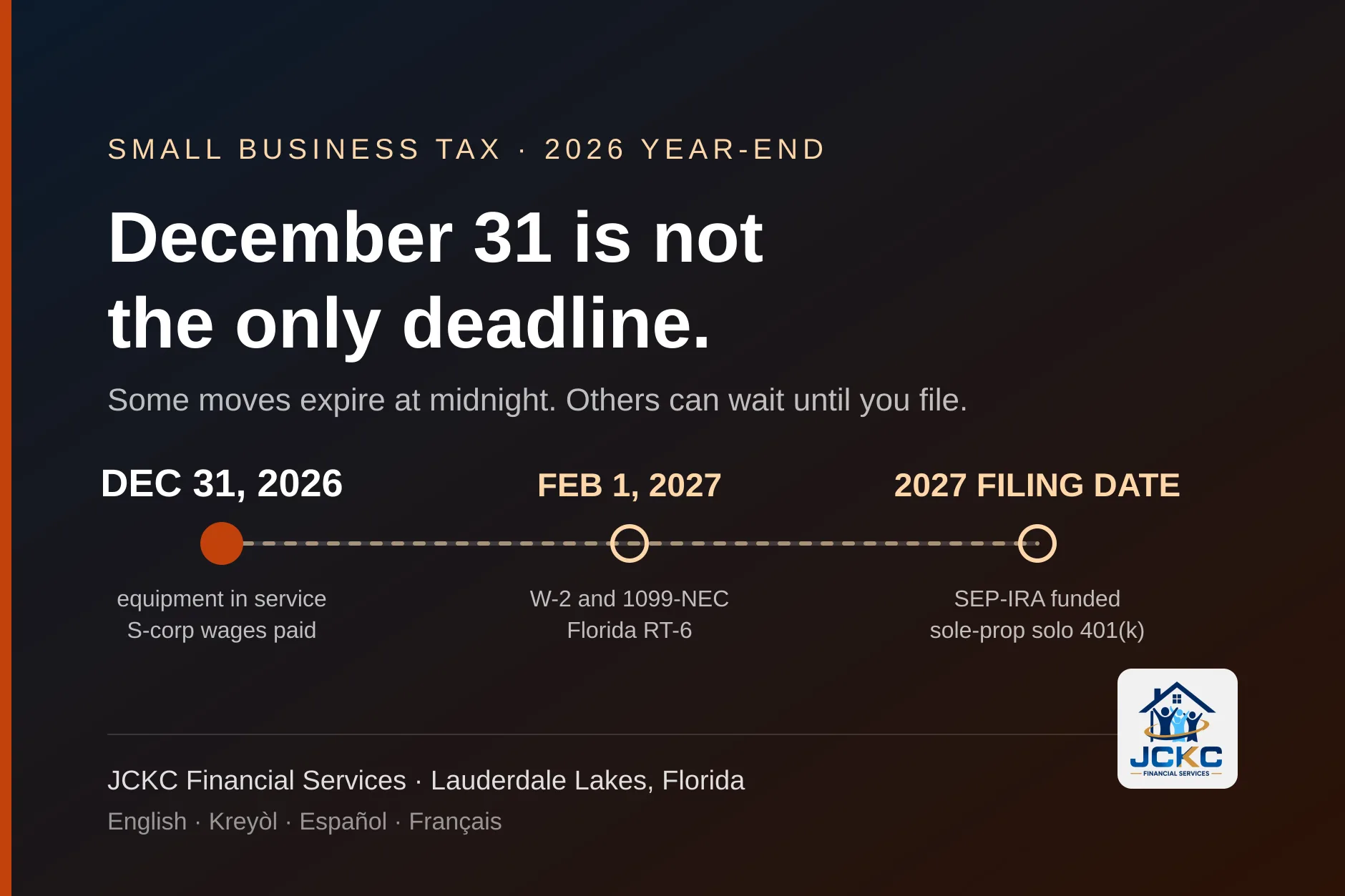
Year-end lists usually put everything under one heading: do it before December 31. That is how owners end up rushing a retirement contribution they could have made in March, while missing the two or three things that genuinely expire at midnight. For a small business on a calendar year, the 2026 moves sort into three dates:
| Move | Real deadline | Why |
|---|---|---|
| Put equipment, vehicles and software in service | December 31, 2026 | Section 179 and bonus depreciation follow the year the property is placed in service |
| Pay S-corporation owner wages through payroll | December 31, 2026 | Wages count in the year they are paid; a January catch-up is a 2027 wage |
| Report a 2% shareholder’s health premiums as wages | Last 2026 payroll | They must appear in Box 1 of the 2026 W-2 |
| Start solo 401(k) deferrals as an S-corporation owner | Last 2026 payroll | Deferrals come out of wages the corporation pays |
| Collect a Form W-9 from every contractor | Before you pay them, or now | You need the taxpayer ID to file the 1099-NEC |
| File 2026 Forms W-2 and 1099-NEC | February 1, 2027 | January 31, 2027 is a Sunday; the next business day applies |
| File the Florida Q4 2026 reemployment report (RT-6) | February 1, 2027 | Due by January 31; a weekend moves it to the next working day |
| Adopt a solo 401(k) as a sole proprietor with no employees | Your 2026 filing deadline, without extensions | Allowed after year-end since 2023 |
| Set up and fund a SEP-IRA | Your 2026 return due date, including extensions | The IRS allows SEP set-up after year-end |
The two February dates are worth a second look. Form 1099-NEC is due January 31 by statute and the 2026 W-2 instructions print February 1, 2027 for the W-2; the reason they line up is that January 31, 2027 is a Sunday, and the IRS treats a filing on the next business day as timely. That is the last day, not a grace period. Plan to have the forms done in the third week of January.911
2. Equipment: in service by December 31
For tax years beginning in 2026, the IRS sets the Section 179 limit at $2,560,000, reduced dollar for dollar once the cost of qualifying property you place in service during the year passes $4,090,000. Sport utility vehicles have their own Section 179 cap of $32,000 for 2026. Those ceilings are far above what most South Florida small businesses spend in a year, so the limit is rarely what decides the deduction. The calendar is.1
The 2025 federal law also made 100% bonus depreciation permanent for qualified property acquired after January 19, 2025, and the IRS issued its guidance on it, Notice 2026-11, in January 2026. Our guide to the 2026 tax changes explains what changed and why; what matters in December is how the deduction is earned:2
- In service, not on order. Both deductions belong to the year the property is ready and available for its use in your business. A van paid for on December 20 and delivered on January 6 is a 2027 deduction, whatever the invoice date says.
- Business use, documented. A vehicle used partly for personal driving is deductible only for its business share. If the share is not written down, the deduction is an argument you will have later.
- A deduction is not a refund of the price. Expensing a $40,000 truck reduces taxable profit by $40,000; it does not return $40,000. Buy what the business needs, and let the rules decide which year it lands in.
- Keep the purchase records for years. If you sell the equipment later, the deduction you took now affects the gain then. More on records in section 9.
Do not buy for the deduction alone
The most expensive December habit we see is spending real cash to save a fraction of it in tax. If the purchase was coming anyway in the first quarter of 2027, bringing it into service before December 31 can make sense. If it was not coming at all, the tax saved does not pay for it.
3. The 20% pass-through deduction after the 2025 law
The qualified business income deduction, which lets most sole proprietors, partners and S-corporation owners deduct up to 20% of qualifying business profit, did not expire after 2025. The IRS says plainly in its 2026 Publication 505 that recent legislation made it permanent. Two changes start with 2026: a minimum deduction of $400 if you have at least $1,000 of qualified business income from an active trade or business, and wider phase-in ranges, $150,000 for married couples filing jointly and $75,000 for everyone else.3
We are not repeating the 2026 income thresholds here; they are in our 2026 tax changes guide, and two copies of a figure is how one of them goes stale. The year-end point is simpler. The limits work off your taxable income, so the other moves in this article, an equipment purchase, an S-corporation salary, a retirement contribution, all move the QBI deduction at the same time. If your 2026 income is anywhere near a threshold, run the numbers together in December rather than one at a time in April.
4. S-corporation owners: salary and health premiums
If you own an S corporation, the IRS’s position is direct: the corporation “must pay reasonable compensation to a shareholder-employee in return for services that the employee provides to the corporation before non-wage distributions may be made.” It can reclassify distributions as wages, and the courts have backed it. There is no percentage in the law. The IRS looks at the facts, including:8
- your training and experience, and your duties and responsibilities;
- the time and effort you devote to the business;
- what comparable businesses pay for similar services;
- the business’s dividend history and what it pays non-shareholder employees;
- how and when bonuses are paid to key people, and any compensation agreement or formula.
December is when that becomes a deadline, because 2026 wages have to be paid in 2026. The same is true of health insurance. If you own more than 2% of the corporation, the premiums the corporation pays for you are reported as wages in Box 1 of your W-2, though not in the Social Security and Medicare boxes, and that is what allows the self-employed health insurance deduction on your own return. The IRS’s bottom line is that the premiums “must ultimately be paid by the S corporation and must be reported as taxable compensation in the shareholder’s W-2.” If your payroll provider does not know the premium amount before the last 2026 payroll, it will not be on the form.8
Florida looks at the same question from its side. The Department of Revenue says it may reclassify distributions as wages for reemployment tax when a corporate officer performs services for the corporation and reports zero wages but receives a significant distribution. An S corporation that pays its owner nothing on payroll is exposed twice, federally and in Tallahassee.12
5. Retirement plans: what December decides
The 2026 limits below come from the IRS’s cost-of-living table, published under Notice 2025-67 in late 2025. The 2027 limits had not been published when this article was written; the IRS normally announces the next year’s figures in the autumn, so check before you rely on any 2027 number.4
| Plan | 2026 limit | Set up by | Note |
|---|---|---|---|
| SEP-IRA | Up to $72,000; compensation counted up to $360,000 | Your 2026 return due date, including extensions | Employer contributions only; eligible employees generally have to be covered too |
| Solo 401(k), employee deferral | $24,500; plus $8,000 catch-up at 50 or older, or $11,250 at ages 60 to 63 | Sole proprietor: 2026 filing deadline without extensions. S-corp owner: through 2026 payroll | Deferrals and employer contributions together are capped at $72,000, before catch-up |
| Solo 401(k), employer contribution | Up to 25% of compensation as the plan defines it, within the $72,000 total | With the plan | Self-employed people use a special calculation on net earnings |
| SIMPLE IRA | $17,000; plus $4,000 catch-up | Closed for 2026: set-up window was January 1 to October 1 | An option to look at for 2027 |
| Traditional or Roth IRA | $7,500; plus $1,100 catch-up at 50 or older | Not a business plan | Can sit alongside a SEP or solo 401(k) |
The deadlines are where most owners get it wrong in both directions. A SEP can be set up for 2026 as late as your 2026 return’s due date including extensions, so there is no reason to open one in a hurry on December 30. A sole proprietor with no employees can also adopt a 401(k) after the year ends, but only up to the filing deadline without extensions, a stricter date. An S-corporation owner is in a different position: the elective deferral comes out of wages the corporation pays, so the plan and your deferral election need to be in place for the 2026 payroll that carries it.56
Two practical details. For a sole proprietor, “compensation” for these plans is net earnings from self-employment after deducting half of your self-employment tax and the contribution itself, which is why the IRS points to the rate table in Publication 560 instead of a flat 25%. And a one-participant 401(k) generally has to file Form 5500-EZ once its assets reach $250,000 at year-end. Our 2026 tax guide for the self-employed covers how these plans compare in more depth.7
If you have employees, the solo plans stop being solo
A one-participant 401(k) covers you, or you and your spouse. Once you hire employees who meet the plan’s eligibility rules, they have to be included and testing applies. A SEP has to cover eligible employees as well. If you are hiring in 2027, choose the plan with that in mind, and look at how a QSEHRA or ICHRA compares if health coverage is part of the same decision.
Six weeks left in the 2026 tax year
Bring your year-to-date numbers. We will tell you which moves still count for 2026, and which can wait until you file.
6. Paying contractors: the 1099-NEC
For payments made in 2026, the threshold for filing Form 1099-NEC for a contractor, and for most other payments on the 1099 forms, is $2,000, up from the $600 that applied for decades. The IRS says the figure will be adjusted for inflation beginning in 2027; the 2027 amount has not been published yet. The change is to paperwork only. A contractor you paid $1,500 still owes tax on it, and the IRS reminds payees that all business income is reportable whether or not a form arrives.910
- Collect W-9s now. A 1099-NEC needs the contractor’s name and taxpayer identification number. Asking in December is easier than chasing a former subcontractor in late January.
- Add up by person, not by invoice. The $2,000 test is the total you paid one person for the year. Three jobs of $800 is a 1099.
- The deadline is February 1, 2027. Form 1099-NEC is due January 31 by statute; January 31, 2027 is a Sunday, so the next business day applies, for the IRS copy and the contractor’s copy.
- Electronic filing has changed. From the 2027 filing season the IRS’s IRIS system is the only intake system for information returns; the older FIRE system has been retired. If you file ten or more information returns in total, you are generally required to file electronically.
Payments by card or through a payment app are generally reported by the payment company, not by you, and the rules for those forms are different. Our 2026 changes guide explains the Form 1099-K threshold; we do not repeat it here.9
7. Payroll year-end and the W-2
If you have employees, including yourself as an S-corporation owner, the 2026 Forms W-2 and W-3 are due to the Social Security Administration on February 1, 2027, on paper or electronically, and employees must have their copies by the same date. An extension to file with the SSA is not automatic; it takes a request on Form 8809 that meets the criteria. Three things are new or worth checking for the 2026 forms:11
- Tips and overtime have their own boxes. Box 12 code TP reports cash tips, code TT reports qualified overtime, and new box 14b carries the tipped-occupation code. If your employees are counting on the new deductions, your W-2 is what proves their amounts. The deductions themselves are explained in our tips and overtime guide.
- Penalties went up. The failure-to-file and failure-to-furnish penalties have been adjusted for inflation for returns required to be filed after December 31, 2026, which includes the 2026 W-2s.
- Names and Social Security numbers. Mismatches are the most common reason a W-2 bounces. Confirm them in December, while the employee is still easy to reach.
The 2026 Social Security wage base is $184,500. If you or an employee earned above it in 2026, the Social Security portion of payroll tax stops at that figure; the Medicare portion does not.34
8. Florida: reemployment tax and corporate income tax
Florida does not tax your personal income, but if you have employees it does charge reemployment tax, the state’s unemployment tax, on the first $7,000 of each employee’s wages per calendar year. A new employer pays 2.7% until it has reported for ten quarters; after that the rate is set by the account’s own history, between a 2026 minimum of 0.1%, or $7 per employee, and a maximum of 5.4%, or $378 per employee. What to do at year-end:13
- File the fourth-quarter report. Form RT-6 for October to December 2026 is due by January 31. When the last day of the month is a Saturday, Sunday or legal holiday, the filing period runs to the end of the next working day, which makes it Monday, February 1, 2027.
- Pay a day early if you pay online. An electronic payment has to be initiated, with a confirmation number, by 5:00 p.m. Eastern on the business day before the due date.
- File even if you owe nothing. The Department requires a report for every quarter, even with no wages to report.
- Get the Social Security numbers right. An erroneous or incomplete report, including a wrong SSN, carries a penalty of $50 or 10% of tax due, whichever is greater, up to $300 per report. An ITIN is not accepted in place of an SSN on this report.
Florida’s corporate income tax is the other state item, and for most of our clients it does not apply. It is imposed on corporations and on entities taxed federally as corporations, at 5.5% of Florida net income after a $50,000 exemption. A sole proprietorship or a single-member LLC owned by an individual does not file, and an S corporation files only if it pays federal income tax at the corporate level. If you do run a C corporation, the Florida return, Form F-1120, is generally due the later of the first day of the fifth month after year-end or 15 days after the federal due date.14
9. Records to keep
December is a good month to make the 2026 file complete, because the receipts are still on the desk. The IRS ties how long to keep records to the period in which a return can be changed or assessed:15
- Three years after you file, for most records that support your income and deductions.
- At least four years for employment tax records, after the tax is due or paid, whichever is later.
- Until the limitations period ends for the year you dispose of it, for property. If you expense a truck in 2026 and sell it in 2031, the purchase records stay until the 2031 return can no longer be examined.
- Longer if income was substantially under-reported, and indefinitely if a return was not filed.
10. What we see in South Florida
Most of the businesses we prepare returns for in Lauderdale Lakes, Lauderhill, Sunrise and across Broward County are small: a contractor with two or three regular subcontractors, a salon with chair renters, a home-care or transport business run by a husband and wife, a corner restaurant. Three patterns come up every December. First, subcontractors paid in cash or by app without a W-9 on file, which turns February into a hunt. Second, S-corporation owners who took distributions all year and no salary, which the IRS and the Florida Department of Revenue both treat as a problem. Third, equipment bought in December for the deduction and delivered in January, which moves the deduction a year.
None of this needs to be complicated, but it does need to be done in the right month. We sit down with owners in English, Haitian Creole, French and Spanish, in our Lauderdale Lakes office or online, and you keep copies of everything. Our tax services page explains what we prepare.
11. The December checklist
Here is the whole job, split the way we like to see it: what to settle now, what can wait, and by when.
- Before December 31, 2026: place any equipment you are buying for 2026 in service; run the S-corporation owner’s 2026 salary through payroll; give your payroll provider the 2% shareholder health premium figure; start solo 401(k) deferrals through payroll if you are an S-corporation owner who wants one for 2026.
- In December, while it is easy: collect a W-9 from every contractor you paid; total 2026 payments per contractor against the $2,000 line; confirm employee names and Social Security numbers; set up access to the IRS IRIS system if you file your own 1099s.
- By Friday, January 29, 2027: initiate any electronic Florida reemployment tax payment for the fourth quarter, so it is confirmed by 5:00 p.m. Eastern on the business day before the due date.
- By Monday, February 1, 2027: file and furnish 2026 Forms W-2 and W-3; file and furnish Forms 1099-NEC; file the Florida RT-6 for the fourth quarter.
- By your 2026 filing deadline: adopt and fund a solo 401(k) as a sole proprietor with no employees (without extensions), or set up and fund a SEP (including extensions).
- All year: keep the records in section 9, and send us the year-end statements as they arrive.
Asking questions does not commit you to anything. If you are not sure which of these applies to your business, that is exactly what a December appointment is for.
12. Frequently asked questions
Do I have to buy equipment before December 31 to deduct it for 2026?
You have to place it in service by December 31, which is not the same as ordering or paying for it. Both Section 179 and the 100% bonus depreciation deduction attach to the year the property is ready and in use in your business. A truck paid for on December 20 and delivered on January 6 is a 2027 deduction. For tax years beginning in 2026 the Section 179 limit is $2,560,000, reduced once qualifying purchases pass $4,090,000, so for most small businesses here the limit is not the constraint; profit and cash are.
Is it too late to open a retirement plan for 2026?
For most owners, no. The IRS lets you set up a SEP for a year as late as the due date of that year’s return, including extensions. A sole proprietor with no employees can also adopt a 401(k) after year-end, as long as it is adopted by the filing deadline without extensions. The one plan that is closed for 2026 is a new SIMPLE IRA, which had to be set up between January 1 and October 1. If you own an S corporation, treat a solo 401(k) as a December job, because your deferrals come out of the wages the corporation pays you.
When are the 2026 Forms W-2 and 1099-NEC due?
February 1, 2027. The W-2 instructions print that date for filing with the Social Security Administration and for giving employees their copies. Form 1099-NEC is due January 31 by statute, but January 31, 2027 is a Sunday, and the IRS treats a filing as timely on the next business day, which is Monday, February 1. Do not read that as an extra weekend to start the work; it is the last day.
Do I still need to send a 1099-NEC for a $900 job?
Not for payments made in 2026. The reporting threshold for most of these information returns rose from $600 to $2,000 for payments after 2025, and the IRS says it will be adjusted for inflation beginning in 2027. The 2027 figure has not been published yet. The contractor still owes tax on the $900; the change is only about whether a form is required.
How much should I pay myself from my S corporation?
There is no number in the law. The IRS requires an S corporation to pay a shareholder-employee reasonable compensation for the services they provide before it makes non-wage distributions, and it lists the factors it looks at: training and experience, duties, time devoted, what comparable businesses pay, and others. The amount is a judgement about your business, which is why we work it out with you rather than quote a percentage. What is not a judgement is the timing: wages for 2026 have to be paid through 2026 payroll.
My S corporation pays my health insurance. What has to happen at year-end?
If you own more than 2% of the corporation, the premiums paid for you have to appear as wages in Box 1 of your W-2, though not in the Social Security and Medicare boxes. That is what lets you take the self-employed health insurance deduction on your own return. If the premiums never reach the W-2, the deduction is in doubt. Tell your payroll provider before the last 2026 payroll, not after the W-2s are printed.
Does Florida tax my small business income?
Florida has no personal income tax, so profit from a sole proprietorship or an S corporation that flows to you is not taxed by the state. Florida’s corporate income tax applies to corporations and to LLCs taxed as corporations; an S corporation files only if it pays federal income tax at the corporate level. What most small employers here do owe the state is reemployment tax on the first $7,000 of each employee’s wages, with the fourth-quarter report due by January 31, which moves to February 1 in 2027.
Which records should I keep, and for how long?
The IRS says to keep records that support your return until the period of limitations runs out, generally three years; employment tax records at least four years; and records for property such as equipment you depreciated until the limitations period ends for the year you sell or dispose of it. For a truck you expense in 2026 and sell in 2031, that means keeping the purchase records well into the 2030s.
13. Sources
- Internal Revenue Service, Publication 946 (2025), How To Depreciate Property — “What’s New for 2026”: for tax years beginning in 2026, the maximum Section 179 deduction is $2,560,000, reduced by the amount by which the cost of Section 179 property placed in service during the year exceeds $4,090,000; $32,000 for sport utility vehicles. Read November 2, 2026.
- Internal Revenue Service, IR-2026-06, Treasury, IRS issue guidance on the additional first year depreciation deduction (January 14, 2026), announcing Notice 2026-11 on the permanent 100% additional first year depreciation deduction for qualified property acquired after January 19, 2025. Read November 2, 2026.
- Internal Revenue Service, Publication 505 (2026), Tax Withholding and Estimated Tax — What’s New: the qualified business income deduction made permanent; from 2026 a minimum deduction of $400 with at least $1,000 of qualified business income from an active trade or business; phase-in ranges of $150,000 (married filing jointly) and $75,000 (other filers); 2026 Social Security wage limit of $184,500. Read November 2, 2026.
- Internal Revenue Service, COLA increases for dollar limitations on benefits and contributions — 2026 column, from Notice 2025-67: elective deferrals $24,500; catch-up $8,000, or $11,250 for ages 60 to 63; defined contribution plan limit $72,000; compensation limit $360,000; SEP maximum contribution $72,000; SIMPLE $17,000 plus $4,000 catch-up; IRA $7,500 plus $1,100 catch-up; taxable wage base $184,500. Read November 2, 2026.
- Internal Revenue Service, Retirement plans for self-employed people — a SEP may be set up for a year as late as the due date, including extensions, of the income tax return for that year; a SIMPLE IRA plan may be set up from January 1 through October 1. (The dollar limits on that page are for earlier years and are not used here.) Read November 2, 2026.
- Internal Revenue Service, Publication 560 (2025), Retirement Plans for Small Business — Reminders: for 2023 and later years, a sole proprietor with no employees can adopt a section 401(k) plan after the end of the tax year, provided it is adopted by the tax filing deadline without regard to extensions. Read November 2, 2026.
- Internal Revenue Service, One-participant 401(k) plans — contributions as employee and employer; compensation for the self-employed is net earnings after half of self-employment tax and the contributions; Form 5500-EZ generally required at $250,000 or more in plan assets; employees who become eligible must be included. Read November 2, 2026.
- Internal Revenue Service, S corporation compensation and medical insurance issues — reasonable compensation before non-wage distributions; factors the IRS considers; premiums for a more-than-2% shareholder reported in Box 1 of Form W-2 and not Boxes 3 and 5; requirements for the above-the-line deduction. Read November 2, 2026.
- Internal Revenue Service, Publication 1099 (2026), General Instructions for Certain Information Returns — reporting threshold increased to $2,000 for tax years beginning after 2025, to be adjusted for inflation beginning in 2027; due dates falling on a Saturday, Sunday or legal holiday are timely on the next business day; IRIS the only intake system from the 2027 filing season; electronic filing required at 10 or more returns in aggregate. Read November 2, 2026.
- Internal Revenue Service, Understanding the Working Families Tax Cuts: Business Tax Provisions, video text script — the 1099-NEC and 1099-MISC threshold of $2,000 for payments made after December 31, 2025; payees must still report all business income. Read November 2, 2026.
- Internal Revenue Service, General Instructions for Forms W-2 and W-3 (2026) — 2026 Forms W-2 and W-3 due to the SSA on February 1, 2027; employee copies by February 1, 2027; extensions not automatic; box 12 codes TP and TT and box 14b; penalties increased for returns required to be filed after December 31, 2026. Read November 2, 2026.
- Florida Department of Revenue, Reemployment Tax Report and Payment Information — Form RT-6 due dates by quarter, the next-working-day rule, the 5:00 p.m. ET electronic payment cutoff, the requirement to file with no wages, the erroneous-report penalty, and reclassification of distributions as wages for an officer reporting zero wages. Read November 2, 2026.
- Florida Department of Revenue, Reemployment Tax Rate Information — initial rate 2.7% for the first 10 quarters; 2026 minimum 0.1% ($7 per employee) and maximum 5.4% ($378 per employee) on wages up to $7,000 per employee. Read November 2, 2026.
- Florida Department of Revenue, Florida Corporate Income Tax — who must file, including S corporations only where federal tax is paid at the corporate level; $50,000 exemption; 5.5% rate for years beginning on or after January 1, 2022; Form F-1120 due dates. Read November 2, 2026.
- Internal Revenue Service, How long should I keep records? — periods of limitations for income tax records, employment tax records and property records. Read November 2, 2026.
For general information only, and not tax advice. JCKC Financial Services is a licensed insurance brokerage that also provides tax preparation and notary services. We are not a law firm and do not provide legal advice. Tax laws, rates, thresholds and deadlines are set by federal and Florida law and by IRS and Florida Department of Revenue procedure, and they change; the figures in this article are those published for the 2026 tax year as of the date it was written, and the 2027 figures it mentions had not yet been released. This article is general information, not tax, legal or financial advice for your business, and it is not a substitute for a review of your own books, entity and payroll.