

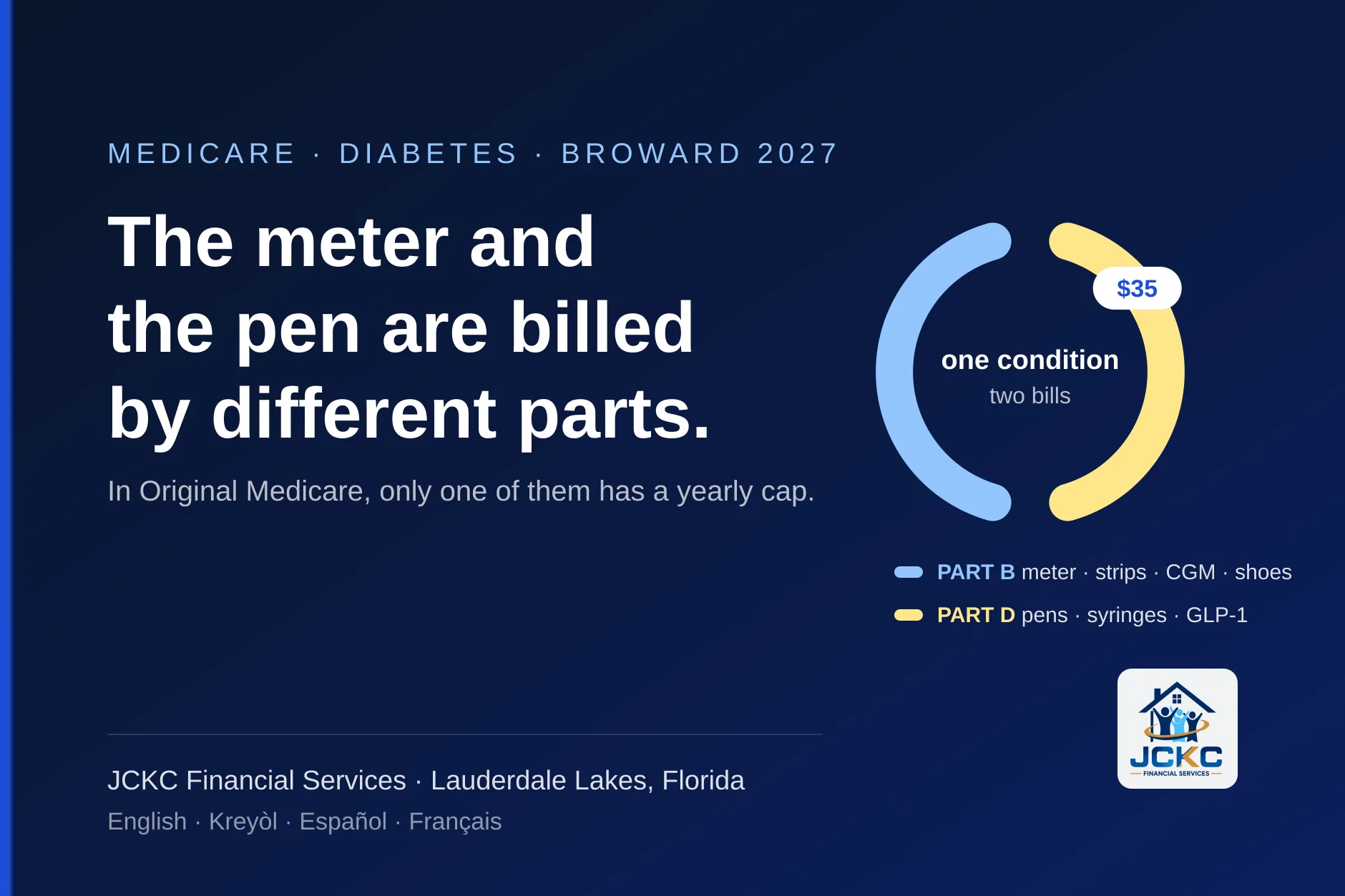
1. One condition, two parts of Medicare
With diabetes you are using both halves of Medicare at once. Equipment and training are medical benefits, paid by Part B; medicines from a pharmacy are drug benefits, paid by Part D; insulin sits on both sides. Here is the whole kit, as Medicare describes it:
| Item | Which part pays | What you pay in Original Medicare |
|---|---|---|
| Blood sugar meter, test strips, lancets | Part B (durable medical equipment) | 20% of the approved amount after the Part B deductible |
| Continuous glucose monitor and sensors | Part B, if you take insulin or have a history of low blood sugar | 20% after the deductible |
| Insulin used with a traditional pump covered as equipment | Part B | No more than $35 a month per product; no deductible |
| Insulin pens, vials, patch-pump insulin, inhaled insulin | Part D | No more than $35 a month per product; no deductible |
| Syringes, pen needles, alcohol swabs, gauze | Part D (Part B does not cover them) | Your drug plan’s cost-sharing |
| Diabetes tablets and non-insulin injections | Part D, per your plan’s formulary | Your plan’s copay or coinsurance, up to the $2,400 cap in 2027 |
| Therapeutic shoes and inserts | Part B, with severe diabetic foot disease | 20% after the deductible |
| Diabetes self-management training | Part B | 20% after the deductible |
| Medical nutrition therapy with a dietitian | Part B | $0 if you qualify |
| Eye exam for diabetic retinopathy | Part B, once a year | 20% after the deductible |
The column that matters most is the last one. Twenty percent of a Part B item has no annual ceiling under Original Medicare on its own, while the Part D items are protected by an out-of-pocket cap. A continuous glucose monitor and a year of sensors, a pair of therapeutic shoes and a course of training are all on the uncapped side. We explain the general split for every kind of drug in our guide to Part B and Part D drugs; this article stays with diabetes.167
2. The meter, the strips and the glucose monitor
Medicare classifies the meter and its supplies as durable medical equipment. That label decides three practical things: a doctor or other provider must order them for use at home, you pay 20 percent of the Medicare-approved amount once you have met the Part B deductible, and Medicare only pays when the supplier is enrolled in Medicare.1
- Meter and test strips. Covered under Part B as equipment and the supplies used with it.
- Lancets and lancet holders. Covered the same way, in set quantities: every three months, up to 300 lancets if you use insulin and 100 if you do not.
- The supplier matters as much as the item. A supplier that participates in Medicare must accept assignment and can charge you only the deductible and the 20 percent. A supplier that does not participate may charge more, and for rented equipment you can end up paying the full cost up front and waiting for Medicare to reimburse you. Ask before you order, not after the bill arrives.
The continuous glucose monitor is where expectations and the rule part company most often. Medicare covers a monitor and its sensors under Part B when you have diabetes, your provider has evaluated you and ordered it, you or a caregiver have been trained to use it, and you take insulin or have a history of problems with low blood sugar. You then pay 20 percent after the deductible, like any other equipment.2
A monitor is not automatic with a diagnosis
The condition that trips people up is the insulin-or-low-blood-sugar test. Somebody with type 2 diabetes controlled on tablets, with no record of hypoglycemia, does not meet it as Medicare.gov describes it, however useful a monitor would be. If your doctor believes you qualify, make sure the evaluation is done and recorded before the order goes to the supplier: Medicare.gov says the provider must evaluate you and make sure you are eligible before ordering a monitor.
3. Shoes, foot and eye care, and the classes
The rest of the Part B diabetes benefit is care rather than equipment, and most of it carries the same 20 percent. Each item has its own eligibility rule, which is why two people with the same diagnosis can get different answers:34
- Therapeutic shoes and inserts. For diabetes with severe diabetes-related foot disease. The doctor who treats your diabetes certifies the need, a podiatrist or other qualified doctor orders them, and you get them from a podiatrist, orthotist, prosthetist, pedorthist or other qualified supplier. Each calendar year: one pair of custom-molded shoes with two more pairs of inserts, or one pair of extra-depth shoes with three pairs of inserts.
- Foot exams and treatment. Every six months, if you have diabetic nerve damage in the lower legs with loss of protective sensation, as long as you have not seen a foot care professional for another reason in between.
- Eye exam for diabetic retinopathy. Once a year, from an eye doctor legally allowed to do the test in Florida. A hospital outpatient setting adds a copayment.
- Diabetes self-management training. Up to 10 hours in the first year (one hour individual, nine in a group), then up to two hours of follow-up each later year, on a provider’s order. It covers eating, activity, monitoring and medicines.
- Medical nutrition therapy. Three hours with a registered dietitian in the first calendar year and two hours a year after that, on a doctor’s referral. You pay nothing if you qualify.
The last two are the ones people leave on the table, and they cost little or nothing. Ask for the referral at your next visit.
4. If you have prediabetes rather than diabetes
A separate program exists for people who do not yet have diabetes. The Medicare Diabetes Prevention Program is a Part B benefit, costs you nothing if you qualify, and runs as 16 weekly sessions over six months with a trained coach, followed by six monthly follow-up sessions. It can be taken in person, live online, or self-paced online, and there is no limit to how many times you can participate.5
The eligibility rule is precise. Within the 12 months before your first session you need a hemoglobin A1c between 5.7 and 6.4 percent, a fasting plasma glucose of 110 to 125 mg/dL, or a two-hour glucose of 140 to 199 mg/dL; a body mass index of 25 or more (23 or more if you are Asian); and no diagnosis of type 1 or type 2 diabetes or end-stage renal disease. In other words it is for the person whose doctor said “borderline” this year, not for someone already being treated. In a Medicare Advantage plan you may need an in-network supplier.5
5. Insulin: two routes, one $35 limit
Insulin is the one diabetes item that can be paid by either part, depending on how it reaches your body:6
- Part B pays for insulin you use with an insulin pump that Medicare covers as durable medical equipment.
- Part D pays for insulin you inject with a pen or a needle, insulin used with disposable “patch” pumps changed every two to three days or with certain reusable pumps that take disposable cartridges, and inhaled insulin. It also pays for the syringes, needles, gauze and alcohol swabs.
- Part B does not pay for those supplies. Medicare says plainly that under Part B you pay all of the cost of insulin-related supplies unless you have Part D.
The cost was levelled across both sides. A one-month supply of each covered insulin product costs no more than $35, and you do not pay a deductible for insulin. A three-month supply can cost no more than $35 for each month, so generally no more than $105. Under Part D the $35 limit applies to everyone who takes insulin, including people who get Extra Help. If you are charged more than that at the counter for covered insulin, something is being billed wrongly and it is worth a call to the plan before you pay.6
6. Your drug plan in 2027
Everything else you collect at a pharmacy for diabetes — metformin and other tablets, non-insulin injections, the blood pressure and cholesterol medicines that usually travel with them — runs through your Part D plan, or the drug coverage built into a Medicare Advantage plan. For 2027, Medicare.gov publishes the limits. No plan may set a deductible above $700 (it was $615 in 2026), and some have none. After the deductible you generally pay 25 percent of the cost of covered drugs until your out-of-pocket spending on covered Part D drugs reaches $2,400 (it was $2,100 in 2026). From that point you pay nothing for covered Part D drugs for the rest of the calendar year.7
Two qualifications keep the cap honest. It counts what you spend on covered Part D drugs, including certain payments made on your behalf such as Extra Help; premiums do not count. And it is a Part D cap, so your meter, strips and monitor are outside it. We answer the common questions about it in what the 2027 Part D cap is, and if your problem is that the costs land all at once in January, the Medicare Prescription Payment Plan spreads them across the year without lowering them.7
The 2027 Part B premium and deductible are not out yet
CMS had not published the 2027 Part B premium or deductible when this was written on October 30, 2026. For 2026 they are $202.90 a month and $283 a year, announced on November 14, 2025, so the 2027 figures are expected in mid-November. The 20 percent coinsurance on your supplies does not move with them. We will update this page when CMS publishes.
Managing diabetes on Medicare?
We will sort your supplies and drugs into Part B and Part D, then price 2027 from the carriers we represent.
7. GLP-1 drugs, and the program that is not for you
GLP-1 drugs are where most of the confusion this autumn is coming from, because two different things are true at once. Medicare.gov is explicit about who the new program is for and who it is not for:8
- If you have type 2 diabetes, your Part D plan is the route. Medicare.gov says people with type 2 diabetes are not eligible for the Medicare GLP-1 Bridge “because your Medicare drug plan should cover GLP-1 medications to treat these conditions”. Whether a specific drug is on a specific plan’s 2027 formulary, at what tier, and whether it needs prior authorization, is decided plan by plan and year by year.
- The Medicare GLP-1 Bridge is for weight management. It runs from July 1, 2026 to December 31, 2027, for people with Part D coverage who are 18 or older and meet one of its BMI-and-condition rules: a BMI of 35 or more; or 30 or more with certain heart, blood pressure or kidney conditions; or 27 or more with prediabetes, a previous heart attack or stroke, or symptomatic peripheral artery disease. Your provider must certify that you are also in a diet-and-exercise program.
- It also excludes people with moderate-to-severe sleep apnea or fatty liver disease, and anyone already getting a GLP-1 through their Part D plan.
The Bridge has its own money rules, and they are not Part D’s. CMS sets a $50 copay. Because the program runs outside the Part D benefit, the Part D deductible does not apply, no part of the $50 counts toward the $2,400 out-of-pocket cap, and there is no Extra Help subsidy on it. CMS has also said the broader BALANCE model will not launch in Medicare in 2027, which is why the Bridge was extended to the end of 2027 instead. Medicare and Medicaid, in CMS’s words, “generally do not cover these drugs for the weight loss indication” outside that program.9
Prediabetes and diabetes are treated in opposite ways
This is the trap in one sentence: prediabetes can make you eligible for the GLP-1 Bridge, and a diagnosis of type 2 diabetes makes you ineligible for it. Someone with diabetes who is told about a “$50 Medicare GLP-1 program” should check their own drug plan’s formulary instead, because that is where their coverage is supposed to come from.
8. Chronic-condition plans in Broward for 2027
A Special Needs Plan is a Medicare Advantage plan that limits who can join. The chronic-condition kind, a C-SNP, enrolls only people with one or more severe or disabling chronic conditions, and can limit itself to a single condition or a group of related ones. It covers the same Part A and Part B services as any Medicare Advantage plan, must include Part D drug coverage, and tailors its doctors, benefits and drug list to the people it serves. You can stay in one only while you continue to have the condition. Here is what the CMS landscape file shows for Broward for 2027:10
| Broward County, plan year 2027 | Count or range |
|---|---|
| Special Needs Plans of all three types | 62 |
| Chronic-condition plans (C-SNPs) | 22, from 9 organizations |
| C-SNPs with “diabetes” in the plan name | 4 |
| C-SNPs with a $0 monthly plan premium | 19 of 22 |
| C-SNPs with a $0 Part D deductible | 11 of 22 |
| In-network out-of-pocket maximum across the 22 | $1,900 to $9,850 |
Read the third row carefully. The landscape file has no column for the condition a plan serves, so the only count we can give from it without guessing is the plan names that say “diabetes”. Several of the other 18 are named for kidney disease and dialysis or for lung conditions, and some name no condition at all; a plan whose name does not mention diabetes may still accept it. The plan’s own Summary of Benefits and enrollment materials state the qualifying conditions. We do not print plan names here, by design.11
The enrollment rule is the useful surprise. Medicare.gov lists a Special Enrollment Period for people with a severe or disabling condition when a C-SNP serving that condition is available: you can join at any time, not only in the autumn. Once you have joined, that particular chance to change ends.10
9. What the Broward numbers say
The scale of this in Broward is not small. CDC’s PLACES estimates put diagnosed diabetes at 13.5 percent of adults in the county, in its 2025 release built on 2023 survey data. Applied to the county’s 1,559,291 adults, that is roughly 210,000 people. The figure covers all adults, not only people on Medicare.12
On the Medicare side, CMS counted 380,230 Broward residents with Medicare in June 2026, of whom 64.8 percent were in Medicare Advantage or another health plan, and 92,958 received Extra Help with drug costs. Extra Help lowers what you pay for Part D drugs; if you think you may qualify, our guide to Extra Help and the Medicare Savings Programs walks through the limits, and our Broward County Medicare page has the rest of the county’s 2027 plan picture.13
10. Original Medicare or a plan: what to check
The choice that decides most of your diabetes costs is not which drug plan; it is whether your Part B side has a ceiling. Under Original Medicare alone, your 20 percent on equipment, training and visits has no yearly limit. A Medicare Advantage plan, including a C-SNP, has an in-network out-of-pocket maximum, and every plan sets its own copays for the same items. Open Enrollment, which most people call Annual Enrollment, runs from October 15 to December 7, with changes taking effect on January 1. Whichever way you lean, these are the questions to put to each plan:1415
- Which glucose meter and monitor brands does the plan cover, and through which suppliers? A plan can limit you to certain brands or suppliers, and changing your monitor mid-year is a nuisance you can avoid by asking now.
- Is each of your diabetes drugs on the 2027 formulary, at what tier, and with what prior authorization or quantity limits? Check every drug, including the non-insulin injection, by name and dose.
- Are your endocrinologist, your podiatrist and your eye doctor in the network for 2027? Check each one by name; a network that suited you this year may not be the same next year.
- What is the copay for durable medical equipment and for the specialist visits? The headline premium tells you little; these lines tell you what a year actually costs.
- For a C-SNP: which conditions does it accept, and what care coordination does it offer? Get the qualifying conditions from the plan’s documents before you apply.
11. What to do before December 7
Annual Enrollment closes on December 7. If you or someone you look after has diabetes and Medicare, this is what to do between now and then:
- Make one list, split in two. On one side, everything you get from a supplier or a clinic: meter, strips, lancets, monitor and sensors, shoes, training. On the other, everything from a pharmacy: insulin, pen needles, tablets, injections. The first list is your Part B exposure; the second is your Part D.
- Check your monitor eligibility. If you use a monitor, or want one, confirm with your doctor that your chart shows insulin use or a history of low blood sugar.
- Read your Annual Notice of Change for 2027. Look for the drug deductible, each diabetes drug’s tier, and any new prior authorization.
- Price both sides, not one. Add the 20 percent on your Part B list to the plan’s drug costs. A low drug cost on top of an uncapped equipment bill is not a cheap year.
- Ask about the two free benefits. Nutrition therapy and, for a family member with prediabetes, the Diabetes Prevention Program.
- Do not wait on a GLP-1 program that is not for you. With type 2 diabetes, your GLP-1 coverage question is a formulary question for each plan you compare.
12. Frequently asked questions
Does Medicare pay for a continuous glucose monitor?
Yes, under Part B, if you have diabetes, your provider evaluates you and orders it, you or a caregiver have been trained to use it, and you take insulin or have a history of problems with low blood sugar. You pay 20% of the Medicare-approved amount after the Part B deductible. Type 2 diabetes managed on tablets alone, with no history of low blood sugar, generally does not meet the test.
How much will my insulin cost in 2027?
No more than $35 for a one-month supply of each covered insulin product, with no deductible, whether Part B pays (a traditional pump covered as equipment) or Part D pays (pens, vials, patch pumps, inhaled insulin). A three-month fill is generally no more than $105. Under Part D the limit applies even with Extra Help. Syringes and pen needles are Part D only.
What is the Part D out-of-pocket cap in 2027?
$2,400, up from $2,100 in 2026, with a maximum deductible of $700. Once your spending on covered Part D drugs reaches $2,400 you pay nothing more for covered Part D drugs for the rest of 2027. It does not cover your meter, strips or monitor, which are Part B items.
Will Medicare pay for a GLP-1 drug if I have type 2 diabetes?
Through your Part D plan, under that plan’s formulary and any prior authorization it requires. Medicare.gov says your drug plan should cover GLP-1 medications to treat type 2 diabetes. Which drug, at what tier and with what limits is set per plan and per year, so check each plan’s 2027 list by drug name and dose.
Can I use the new $50 Medicare GLP-1 program instead?
Not if you have type 2 diabetes. The Medicare GLP-1 Bridge, which runs from July 1, 2026 to December 31, 2027, excludes people with type 2 diabetes, moderate-to-severe sleep apnea or fatty liver disease, and anyone already getting a GLP-1 through their Part D plan. Prediabetes with a BMI of 27 or more can qualify. Its $50 copay does not count toward the Part D cap.
Is there a Medicare plan for diabetes in Broward?
In the CMS landscape for 2027, Broward has 22 chronic-condition Special Needs Plans from 9 organizations, and 4 carry the word “diabetes” in their plan name. Others may accept diabetes too. The qualifying conditions are in each plan’s own documents, so confirm eligibility before you apply.
When can I join a chronic-condition plan?
At any time, if you have a qualifying condition and a plan serving it is available where you live; once you join, that Special Enrollment Period ends. Otherwise the normal window applies: Open Enrollment from October 15 to December 7, with coverage from January 1.
13. Sources
- Medicare.gov (CMS), Blood sugar monitors, Blood sugar test strips and Lancets & lancet holders — Part B durable medical equipment, 20% after the deductible, supplier rules, lancet quantities. Read October 30, 2026.
- Medicare.gov (CMS), Continuous glucose monitors — eligibility (insulin or a history of low blood sugar, training, provider evaluation) and costs. Read October 30, 2026.
- Medicare.gov (CMS), Therapeutic shoes & inserts, Foot care (for diabetes) and Eye exams (for diabetes). Read October 30, 2026.
- Medicare.gov (CMS), Diabetes self-management training and Medical nutrition therapy services — hours, eligibility and costs. Read October 30, 2026.
- Medicare.gov (CMS), Medicare Diabetes Prevention Program — sessions, eligibility thresholds and the exclusion for a diabetes diagnosis. Read October 30, 2026.
- Medicare.gov (CMS), Insulin — the Part B and Part D split, the $35 monthly limit, no deductible, the three-month rule and Extra Help. Read October 30, 2026.
- Medicare.gov (CMS), How much does Medicare drug coverage cost? — the $700 maximum deductible and $2,400 out-of-pocket cap for 2027 ($615 and $2,100 in 2026), and the 25% coinsurance stage. Read October 30, 2026.
- Medicare.gov (CMS), Weight loss drugs (the Medicare GLP-1 Bridge) — eligibility rules and the exclusion for type 2 diabetes. Read October 30, 2026.
- Centers for Medicare & Medicaid Services, Medicare GLP-1 Bridge — dates, the $50 copay and why it does not count toward the cap; and BALANCE Model, page last modified September 29, 2026. Read October 30, 2026.
- Medicare.gov (CMS), Special Needs Plans (SNP) and Special Enrollment Periods; and 42 CFR § 422.2, the definition of a chronic condition special needs plan. Read October 30, 2026.
- Centers for Medicare & Medicaid Services, CY2027 Medicare Advantage / Part D Landscape Source Files, released September 28, 2026 — Broward County Special Needs Plans, counted by JCKC from the file on October 12, 2026.
- Centers for Disease Control and Prevention, PLACES: County Data, 2025 release — diagnosed diabetes among adults, crude prevalence, Broward County, 2023 data. Accessed October 12, 2026.
- Centers for Medicare & Medicaid Services, Medicare Monthly Enrollment, June 2026 data, released September 23, 2026 — Broward County. Accessed October 12, 2026.
- Centers for Medicare & Medicaid Services, 2026 Medicare Parts A & B Premiums and Deductibles, published November 14, 2025 — the $202.90 premium and $283 deductible. Read October 30, 2026.
- Medicare.gov (CMS), Joining a plan — Open Enrollment, October 15 to December 7, coverage from January 1. Read October 30, 2026.
For general information only. This article explains Medicare coverage rules and figures as published by the Centers for Medicare & Medicaid Services, and county estimates published by CMS and the Centers for Disease Control and Prevention. It is not medical advice, and it is not a determination of what you will pay. Whether an item is covered for you depends on your diagnosis, your provider’s order and documentation, your supplier and your plan. Formularies, networks and costs are set per plan and per year. JCKC Financial Services is an independent insurance brokerage and tax practice.