

What this article is, and what it is not
It explains how employer group life works and what Florida’s conversion statutes and the federal tax rule say, with a link to each. It is not a quote: no prices or carriers are named here, and your own certificate controls the details.
1. What group life at work actually is
Employer group life is one insurance contract, the master policy, issued to your employer and covering a group of employees. You do not hold a policy; you hold a certificate that describes your share of it. The tax law has its own definition of group-term life, and it explains a lot about how these plans behave: the coverage has to provide a general death benefit to a group of employees, and the amount for each person has to come from a formula that prevents individual selection, using factors such as age, years of service, pay or position. Four consequences follow from that structure:1
- The employer chose the contract, not you. The insurer, the terms, the amount formula and the date coverage ends are all in the master policy. Your certificate summarizes them.
- The amount is set by the formula, often a multiple of pay or a flat figure. It is not set by what your family needs, and nobody at work has looked at your mortgage or your children’s ages.
- The coverage is tied to your eligibility. Leave the job, drop below the hours that make you eligible, or move into a class the plan does not cover, and the insurance on you stops, on a date the certificate sets.
- It is usually term insurance. It pays if you die while covered and builds no cash value. Year to year it can be renewed, repriced, changed or ended by the employer.
None of that makes group life bad. Basic coverage the employer pays for is one of the most efficient benefits most people ever receive. It means group life is borrowed, and the rest of this article is about what happens when the loan is called in.
2. The open enrollment choices that matter
Many employers hold benefits open enrollment in the fall, in the same weeks the Marketplace and Medicare enrollment periods run, so the life insurance line on the benefits portal gets the least attention of the year. It deserves five minutes. These are the choices it usually contains:
- Basic life. The amount the employer provides, often at no cost to you. You usually do not choose the amount; the formula does.
- Supplemental or optional life. Extra coverage you buy through payroll, in steps. It is convenient, and the price is set by the group plan, usually by age band, so it can rise as you move into an older band.
- Spouse and child coverage. Small amounts on your family members, bought through you. If you leave, the coverage on them is tied to yours.
- Accidental death and dismemberment. Pays only for death or injury by accident. It is not life insurance in the sense your family needs, because it pays nothing for a death from illness, and the tax law does not even count accident-only coverage as group-term life.
- The beneficiary designation. A separate form for the group coverage, held by the employer or the insurer. It does not follow the form on any other policy you own.
Evidence of insurability: the question that catches late enrollees
Most plans let you take a certain amount of supplemental life without health questions when you are first eligible. Ask for more than that amount, or sign up in a later year, and the insurer will usually ask for evidence of insurability: a health questionnaire, sometimes more, and approval is the insurer’s decision. The amount and the rules are in your plan, not in any statute, so look for the words “evidence of insurability” in your enrollment materials before you assume the coverage you selected is the coverage you have.
3. The $50,000 tax rule and code C on your W-2
Here is the part almost nobody is told at enrollment, and the part our tax clients ask about every February. Federal law lets your employer give you up to $50,000 of group-term life coverage tax-free. Above that, the value of the extra coverage is income to you. The rule is in section 79 of the Internal Revenue Code, and the IRS explains how employers apply it in Publication 15-B. The value is not what the insurer actually charges. It comes from a uniform table, by age band, of the cost per $1,000 of coverage for one month:12
| Age on the last day of the tax year | Cost per $1,000 per month |
|---|---|
| Under 25 | $0.05 |
| 25 through 29 | $0.06 |
| 30 through 34 | $0.08 |
| 35 through 39 | $0.09 |
| 40 through 44 | $0.10 |
| 45 through 49 | $0.15 |
| 50 through 54 | $0.23 |
| 55 through 59 | $0.43 |
| 60 through 64 | $0.66 |
| 65 through 69 | $1.27 |
| 70 and older | $2.06 |
Your employer multiplies the coverage over $50,000, in thousands, by the rate for your age, then by the months of coverage, then subtracts anything you paid toward the insurance. The same rates sit in the federal regulation, where they have applied to coverage provided since July 1, 1999. A few illustrations, worked from the table for someone who pays nothing toward the coverage:13
- Age 42, $120,000 of group life. $70,000 over the limit: 70 × $0.10 × 12 = $84 a year added to wages.
- Age 57, $150,000. $100,000 over the limit: 100 × $0.43 × 12 = $516 a year.
- Age 62, $200,000. $150,000 over the limit: 150 × $0.66 × 12 = $1,188 a year.
- The IRS’s own example: $200,000 at age 45, the employee paying $100 a year toward it, puts $170 in wages ($0.15 × 150 × 12 = $270, less $100).
That amount is added to boxes 1, 3 and 5 of your Form W-2 and shown again in box 12 with code C. It is subject to Social Security and Medicare taxes, and your employer may withhold income tax on it. What you pay in tax depends on your bracket, so the figures above are additions to taxable wages, not tax bills. Two smaller rules from the same publication: group-term life on a spouse or dependent can be excluded as a minimal fringe benefit if the face amount is not more than $2,000, and if group coverage over $50,000 continues after you leave, you pay the employee share of Social Security and Medicare tax on it with your own return. These figures are from the 2026 edition of Publication 15-B; the 2027 edition had not been published when we wrote this, and the IRS normally releases it around the turn of the year.1
The tax is small; what it tells you is not
For most people the imputed income on group life costs less in tax than they expected. The useful part is what the box 12 figure reveals: how much coverage you actually have at work, and how fast the IRS value rises with age. When it appears or disappears from one year to the next, the coverage changed.
4. What happens when you leave the job
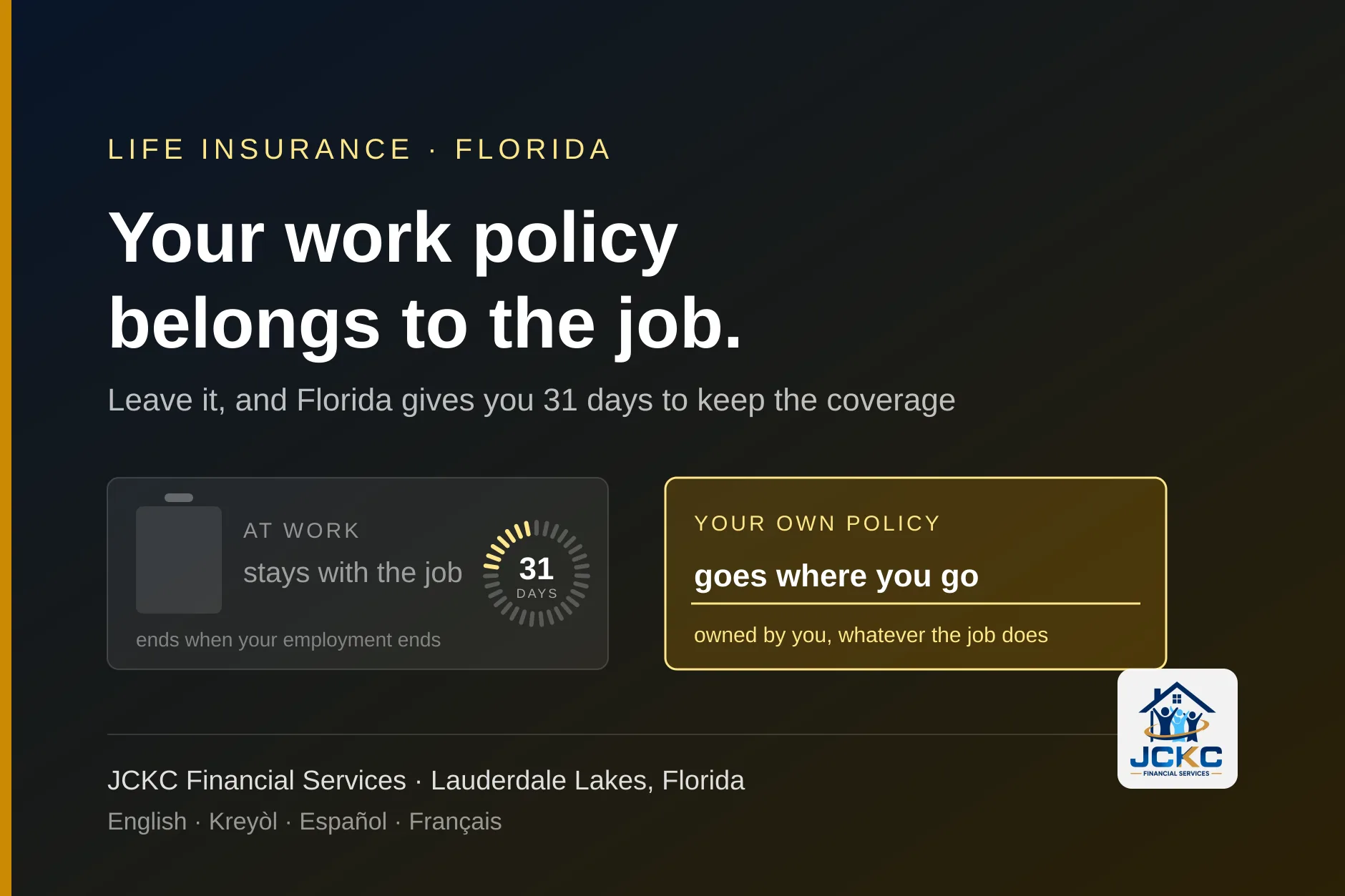
The default is short. When your employment ends, the insurance on you ends, on the date the certificate gives. There are three ways to keep coverage in place after that, and only one of them is a Florida right:
- Conversion. Florida law requires a group life policy to let you turn the coverage you are losing into an individual policy from the same insurer, without evidence of insurability, if you act within 31 days. Section 5 below goes through the statute line by line.
- Portability, if your certificate offers it. Some group policies let you keep group term coverage after you leave, usually by paying the insurer directly. This is a contract feature, not a statutory right: whether you have it, how much you can keep, for how long and at what price are all in the certificate.
- A policy of your own. Bought on its own terms, underwritten on your health at the time, and owned by you whatever happens to the job. Ideally it is already in place before you need it.
The job change itself is when this goes wrong: people assume the next job brings life insurance, which may be true after a waiting period and at a different amount, while the 31 days run. If the reason for leaving was a layoff, health coverage is the louder problem, and we cover it separately in our guide to coverage after a job ends. Put the life insurance deadline on the same list.
5. Florida’s conversion right, read word for word
Section 627.566 of the Florida Statutes is short, and every clause in it matters. It provides that when the insurance on a covered person, or on a covered dependent, ceases because of termination of employment or of membership in the eligible class, the person is entitled to have the insurer issue an individual policy of life insurance without evidence of insurability and without health or other supplementary benefits, provided the application is made and the first premium paid within 31 days after that termination. Here is what each condition means in practice:4
| What the statute says | What it means for you |
|---|---|
| Coverage ceases because of termination of employment or of membership in the eligible class | Quitting, being let go, and losing eligibility while still employed, for example by moving to a class the plan does not cover, can all trigger it. |
| Issued “without evidence of insurability” | No health questions and no medical exam. A diagnosis since you were hired does not stop the conversion. |
| Application made and first premium paid “within 31 days after such termination” | Both, not just a phone call. Count from the date the coverage terminates, which the certificate sets, and do not wait for the insurer to remind you. |
| On any form customarily issued, “except that the group policy may exclude the option to elect term insurance” | You may be offered only permanent coverage, which generally costs more per dollar of coverage than term. Check what forms your certificate allows. |
| Amount “not in excess of the amount of life insurance which ceases” | You can convert up to what you are losing, not more. If you are moving to another class with new group coverage, that amount can be reduced. |
| Premium at “the insurer’s then customary rate” for the form, amount, class of risk and “age attained on the effective date” | Priced for who you are on the day you convert, not on the day you were hired. This is why conversion can be expensive. |
| “Without health or other supplementary benefits” | Riders the group plan carried, such as accident or disability features, do not come across. |
The same section gives a conversion privilege to a surviving dependent when the employee dies, for the dependent coverage that ends because of the death, and to a dependent who stops qualifying as a family member under the plan while the employee is still covered. The statute does not require the conversion policy to be cheap, and it usually is not. What it secures in practice is access: someone whose health would make a new policy hard to get still has a door, as long as they walk through it within 31 days.4
6. When the employer ends the plan instead
A different section covers the case where you do not leave but the plan does: the employer cancels group life, or the group policy is amended so as to end the insurance for your class. Section 627.567 gives the conversion right in that case only to a person who has been insured under the policy for at least five years before the termination date, on the same conditions as section 627.566.5
It then lets the group policy cap the individual policy at the smaller of two amounts: the coverage you are losing, less any life insurance you are or become eligible for under any group policy issued or reinstated by the same or another insurer within 31 days, or ten thousand dollars. So someone with $150,000 of group life who has been covered for four years when the plan ends may have no Florida conversion right at all, and someone covered for six years may be limited to $10,000. When a new group plan replaces the old one, the coverage on the new plan is the answer; when nothing replaces it, there may be very little.5
Small employers and changing plans
If you work for a small business, a nonprofit or a family company, this section matters more than the one about leaving. A small employer’s benefits can change from one year to the next with little warning. If you are told the life insurance is ending, ask in writing whether there is a replacement plan, what your conversion right is and the deadline, and do not let the 31 days run while the answer is being found.
7. If you die inside the 31 days
Florida law closes one gap that would otherwise be cruel. Section 627.568 requires the group policy to provide that if you die during the period in which you could have converted under either section, and before the individual policy took effect, the amount you would have been entitled to convert is payable as a claim under the group policy, whether or not you had applied for the individual policy or paid its first premium.6
It only helps if the family knows the coverage existed. Write the group certificate number, the insurer and the benefits contact on the same page as your other policies, and tell the person who would handle things for you where that page is.
Leaving a job, or picking benefits this month?
Before the 31 days start, find out what your group life converts to and what a policy of your own would cost from the carriers we represent.
8. Portability, conversion or your own policy
When you leave a job, or when you are deciding how much to rely on work coverage at all, the three options compare like this. The cost column is deliberately qualitative: actual prices depend on your age, health and the policy, and we quote them individually.
| Portability | Conversion | Your own policy | |
|---|---|---|---|
| Where the right comes from | The group contract, if it offers it | Florida law, s. 627.566, for group policies it governs | Your own contract |
| Health questions | Set by the certificate | None: “without evidence of insurability” | Usually, at application |
| Deadline | Set by the certificate | Apply and pay within 31 days | Any time you qualify, ideally while employed and healthy |
| Type of coverage | Usually group term | Forms the insurer customarily issues; the plan may exclude term | Your choice of term or permanent |
| How much | Limits set by the certificate | Up to the amount you are losing | What you qualify for and choose |
| Price | Set by the group plan, often rising with age | Insurer’s customary rate at your attained age | Set at purchase; level for the term on many term policies |
The rule of thumb that falls out of the table: conversion is the door for someone who cannot qualify for new coverage, portability is the bridge when a certificate offers it on reasonable terms, and a policy you own is the foundation that makes the other two optional. Someone who can still qualify for an individual policy is usually better served by buying one than by converting at a rate set for an older age and possibly on a permanent form they did not need.
9. Why group life alone is a risk for a family
Families who rely only on group life are not careless; they are relying on a benefit that looks permanent and is not. The risks are structural:
- It ends at the worst time. A layoff, a serious illness that forces you out of work, a move to part-time hours. The moments when coverage is most needed are the ones that end it.
- The amount is the plan’s, not the family’s. A formula based on pay knows nothing about a mortgage, three children or a parent you support. We cover how to size the number your family actually needs in how much life insurance do I need; the point here is that the employer’s number is a coincidence.
- Your health can change the price of every alternative. Healthy, you can choose. After a diagnosis, conversion may be the only door left. And the employer can redesign the plan in any enrollment email.
- It is one more beneficiary form in someone else’s file. Group coverage keeps its own designation with the employer or insurer, and for employer plans federal law can override Florida’s divorce rule. We walk through that in who actually gets your life insurance.
The comparison of term, whole and final expense, and the ballpark of what coverage costs, is in our life insurance guide for South Florida families. The short version for this article: group life is a good addition and a poor foundation.
10. What we see in South Florida households
In our office in Lauderdale Lakes, the households this affects most are the ones where work is steady but jobs change: two earners with different employers, someone who moved from a hospital to an agency or from one hotel group to another, a parent with a second job that has no benefits at all. Many support relatives here and abroad, so the family’s need is larger than any pay-based formula assumes.
We see the other side at tax time. A code C amount on a W-2 is how we often learn a client has more group coverage than they knew, or that it disappeared with a job they left in March. Because we prepare the return and place life insurance in the same office, we can show you both lines at once: what the coverage at work does for you, what it costs you in tax, and what a policy you own would add, in English, Haitian Creole, French or Spanish.
11. What to do this open enrollment
This is the short list, in the order we would do it during open enrollment or in the week you give notice:
- Find your certificate and your benefits summary. Write down the basic amount, any supplemental amount, the insurer and the coverage end date rules.
- Check box 12 of last year’s W-2 for code C. If there is a figure, your coverage is over $50,000 and you now know roughly how much.
- Look for the words “conversion” and “portability”. Note the deadline for each, the forms of coverage allowed and who to contact. Keep this with your other policies.
- If you are electing supplemental coverage, ask about evidence of insurability so you know whether the amount you chose is actually approved.
- Update the beneficiary on the group coverage, separately from every other policy.
- Decide how much coverage you want to own personally, so that losing the job would not leave your family short. Then the group coverage is a bonus.
- If you are leaving, put the 31-day deadline in your calendar from the day coverage ends, and compare conversion with portability and with a new policy before it runs out.
12. Frequently asked questions
What happens to my work life insurance when I quit or get laid off?
In most cases the group coverage ends when your employment ends, or shortly after, on a date set in the certificate. Florida law requires a group life policy to let you convert the coverage you are losing into an individual policy, without evidence of insurability, if you apply and pay the first premium within 31 days. Some group policies also offer portability, which is a separate contract feature. If you do neither, the coverage is simply gone.
What is the difference between portability and conversion?
Conversion is a right Florida law requires every group life policy to include: you swap the group coverage for an individual policy from the same insurer, with no health questions, at the insurer’s customary rate for your age at the time. Portability is not required by that statute. Where a certificate offers it, it usually lets you keep group term coverage after you leave, on terms the certificate sets out. Read your certificate for both, because the deadlines can differ.
Why is there an amount for life insurance on my W-2 in box 12 with code C?
Because the IRS treats the value of employer-provided group-term life above $50,000 as taxable wages. Your employer works out that value from an IRS table based on your age, subtracts anything you paid toward the coverage, and adds the result to boxes 1, 3 and 5 of your W-2, showing it again in box 12 with code C. It is subject to Social Security and Medicare taxes. It is not a mistake, and it is not money you received.
Is the IRS table the price of my coverage?
No. The table in IRS Publication 15-B is a uniform valuation the tax law uses to measure the benefit, set in a regulation that has applied since July 1, 1999. It is not what an insurer would charge you for an individual policy, and it says nothing about what a conversion policy will cost. Prices depend on your age, health and the policy, and we quote them from the carriers we represent.
Do I need to answer health questions to convert my group life?
No. The Florida statute says the individual policy is issued without evidence of insurability, provided you apply and pay the first premium within 31 days. That is the main reason conversion matters for someone whose health has changed. The trade-off is price: the premium is set at the insurer’s customary rate for your age on the effective date, and the converted policy carries no health or other supplementary benefits.
What if I die during the 31 days before I convert?
Florida law requires the group policy to pay the amount you would have been entitled to convert as a claim under the group policy, whether or not you had applied or paid the first premium. Your beneficiary should still be told the coverage existed and that the death fell inside the conversion period, because nobody else will tell them.
My employer is changing insurers or ending the plan. Do I get the same conversion right?
Not necessarily. When the group policy itself ends, the Florida statute reaches only people who had been insured under it for at least five years, and it allows the group policy to cap the individual policy at the smaller of the coverage you lost, less any new group coverage you can get within 31 days, or ten thousand dollars. If a new group plan replaces the old one, you may simply move to it. Ask the benefits office in writing.
Should I drop my group life if I buy my own policy?
Usually not. Basic group life the employer pays for costs you little or nothing and adds to what your family receives. The point is to stop relying on it alone: own enough personally to protect the family if the job ended tomorrow, and treat the group coverage as an addition.
13. Sources
- Internal Revenue Service, Publication 15-B (2026), Employer’s Tax Guide to Fringe Benefits, section “Group-Term Life Insurance Coverage” — the $50,000 exclusion, the formula requirement, Table 2-2 (cost per $1,000 of protection for one month), reporting in boxes 1, 3, 5 and box 12 code C, the worked example, the $2,000 dependent rule and the rule for former employees. 2026 edition; the 2027 edition was not yet published. Read November 2, 2026.
- 26 U.S.C. § 79, Group-term life insurance purchased for employees, text at Cornell Legal Information Institute — subsection (a), inclusion of cost above $50,000 of coverage less employee payments; subsection (c), cost set by uniform premiums in five-year age brackets prescribed by regulation. Read November 2, 2026.
- 26 CFR § 1.79-3, Determination of amount equal to cost of group-term life insurance, eCFR — paragraph (d)(2), Table I, uniform premiums for $1,000 of group-term life insurance protection, for coverage provided after June 30, 1999. Read November 2, 2026.
- Florida Statutes (2026), s. 627.566, Conversion on termination of eligibility — individual policy without evidence of insurability, application and first premium within 31 days, forms, amount, premium at attained age, and the dependent conversion privilege. Read November 2, 2026.
- Florida Statutes (2026), s. 627.567, Conversion on termination of policy — at least 5 years insured, and a cap of the smaller of the coverage lost, less new group coverage within 31 days, or ten thousand dollars. Read November 2, 2026.
- Florida Statutes (2026), s. 627.568, Death pending conversion — the convertible amount is payable as a claim under the group policy whether or not application or first premium has been made. Read November 2, 2026.
For general information only; not legal or tax advice. This article describes federal tax rules and Florida statutes as published, with a link to each. Your group certificate and master policy, not this article, govern what your coverage does, including whether portability is offered and which state’s law applies to the group policy. Federal employees, members of the military and people covered under a policy issued outside Florida may be under different rules. JCKC Financial Services is a licensed insurance brokerage and tax practice, not a law firm; nothing here is a legal opinion, a tax opinion on your return or a quote. Figures are labeled with the year of the source they come from.