

The short answer
A Medicare plan or agent may not cold-call you, and Medicare itself never calls to sell you anything. If an unexpected caller asks for your Medicare number, your Social Security number or a decision today, hang up, look up 1-800-MEDICARE yourself, ask for an interpreter if you want one, and bring the caller’s name and number to someone you trust.1, 2
Key takeaways
- Unsolicited calls, robocalls, texts and voicemails from a plan or agent are prohibited by 42 CFR 422.2264; a call is allowed when you gave consent or started the contact.2
- Medicare.gov says Medicare will never call you to sell you anything or visit you at your home.1
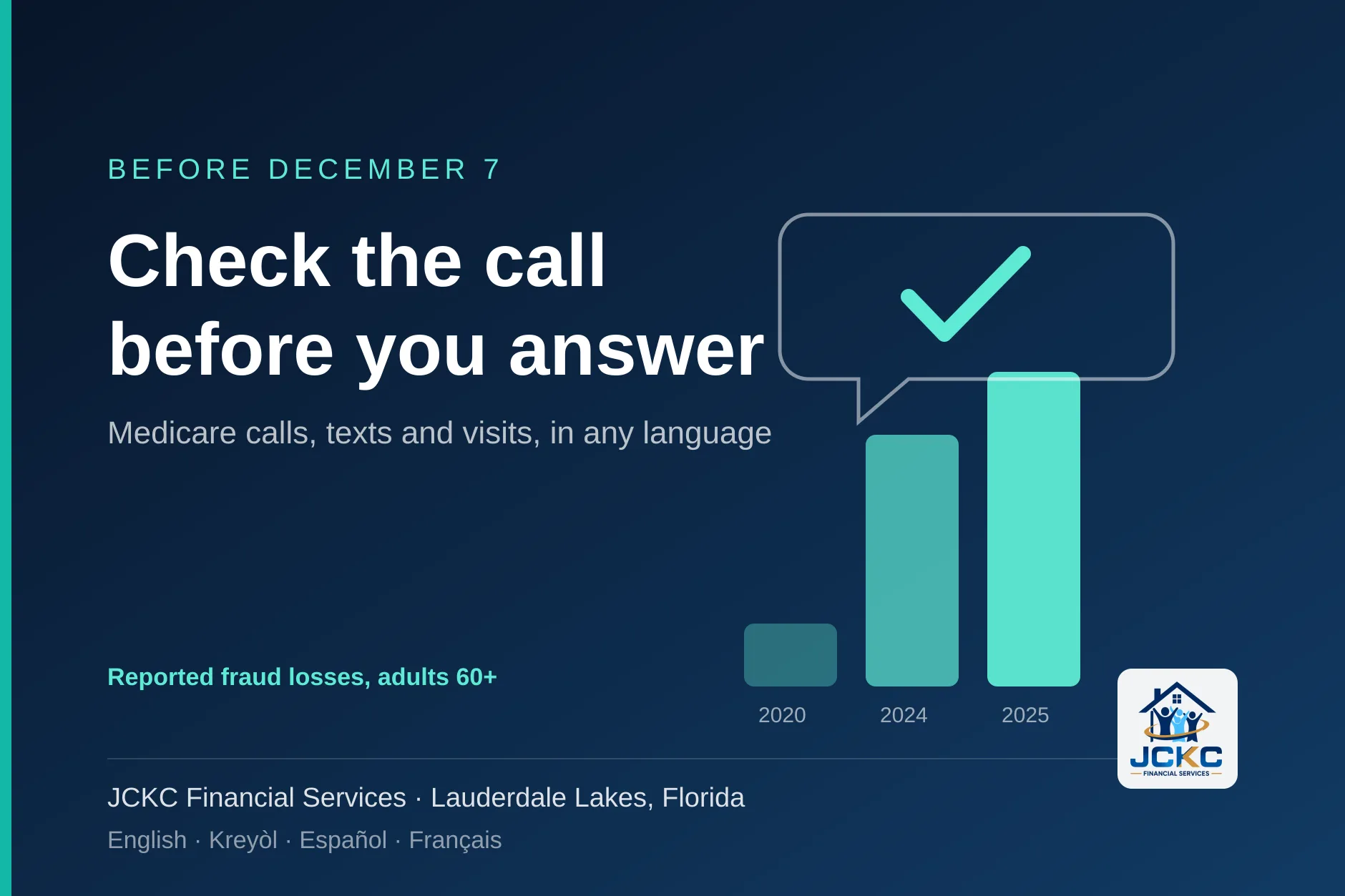
- The FTC reports that adults 60 and older reported over $3 billion in fraud losses in 2025, up from about $600 million in 2020.4, 5
- When you report a scam to 1-800-MEDICARE you can ask for a free interpreter, 24 hours a day, and you have the right to Medicare materials in languages other than English.3
- Never give a Medicare number, Social Security number or bank detail to a caller you did not choose to speak to. Call back on a number you looked up.
- Annual Enrollment runs October 15 to December 7. Nobody has to decide on a call today.8
1. Why is the phone ringing about Medicare now?
Every fall the same thing happens. Plans are allowed to advertise the coming year, Annual Enrollment opens, and people who are already thinking about their coverage hear from many sources at once. Medicare Annual Enrollment runs from October 15 to December 7, and Medicare.gov says coverage chosen in that window starts January 1 of the next year, as long as the plan receives your request by December 7.8 In 2026 that window closes on a Monday. As of today, November 13, there are 24 days left.
That timing is why this is the most crowded stretch of the year for phone calls, mailers and knocks on the door about Medicare. Some of that contact is legitimate: a plan you already belong to may write to you, and a licensed agent you asked for help may call you back. Some of it is not. A scammer does not need to know anything about you except that you are probably thinking about Medicare right now.
This article is part of a series. Our earlier guide, Why Your Phone Will Not Stop Ringing About Medicare, explains the marketing rules in general. This one starts from a narrower question: what does a Kreyòl-speaking household need in hand to check a call that arrives in a hurry, usually in English, usually when the person who normally helps with paperwork is not in the room?
What this article does not claim
We found no source that says Haitian or Kreyòl-speaking households are targeted more than anyone else, so we do not say it. The FTC numbers below describe all adults 60 and older. What we do say is narrower and checkable: a fast call in a second language is harder to verify, and the steps that follow work in any language.
JCKC Financial Services is itself a Medicare marketing entity. Everything in the rules section below applies to us as much as to the caller you have not met. That is part of why we give you the checks instead of asking you to trust us: a licensed agent expects to be checked and has nothing to fear from it.
2. What do the federal rules say about calls?
The federal rule on contacting people about Medicare Advantage and Part D plans is 42 CFR 422.2264. Among the things a plan or an agent may not do, it lists using telephone solicitation, which is cold calling, and also robocalls, text messages and voicemail messages. Its examples of prohibited contact include calls based on a referral, calls to people who are leaving a plan (other than quality surveys), and calls to people who attended a sales event unless they gave express permission to be contacted.2
The same section says what is not unsolicited. Under paragraph (a)(3), calls are not considered unsolicited if you give consent or start the contact with the plan. Returning your call, or calling you after you sent back a business reply card, is also treated as not unsolicited. A plan may also call people who submitted an enrollment application to conduct business related to that enrollment, and plans that contact members about plan business must give written notice at least once a year of the member’s ability to opt out of future plan-business calls.2
| Type of contact | What the rule says | Paragraph |
|---|---|---|
| Cold call, robocall, text or voicemail to sell a plan | Prohibited unsolicited contact | (a)(2)(iv) |
| Call after you asked for information or started contact | Not considered unsolicited | (a)(3) |
| Call because you gave consent | Not considered unsolicited | (a)(3) |
| Call to someone who attended a sales event, without express permission | Prohibited | (a)(2)(iv)(C) |
| Call after you submitted an enrollment application, about that enrollment | Allowed | (b)(1)(ii) |
| Plan business calls to current members | Allowed, with written notice at least once a year of the right to opt out | (b)(2) |
| In-person personal marketing appointment | Scope of Appointment must be in writing; valid for 12 months | (c)(3) |
Source: 42 CFR 422.2264, law.cornell.edu/cfr/text/42/422.2264, text amended through 91 FR 17583 (April 6, 2026), read November 13, 2026.
One more rule matters for visits and appointments. A personal marketing appointment is one tailored to an individual or a small group, and the Scope of Appointment, meaning what the agent and you have agreed to talk about, must be in writing for in-person personal marketing appointments. The scope is valid for 12 months from the date you sign or from your first request for information.2 If someone comes to your door or home asking to discuss Medicare plans and you did not invite them, that is a reason to say no and close the door, not a reason to start signing forms.
Read this twice
The rule is about your consent. A call you asked for is fine. A call you did not ask for, from a plan or an agent selling a plan, is not. You do not have to prove anything to the caller; you only have to hang up.
3. What will Medicare itself never do?
Medicare.gov is direct about this. In its own words, “Medicare will never call you to sell you anything or visit you at your home.” It adds that Medicare, or someone representing it, will call to ask for personal information only in limited cases: for example an agent returning your call after you joined a plan, reported fraud or left Medicare a message.1
The same page gives a short list of protections worth saying out loud to the whole household:
- Share your Medicare card, Medicare Number or Social Security information only with your doctor or the people who should have it, such as insurers acting for you.
- Do not join a Medicare health or drug plan over the phone unless you called and asked for help.
- Do not accept money or gifts in exchange for free medical care.
- Do not let anyone except your doctor or other Medicare providers review your medical records or recommend services.
- Compare your calendar with your Medicare statements, and check that each listed service really happened.
Those five lines cover most of the fraud tricks a household meets in a season. If a caller needs your Medicare Number to "verify your account," to "send your new card," or to "lock in your benefits before the deadline," none of those is a reason Medicare gives. Hang up, and report the call if you want to: suspected fraud goes to 1-800-MEDICARE (1-800-633-4227), or online to the HHS Office of Inspector General.1, 9
The number on the screen proves nothing
The FTC says scammers pose as government agencies and familiar businesses, and that caller ID numbers can be faked.6 A call that shows "Medicare," a Broward area code or a number you have seen before can still be a scam. Judge the call by what it asks, never by what the screen shows.
4. What does the FTC data show for older adults?
Everything in this section comes from one source: the Federal Trade Commission’s report to Congress, Protecting Older Consumers 2025–2026, dated October 19, 2026, which uses reports collected in calendar year 2025.4, 5 The FTC’s own caution applies to every number: the data is self-reported, not a survey, and the FTC says most frauds are never reported to the government, so these figures likely capture only a fraction of older adults harmed.4
| Measure | Figure | Year |
|---|---|---|
| Reports to the FTC’s Consumer Sentinel, all ages | More than 6.2 million (over 3 million about fraud) | 2025 |
| Reported fraud losses, all ages | About $16 billion | 2025 |
| Reports from people 60 and older (those with age information) | 469,597, about 33% of reports with age information | 2025 |
| Of those, reports that included a money loss | About 123,000 | 2025 |
| Reported losses, people 60 and older | Over $3 billion (about $2.4 billion in 2024; about $600 million in 2020) | 2025 |
| Share of older adults’ fraud reports with no money lost | About 74% | 2025 |
| Median reported loss | About $900 (ages 60 and over); $2,000 (ages 80 and over) | 2025 |
| Losses of $100,000 or more | 6% of older adults’ loss reports; 70% of their reported losses | 2025 |
Source: FTC, Protecting Older Consumers 2025–2026 (October 19, 2026), pp. 19–22, ftc.gov/system/files/ftc_gov/pdf/2026-older-adults-report-10192026.pdf. Self-reported data, not a survey.
Source: FTC, Protecting Older Consumers 2025–2026 (October 19, 2026), pp. 19 and 21. Self-reported; the same figures are in Table 2. Bars are proportional to the values; the shortest bar is widened on narrow screens so its label fits.
Read the chart and the table together. Reported losses by adults 60 and older rose about fivefold in five years, from about $600 million in 2020 to over $3 billion in 2025. The FTC says that rise was driven largely by a small number of very large individual losses: reports of $100,000 or more were 6 percent of older adults’ loss reports but 70 percent of their total reported losses.4 The typical report looks different. The median reported loss for people 60 and over held at about $900, and for people 80 and over it was $2,000, a 21 percent increase over 2024.4
Two details are especially useful at a kitchen table. First, about 74 percent of older adults’ fraud reports did not indicate any money lost. Older adults reported frauds they spotted, and avoided, at a 34 percent higher rate than people 18 to 59.4 In other words, noticing and reporting works. Second, the FTC notes that among older adults’ no-loss phone scam reports, the scams most often described impersonated Medicare, banks, Amazon and the FTC.4 Medicare is one of the names scammers wear on a phone call. That does not mean any call about Medicare is a scam; it means a call that starts with "this is Medicare" has not yet told you who is calling.
Notice, then report
In 2025, about three out of four fraud reports from adults 60 and older described a scam that did not cost the person money. That is what a household that checks looks like. If you spot a bad call, you have already done the hard part.
The FTC also reports that, for older adults, median individual losses were higher for frauds that began with a phone call, even though more reports and more total dollars came from frauds that started on social media.4 A phone call is not the most common route, but when it works, it tends to cost more.
5. Why does language matter when you check a call?
A scam does not need a language to work, but checking a call does. If the caller speaks fast English, uses words like "Part D redetermination" or "benefit verification," and says your coverage ends tonight, a person who reads most documents in Kreyòl is being asked to make a decision in the language where they have the least time to think.
Medicare.gov addresses part of this directly. On its page about other languages it says you have the right to get materials from Medicare in languages other than English, and that when you call 1-800-MEDICARE to report a scam you can ask for an interpreter, 24 hours a day, 7 days a week, except some federal holidays. That page names English and Spanish for the Medicare & You handbook and Medicare Summary Notices and does not list Haitian Creole among the languages it names, so ask for a Haitian Creole interpreter when you call and, if you need a document in another form, ask for it.3 The interpreter service is for a call you place to a number you looked up. It is not something a caller who phoned you can offer you.
The FTC also publishes consumer material in Kreyòl Ayisyen (Haitian Creole). Its multilingual resources page lists "Kijan pou Evite Magouy Kont Imigran yo" (Avoiding Scams Against Immigrants) and a Kreyòl immigration help item.7 Those pages are about immigrant-focused scams in general, not about Medicare, but they are written for the same households and are free.
There is a practical consequence for the household. When the language of a call is not the language of the person who answered, the safest rule is one that does not depend on language at all: nobody decides, signs or gives a number during a call you did not start. Ask for the caller’s name and the plan’s name, say you will call back, and end the call. The two minutes you spend afterwards are for checking, with an interpreter if you want one, on a number you chose.
Reading a plan document in Kreyòl is not a courtesy
At JCKC we read plan documents with clients in Kreyòl, English, French or Spanish, and we explain the plan’s network, drugs and costs before anyone signs. A plan you understood in your own language is also a plan that is hard to switch by phone without you noticing.
6. How do you tell a licensed agent from a scam?
The table below sets out the differences that matter. They come from the federal rules and the Medicare.gov and FTC pages in the source list, plus the plain practice of checking any licensed professional.
| What to look at | A licensed agent | A scam call |
|---|---|---|
| Who started it | You asked, booked or called, or you consented | It came out of the blue |
| Who they say they are | Gives full name, company and a Florida license number you can look up | Says "Medicare" or "your plan" and avoids a name and license number |
| What they ask for | Questions about your doctors and drugs, in a conversation you agreed to | Your Medicare Number, Social Security number or bank details, right away |
| How fast they push | Gives you time; the window runs to December 7 | Says it must be done today or you lose coverage |
| How they want to be paid | Never asks for gift cards, wire transfers, payment apps or cryptocurrency | Gift cards, wire transfer, payment app or cryptocurrency |
| What happens if you say "I will call back" | Says of course, and gives you the number | Argues, hangs up, or says the offer will expire |
Sources: 42 CFR 422.2264; Medicare.gov, Report Medicare fraud and abuse; FTC, How to avoid a scam (July 2023). Payment-method list from the FTC page.
You can run this table in your head in about ten seconds. Did you ask for this call? Did the person say who they are and which company they work for? Can they give a license number you can look up yourself? Are they asking you to decide today? Do they want a payment method that cannot be reversed? The FTC lists the payment methods scammers insist on: cryptocurrency, wire transfers, payment apps and gift cards. It also warns about checks that later turn out to be fake, and says that honest businesses will give you time to make a decision.6
Run the same check on us. Jacky Catule’s National Producer Number (NPN) is 17368280, and his Florida life and health license (2-15) was issued on September 10, 2014, according to the Florida Department of Financial Services licensee record, which anyone can search. We would rather you check than trust.
Text messages deserve a separate line. The FTC says a legitimate company will not text or email a link to update your payment information, and that scammers say you need to confirm personal or financial information when you do not. It asks people to forward phishing texts to 7726 (SPAM) and to report them at ReportFraud.ftc.gov.10 A text about "your Medicare benefits" that includes a link is not a message from Medicare.
Not sure who called you?
Bring the number and the name and we will check it with you, in Kreyòl, English, French or Spanish.
7. What can you say on the phone, in Kreyòl and English?
Most of the time you do not need a long conversation. You need three or four short sentences you can say without thinking. Here they are in English with a Kreyòl version beside each one. Use whichever language is easier in the moment.
- "I am not interested." In Kreyòl: Mwen pa enterese. You do not owe an explanation.
- "I do not give information over the phone." In Kreyòl: Mwen pa bay enfòmasyon pa telefòn.
- "Give me your name, your company and your Florida license number." In Kreyòl: Ban mwen non ou, non konpayi a ak nimewo lisans Florid ou. A real agent expects this question.
- "I will call back on a number I look up." In Kreyòl: M ap rele w tounen sou yon nimewo m chèche tèt mwen.
- "Do not call this number again." In Kreyòl: Pa rele nimewo sa a ankò.
After the call, write down the date, the time, the number that showed, the name the caller gave and what they asked for. A caller who gave a real name and a real license number will be easy to confirm. A caller who would not give either has told you what you need to know.
If you want to check a plan or an offer, use a number you looked up yourself. For anything that sounds like fraud, 1-800-MEDICARE is the number Medicare.gov gives for reporting, and you can ask for an interpreter when it answers.1, 3 You do not need a long speech, and you do not need to explain why you are calling. "A caller asked for my Medicare Number and I want to report it" is enough.
The one rule to teach children and grandchildren
If a call you did not start asks for a number, a payment or a decision, the answer is "I will call you back," and then you do not. That one habit stops nearly every phone scam in this article, whatever language the call is in.
8. What if you already gave out information?
Sometimes the call worked. A voice sounded kind, the question seemed simple, and a Medicare Number or a bank detail went out. If that happened to you or to someone you help, you are not the first, and the steps below are quick. Do them the same day if you can.
| What happened | Who to contact | Why |
|---|---|---|
| Gave a Medicare Number or suspect Medicare fraud | 1-800-MEDICARE (1-800-633-4227), or report online at oig.hhs.gov | This is how Medicare.gov says to report suspected fraud |
| Plan member who suspects fraud | 1-877-7SAFERX (1-877-772-3379) | The fraud line Medicare.gov lists for plan members |
| Gave a Social Security number or think your identity was used | identitytheft.gov | The link Medicare.gov gives for identity theft |
| Any scam call, text or visit | ReportFraud.ftc.gov | The FTC’s page for reporting scams |
| Suspected health care fraud, to the Inspector General | 1-800-HHS-TIPS | The HHS-OIG hotline |
| Bank or card details given | Your bank, the same day | Ask what to do about the account |
Sources: Medicare.gov, Report Medicare fraud and abuse, medicare.gov/basics/reporting-medicare-fraud-and-abuse; HHS-OIG, oig.hhs.gov/fraud/report-fraud; FTC, ReportFraud.ftc.gov. Read November 13, 2026.
The order matters less than starting. The Medicare.gov page recommends creating a secure Medicare.gov account so you can see Original Medicare claims once they are processed, and comparing your own calendar with your statements to confirm each service listed really happened. If something on a statement was not done for you, call the provider’s office about it and report the fraud.1 If you are a member of a Medicare Advantage or Medicare drug plan, Medicare.gov also lists a fraud line for plan members, 1-877-7SAFERX (1-877-772-3379).1
If your Social Security number or bank information went out, the Medicare.gov page points to identitytheft.gov for reporting identity theft, and your bank can tell you what to do about the account. The FTC takes scam reports at ReportFraud.ftc.gov.1, 6 Do not send money to "fix" the problem. A new request for payment from the same caller is a sign the first call was the scam.
Shame helps the scammer
The FTC’s data shows how many older adults report frauds they spotted. Reporting a call, even a call that nearly worked, is how patterns get noticed. If you tell someone quickly, there is more that can be done.
9. How can a son, daughter or neighbor help?
A great many Medicare conversations in a Haitian household are family conversations. A daughter reads the mail, a son sits with a parent at the computer, a church friend drives someone to an appointment. The FTC data shows how important that help is. Among reports filed in 2025 for people 80 and over, about 17 percent were submitted by another person on the consumer’s behalf, a far higher rate than any other age group.4
| Age group | Reports filed on someone’s behalf |
|---|---|
| 80 and over | 17.0% |
| 70–79 | 6.4% |
| 60–69 | 3.8% |
| 50–59 | 2.6% |
Source: FTC, Protecting Older Consumers 2025–2026 (October 19, 2026), p. 23, footnote 77. Excludes reports collected by Sentinel data contributors.
If you are the helper, three habits make the biggest difference.
- Keep a short call log together. A page by the phone with the date, the number and the name the caller gave. It takes ten seconds and makes a later report possible.
- Agree on one rule ahead of time. "We do not give numbers or sign anything on a call we did not start." Say it once, kindly, before the Annual Enrollment calls begin.
- Offer to be on the call-back. When your parent calls 1-800-MEDICARE to report a scam, or calls a licensed agent back, sit beside them, ask for the interpreter if they want one, and let them speak for themselves.
One caution for helpers: if you are going to help someone choose a plan, do it on a call or in an appointment that the older person started, and with their agreement. Our guide to helping a parent choose a Medicare plan in Broward covers what to gather and what to ask. Our short answer on whether an agent can call you without permission is two minutes long and is easy to print for the kitchen.
10. Your checklist before December 7, and next steps
With 24 days left in Annual Enrollment, here is a checklist for a household that wants to be calm about it.8
- Pick your rule. Nobody gives a number, signs or decides on a call, text or visit they did not start.
- Start the call log. A sheet of paper by the phone is enough.
- Find your plan’s letter. Your current plan’s Annual Notice of Change tells you what is changing for 2027; our guide to reading it is in all four languages.
- Choose one trusted person. Someone who can sit with you when you check a call, and who knows to ask for an interpreter.
- Look up, never call back on the number given. Every verification call goes to a number you chose.
- Decide before December 7, not on a call. The window is long enough to compare plans calmly.8
- If you are in a Medicare Advantage plan, remember there is a second window, January 1 to March 31, only for people already in an Advantage plan, to switch within Medicare Advantage or go back to Original Medicare.8
If you want a licensed agent to look at your options with you, you start the contact: you book, you call, or you walk in. We explain the plan’s network, drugs and costs in Kreyòl, English, French or Spanish before you decide. You can see how a review works on our Medicare services page, and you can book a time on the booking page. If a call has already worried you, bring the number and the name, and we will go over it with you.
Not sure who called you? Let’s check it together.
Bring the phone number, the name the caller gave and anything you were sent. We will tell you what we can see, in your language, and we will help you report it. Call (954) 825-9923 or book a time. JCKC Financial Services, 3692 W. Oakland Park Blvd., Lauderdale Lakes, FL 33311. Monday to Friday, 9 AM to 5 PM.
Simply put: you have until December 7, nobody may cold-call you to sell a plan, Medicare never calls to sell anything, and the safest answer to any call you did not start is "I will call you back," in Kreyòl or English.
11. Frequently asked questions
Is it legal for a Medicare agent to call me if I never asked?
Federal marketing rules say no. 42 CFR 422.2264 lists telephone solicitation, robocalls, text messages and voicemail messages among the unsolicited contact a plan or agent may not use, and says a call is not unsolicited when you gave consent or started the contact yourself. If you did not ask for the call and did not agree to it, the call is a warning sign. If a call like that has already happened, bring us the number and we will go over it with you.
Does Medicare ever call to sell me a plan or visit my home?
No. Medicare.gov says Medicare will never call you to sell you anything or visit you at your home. It lists a few limited cases where Medicare or someone representing it may call for personal information, such as an agent returning your call after you joined a plan, reported fraud or left a message. If you did not do one of those things first, treat the caller as unverified. If a caller claimed to be Medicare, tell us at (954) 825-9923 and we will help you check it.
Can I ask for an interpreter when I check a call?
Yes. Medicare.gov says that when you call 1-800-MEDICARE to report a scam or a fraud concern, you can ask for an interpreter on the line, 24 hours a day, 7 days a week except some federal holidays, and that you have the right to get materials from Medicare in languages other than English. Make the call yourself, using a number you looked up, never one the caller gave you. We can sit with you for that call, in Kreyòl, English, French or Spanish.
Is the caller ID proof that the call is local or real?
No. The FTC says scammers pose as government agencies and familiar businesses and that caller ID numbers can be faked. A number that looks like a Broward or Miami-Dade area code, or like Medicare, tells you nothing about who is on the line. Bring us the number that showed on your screen and we will look at it with you.
What should I do if I already gave my Medicare number?
Do not wait. Report it to 1-800-MEDICARE, and to the HHS Office of Inspector General at 1-800-HHS-TIPS, and use identitytheft.gov if you think your identity was used. Then read your Medicare statements for services you did not receive. Table 4 in this article walks through who to call for what. We can walk through each step with you at JCKC, (954) 825-9923.
Can my son, daughter or neighbor report a scam for me?
Yes. The FTC report shows that reports filed on behalf of another person are common for the oldest adults: about 17 percent of the reports for people 80 and over in 2025 were filed by someone else. Sit with your helper, let them write down the caller’s name, number and what was said, and let them make the report with you. We are glad to sit with you and your helper, in person or by phone, at (954) 825-9923.
Does this article say Haitian families are targeted more than others?
No, and no source we read says so. The FTC data in this article covers all adults 60 and older, not any one community. What we can say is that a household that gets most information in Kreyòl has a real language barrier to checking a fast English call, and that the checks in this article work in any language. At JCKC we explain plans in Kreyòl, English, French and Spanish.
Does the Annual Enrollment deadline give a caller the right to rush me?
No. Annual Enrollment runs October 15 to December 7, which is a long window, and coverage starts January 1 if your plan gets your request by December 7. The FTC says honest businesses will give you time to make a decision. A caller who says you must decide today is using pressure, not a deadline. If you want help comparing plans before December 7, book a time with us at (954) 825-9923.
12. Sources
Current as of November 13, 2026. Every rule and figure comes from the page linked in the source list, read on November 13, 2026. The FTC figures are for calendar year 2025 and are self-reported. The 2027 Part B premium has not been announced and is not used here. The license detail in Section 6 comes from the Florida Department of Financial Services licensee record as verified in our compliance file on October 25, 2026.
- Medicare.gov, Report Medicare fraud and abuse. Read November 13, 2026.
- U.S. Code of Federal Regulations, 42 CFR 422.2264, Marketing and communications: Contact, text amended through 91 FR 17583 (April 6, 2026). Read November 13, 2026.
- Medicare.gov, Get Medicare information in other languages. Read November 13, 2026.
- Federal Trade Commission, Protecting Older Consumers 2025–2026, report to Congress dated October 19, 2026. Read November 13, 2026.
- Federal Trade Commission, FTC Issues Annual Report to Congress on Agency’s Actions to Protect Older Adults (October 19, 2026). Read November 13, 2026.
- Federal Trade Commission, How to avoid a scam (page dated July 2023). Read November 13, 2026.
- Federal Trade Commission, Consumer information in more languages (Kreyòl Ayisyen items). Read November 13, 2026.
- Medicare.gov, Joining a plan (Open Enrollment October 15–December 7; Medicare Advantage Open Enrollment January 1–March 31). Read November 13, 2026.
- HHS Office of Inspector General, Report fraud (1-800-HHS-TIPS). Read November 13, 2026.
- Federal Trade Commission, How to recognize and avoid phishing scams (page dated September 2022). Read November 13, 2026.
Disclaimer: JCKC Financial Services is a licensed independent insurance brokerage. This article is for general educational purposes only and is not tax, legal, medical, or financial advice, nor a substitute for guidance from a licensed professional about your specific situation. We are not connected with or endorsed by the United States government or the federal Medicare program. Plan counts, premiums, costs and availability change every year; call us at (954) 825-9923 for current specifics.