

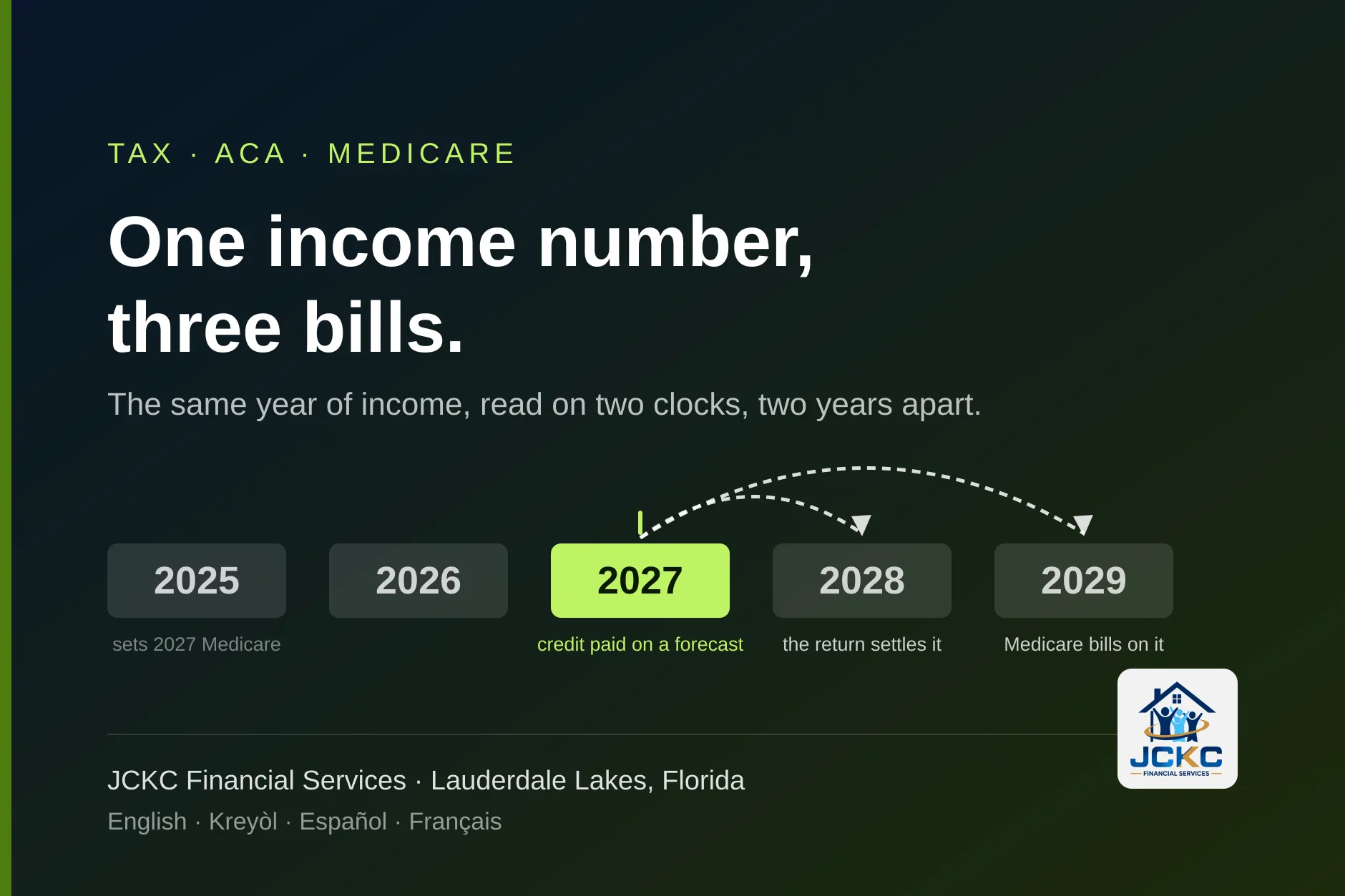
1. One income, three bills, three different years
We prepare tax returns and we place health coverage, so we see both halves of the same household on the same afternoon. The confusion we meet most is a reasonable one: people assume the government takes one income number from one tax return and uses it everywhere. It does take the number from your return, in the end. But the two programs read it at different times, for different years, and after different adjustments. Here is the calendar for a household going into 2027:
| Income for the year | What it sets | When it is settled |
|---|---|---|
| 2025 (the return you filed in 2026) | Your 2027 Medicare Part B premium and any Part D surcharge | Already fixed. Social Security normally uses the return two years before the premium year |
| 2026 (the year now ending) | Your 2026 Marketplace credit, finally; and your 2028 Medicare surcharge | On the 2026 return you file in spring 2027, the first with no repayment cap |
| 2027 (the year you are estimating now) | Your 2027 Marketplace credit; and your 2029 Medicare surcharge | Estimated on your Marketplace application now, reconciled on the 2027 return in 2028 |
Read the middle row twice. The income of the year that is ending right now does two jobs: it settles this year’s Marketplace credit next spring, and it sets the Medicare surcharge for 2028. And the bottom row is the one you are being asked to forecast this month, on a Marketplace application, while the same household may be choosing a Medicare plan during Annual Enrollment. The forms come at you separately. The money does not.
2. The Marketplace credit runs on a forecast
HealthCare.gov puts it in one line: Marketplace savings are based on your expected household income for the year you want coverage, not last year’s income.1 When you apply for 2027 coverage between November 1, 2026 and January 15, 2027, you are giving a forecast of 2027, and the Marketplace computes the advance payments of the credit it sends to your insurer each month from that forecast.29
The tax return comes later, and it does a different job. The IRS compares the advance payments made for you with the credit you are actually allowed, using your actual household income, on Form 8962, filed with the return for that same year.23 If you were paid less in advance than you were owed, the difference comes back to you. If you were paid more, you owe it back. So the 2027 credit is calculated in 2026, paid during 2027, and only becomes final when you file in 2028.
That is why basing the 2027 application on the 2025 or 2026 return, without thinking, is the expensive habit. A prior return is a perfectly good starting point. It is the wrong answer whenever the coming year will look different: a spouse retiring, a business year that has turned, a pension starting, a sale planned, or a Roth conversion you have been meaning to do.
The forecast can be changed during the year
If your income changes in 2027, you can report it to the Marketplace and the advance payments are adjusted for the rest of the year. HealthCare.gov warns that failing to report changes can mean owing money back when you file.1 Reporting is not a penalty. It is how the reconciliation stays small.
3. Next spring is the first reconciliation with no ceiling
This is the change that turns a forecasting error from an annoyance into a bill. Until now, if your advance credit payments ran higher than your allowable credit, a repayment cap tied to your income limited how much you paid back, provided your household income was under 400% of the poverty line. The IRS now states it plainly: there is no repayment cap for tax years after 2025.2 Three consequences follow:
- The first uncapped return is the 2026 return, the one most households will file in spring 2027. If 2026 ran higher than the estimate you gave last autumn, every dollar of excess advance payment is added to your tax for the year.
- The 400% limit is back for 2026. The IRS says the expansion above 400% of the federal poverty line applied to tax years 2021 through 2025.2 A household whose 2026 income lands above the line is allowed no credit at all, so the entire year’s advance payments become excess.
- 2027 works the same way under current law. The IRS describes no extension, and HealthCare.gov says its 2027 income levels and savings arrive on November 1.11 We will confirm against that page, and so should you.
For the history of why premiums jumped in 2026 and what the cliff did to Florida enrollees, see our article on the subsidy cliff. The point for this article is narrower and more urgent: the return you file next spring is the first one where a wrong forecast is paid for in full.
4. Medicare looks two years back
Medicare does the opposite of the Marketplace. It does not ask you for a forecast at all. The regulation directs Social Security to use the modified adjusted gross income the IRS holds for the tax year two years prior to the year the surcharge applies to, and, where the IRS has not supplied that year, to use the year three years prior temporarily and correct it later.4 A 2027 premium is therefore set from your 2025 return, already filed, already final.
The surcharge itself is the income-related monthly adjustment amount, IRMAA, and it is added both to the Part B premium and on top of whatever a Part D drug plan charges. For 2026, CMS set the standard Part B premium at $202.90; the first surcharge tier begins above $109,000 of income on an individual return and $218,000 on a joint return, where the Part B total becomes $284.10 a month and $14.50 is added to the drug plan premium.6 The full table, every tier, is in our guide to the income surcharge.
The two-year lag has a consequence people only see in hindsight. Whatever you do with your income in 2027 is invisible to Medicare until 2029. A Roth conversion this December raises your 2028 premiums, not your 2027 ones. A capital gain next summer shows up on a Medicare bill two Januaries later, long after the money has been spent or reinvested.
The 2027 brackets are not published yet
CMS had not published the 2027 Part B premium or income brackets when this was written on October 30, 2026. The 2026 figures came out on November 14, 2025, so the 2027 announcement is normally expected around mid-November.6 Every Medicare figure in this article is a 2026 figure and says so. We will not print a 2027 threshold before CMS does.
5. Two programs, two definitions of income
Both programs say “modified adjusted gross income”, and both start from line 11 of Form 1040, adjusted gross income. They then add back different things. The difference that matters most to retirees is Social Security: the Marketplace adds back the part of your benefit that is not taxed; Medicare’s definition does not.125
| Item | Marketplace credit (household income) | Medicare surcharge (IRMAA) |
|---|---|---|
| Wages, self-employment profit, pensions, interest, dividends | Counted, through adjusted gross income | Counted, through adjusted gross income |
| Social Security, the taxable part | Counted | Counted |
| Social Security, the non-taxable part | Added back, so the whole benefit counts | Not added back |
| Tax-exempt interest, such as municipal bonds | Added back | Added back |
| Foreign earned income excluded from tax | Added back | Added back |
| Traditional IRA and 401(k) withdrawals, Roth conversions | Counted (the taxable amount) | Counted (the taxable amount) |
| Capital gains you realize | Counted | Counted |
| Qualified withdrawals from a Roth account | Not counted | Not counted (not in adjusted gross income) |
| Income of a dependent who is required to file | Counted in household income | Not on your return, so not counted |
| Supplemental Security Income (SSI) | Not counted | Not counted |
For a working household the two numbers are often close. For a household where someone already draws Social Security, they can be thousands of dollars apart: the same year’s income is measured higher by the Marketplace than by Medicare. That is not a mistake on either side, and nothing on Form 1040 shows you either number. You have to build them.
One household, two programs
We prepare the return and we place the coverage. Bring both sets of papers to one appointment.
6. The mixed household: one spouse on Medicare, one on the Marketplace
This is the household the forms were not designed for, and in our office it is common: one spouse has turned 65 and moved to Medicare; the other is younger and still on a Marketplace plan. HealthCare.gov is clear that once you have Medicare Part A or Medicare Advantage you do not qualify for Marketplace savings, and that Marketplace coverage does not end by itself when Medicare starts.8 The younger spouse keeps the credit. Four rules then decide how it is calculated:
- You generally must file jointly. Married taxpayers generally must file a joint return to take the premium tax credit; filing separately disqualifies you, apart from narrow exceptions for victims of domestic abuse or spousal abandonment.23
- The Medicare spouse still counts in your household size. On a joint return your tax family is both of you. Only the coverage family, the people enrolled in the plan, leaves the Medicare spouse out.23 So the poverty-line test uses a household of two.
- The Medicare spouse’s income is your household income. Household income is the joint return’s modified adjusted gross income, including all of the Medicare spouse’s Social Security, taxable and non-taxable.12
- The Marketplace spouse’s income is the Medicare spouse’s IRMAA income. The surcharge thresholds for a joint return apply to the joint figure, so the younger spouse’s wages or business profit two years ago sit in the older spouse’s Part B premium today.46
Put those together and a single decision travels through the whole household. A pension the older spouse starts drawing raises the younger spouse’s Marketplace premium the same year. A good business year for the younger spouse raises the older spouse’s Medicare premium two years later. Neither program will tell you that the other exists.
Filing separately does not get you out of it
People sometimes ask whether filing separately would protect the younger spouse’s credit. Generally it removes the credit entirely. It also moves the Medicare spouse onto the harshest surcharge schedule: in 2026, a married person who lived with their spouse at any time in the year and filed separately paid the standard $202.90 up to $109,000 of income, and $649.20 a month for Part B above it, with $83.30 added to Part D.6
7. The two cliffs sit at very different heights
The most useful thing we can tell a mixed household is where the two cliffs actually are, because they are nowhere near each other. Using the figures that exist today:
| Marketplace credit for 2027 | Medicare surcharge for 2027 | |
|---|---|---|
| Income it reads | Projected 2027 household income, reconciled on the 2027 return | Your 2025 return |
| Where the cliff is for a couple | 400% of the poverty line for a household of two: $86,560, using the 2026 guideline of $21,640 | $218,000 joint, using the 2026 threshold (2027 not yet published) |
| One dollar over | No credit for the year; every advance payment repaid, with no cap | Part B total $284.10 instead of $202.90, plus $14.50 on Part D (2026 amounts), for each spouse on Medicare |
The $86,560 is our arithmetic: four times the 2026 HHS poverty guideline for two people in the 48 contiguous states, which is the guideline the IRS rule points to for 2027 coverage.72 For a single person the same line is $63,840. HealthCare.gov will post its own 2027 figures on November 1, and if they differ from ours, theirs govern.11
An illustration, with round numbers rather than a client’s: a couple filing jointly, he 67 and on Medicare, she 62 on a Marketplace plan, expecting about $80,000 of household income in 2027. They are under the Marketplace line, so she keeps a credit. If he converts $10,000 from a traditional IRA to a Roth in 2027, household income becomes $90,000. That is over $86,560. Her credit for 2027 falls to nothing, and every advance payment made during 2027 is repaid with the return they file in 2028. His Medicare premium for 2029, meanwhile, would not move at all: $90,000 is nowhere near even the 2026 joint threshold of $218,000.
So for most mixed households we meet, the Marketplace cliff is the one that binds, and the Medicare surcharge is the one people worry about. The worry is understandable. The arithmetic usually points the other way.
8. What a Roth conversion, a sale or a withdrawal moves
Here is what the common one-off events do, measured on both clocks. The IRS lists several of them by name as the kind of event that can raise household income significantly in a year.2
- A Roth conversion. The taxable part counts in the year you convert, for that year’s Marketplace credit, and it reaches Medicare two years later. Qualified Roth withdrawals afterwards count in neither.110
- Selling stock, a business or a property. A realized capital gain counts in both. For the IRMAA consequences of a sale and why it is not a life-changing event, see our article on Form SSA-44.
- A traditional IRA or 401(k) withdrawal. It is includible in taxable income, so it counts in both. Required minimum distributions begin in the year you turn 73, so a household that has postponed withdrawals meets this one whether it plans to or not.10
- A lump sum of Social Security back pay. The IRS names it as an event that can significantly raise household income for the Marketplace credit.2
- A qualified charitable distribution. From age 70½, money paid from an IRA directly to a charity is reported with a taxable amount of zero.10 For a giving household it lowers both numbers at once, and in a mixed household it lowers the younger spouse’s Marketplace income too.
- Deductible contributions. Contributions to a traditional IRA are among the adjustments that lower adjusted gross income, which feeds both programs.11
None of this tells you what to do. It tells you what each move costs on each clock, which is the part people discover a year or two late. The decision belongs to you, and in many households it comes down to timing rather than amount: the same conversion can cost a subsidy in one year and cost nothing in a year when nobody in the house is on a Marketplace plan.
December moves land on two bills
A conversion or a sale made in December 2026 counts for 2026. That means it is reconciled against the 2026 Marketplace credit on the first uncapped return, next spring, and it is the year Medicare reads for 2028 premiums. Check both before the trade date, not after.
9. Why this lands in South Florida households
This is not an abstract problem in Broward. Two things about South Florida make it common. Households here often span generations and ages: a spouse several years older or younger, an adult child or a parent claimed as a dependent, a family where one person is on Medicare and two others are on a Marketplace plan. And a large share of the families we serve earn through self-employment or variable hours, which is exactly the income that is hard to forecast and easy to under-estimate.
The calendar compounds it. Medicare Annual Enrollment runs October 15 to December 7, and Marketplace open enrollment for 2027 runs November 1 to January 15, with December 15 the last day to choose a plan that starts on January 1.89 For five weeks, from November 1 to December 7, the same household can be choosing a Medicare plan for one spouse and forecasting income for the other spouse’s Marketplace credit, and it is the same income.
This is the one conversation where a tax preparer and an independent broker are usefully the same person. At JCKC we prepare the return and we place coverage, from the carriers we represent, in Lauderdale Lakes, and we can go through both in English, Haitian Creole, French or Spanish. Bring the letters and the returns; you do not have to decide anything at the table.
10. What to check before December 7 and January 15
Work through this before the windows close. It takes an hour with the right papers in front of you:
- Find your 2025 return and your Medicare premium letter. The return is what your 2027 surcharge is built on. If the income on it no longer describes you because of retirement or another life-changing event, the remedy is the separate procedure in our SSA-44 article.
- Estimate 2026 as it actually ran. Compare it with the income you gave the Marketplace last autumn. If it is higher, set money aside for next spring: the 2026 return has no repayment cap.
- Forecast 2027 for the Marketplace application, including the Medicare spouse’s full Social Security, any pension, any required distribution and anything you plan to sell or convert. Use 2027, not last year.
- Build both numbers for 2027, the Marketplace one with non-taxable Social Security added back and the Medicare one without, and see which cliff is nearer.
- Date any conversion, sale or withdrawal against both clocks: the Marketplace year it lands in, and the Medicare year two years on.
- If one spouse starts Medicare in 2027, end that spouse’s Marketplace coverage on the application; it does not end by itself. HealthCare.gov lets you report a Medicare start date up to three months ahead.8
- Confirm the 2027 numbers when they publish: HealthCare.gov income levels on November 1, CMS Part B premium and brackets normally in mid-November. Our guides on how the premium tax credit works and the income limit in Florida are updated when they do.
11. Frequently asked questions
Is my 2027 ACA subsidy based on my 2026 tax return?
No. The premium tax credit for 2027 is calculated from your projected household income for 2027, the estimate you give the Marketplace when you apply. It is then settled on Form 8962 with the tax return you file for 2027, in 2028. Your 2026 return can be a sensible starting point for the estimate, but it is not what the credit is built on, and if 2027 will look different you should estimate 2027.
Which tax year sets my 2027 Medicare IRMAA?
Normally 2025. Social Security uses the modified adjusted gross income the IRS has for the tax year two years before the year the surcharge applies to. If the IRS has not supplied that year, Social Security temporarily uses the year three years before, 2024, and corrects it later.
Is there still a cap on what I repay if my income runs higher than I estimated?
Not any more. The IRS states there is no repayment cap for tax years after 2025. If your advance credit payments for 2026 or 2027 turn out to be more than the credit you are allowed, you repay the full difference with your return. The first return where that applies is the one you file for 2026, in spring 2027.
Are the enhanced subsidies back for 2027?
Not as far as the IRS states the law. Its premium tax credit questions and answers say the expansion above 400% of the federal poverty line covered tax years 2021 through 2025. For 2026 the 400% limit is back, and the IRS describes no extension for 2027. HealthCare.gov publishes its 2027 income levels and savings on November 1, 2026, and that is the page to confirm against.
My husband is on Medicare and I am on a Marketplace plan. Does his income count for my subsidy?
Yes, if you are married you generally must file a joint return to take the credit, and household income is the joint return's modified adjusted gross income, including all of his Social Security, taxable and non-taxable. He also counts in your household size, even though he is not enrolled in your plan.
Could we file separately to protect my subsidy?
Generally no. Married filing separately disqualifies you from the premium tax credit, apart from narrow exceptions for victims of domestic abuse or spousal abandonment. It also puts the Medicare spouse on the harshest IRMAA schedule: in 2026, a married person who lived with a spouse and filed separately went from the standard $202.90 Part B premium straight to $649.20 a month above $109,000 of income.
Does a Roth conversion affect both programs?
Yes. The taxable part of a conversion is added to your adjusted gross income for the year you convert, which raises the household income for that year's Marketplace credit and the income Medicare will look at two years later. Qualified withdrawals from a Roth account later on are not counted by the Marketplace.
When are the 2027 IRMAA brackets published?
They had not been published when this was written on October 30, 2026. CMS announces the next year's Part B premium and income brackets in the autumn; the 2026 figures came out on November 14, 2025. The thresholds in this article are the 2026 ones and are labelled as such.
My income dropped after I retired. Can I fix my IRMAA?
Possibly, and that is a separate procedure. If a life-changing event such as stopping work cut your income, you can ask Social Security to use a more recent year with Form SSA-44. We explain that procedure step by step in our article on the life-changing event.
12. Sources
- HealthCare.gov, What’s included as income — savings based on expected income for the coverage year; Marketplace MAGI; income types counted and not counted. Read October 30, 2026.
- Internal Revenue Service, Questions and answers on the Premium Tax Credit (FS-2025-10, page updated September 21, 2026) — projected household income (Q3), events that raise income (Q4), the 100% to 400% range and the 2021 to 2025 expansion (Q7), household income and MAGI (Q8), coverage family (Q24), filing requirement (Q28), no repayment cap after 2025 (Q31). Read October 30, 2026.
- Internal Revenue Service, Instructions for Form 8962 (2025) — tax family, coverage family, household income, and the joint-return requirement for married taxpayers. Read October 30, 2026.
- Code of Federal Regulations, 20 CFR § 418.1135 — Social Security uses the MAGI for the tax year two years prior, or three years prior temporarily. Read October 30, 2026.
- Code of Federal Regulations, 20 CFR § 418.1010(b)(6) — the definition of modified adjusted gross income for the Medicare surcharge. Read October 30, 2026.
- Centers for Medicare & Medicaid Services, 2026 Medicare Parts A & B Premiums and Deductibles, published November 14, 2025 — the $202.90 standard Part B premium and the 2026 Part B and Part D income-related tables, including married filing separately. Read October 30, 2026.
- U.S. Department of Health and Human Services, ASPE, 2026 Poverty Guidelines — $15,960 for one person and $21,640 for two in the 48 contiguous states. The 400% figures in this article are four times these. Read October 30, 2026.
- HealthCare.gov, Medicare and the Marketplace — no Marketplace savings once you have Part A or Part C; Marketplace coverage does not end automatically; Medicare Open Enrollment October 15 to December 7. Read October 30, 2026.
- HealthCare.gov, When can you get health insurance? — open enrollment November 1 to January 15; December 15 for coverage from January 1. Read October 30, 2026.
- Internal Revenue Service, Retirement plans FAQs regarding IRA distributions — distributions includible in taxable income, required minimum distributions from age 73, qualified charitable distributions from age 70½. Read October 30, 2026.
- HealthCare.gov, Saving money on health insurance — 2027 income levels and savings published November 1; adjustments to income include conventional IRA contributions. Read October 30, 2026.
For general information only. This article explains rules published by the IRS, HealthCare.gov, the Social Security Administration in the Code of Federal Regulations, and the Centers for Medicare & Medicaid Services. It is not tax, legal or investment advice, and it is not a determination of your credit or your premium. Only the IRS decides your premium tax credit and only Social Security decides your income-related monthly adjustment amount. Examples use round illustrative numbers, not a real household. Confirm Marketplace figures at HealthCare.gov and Medicare figures at Medicare.gov. JCKC Financial Services is an independent insurance brokerage and tax practice.